snAPI is a powerful software library designed for convenient programming control of PicoQuant time-correlated photon counting devices (also known as time taggers) using the Python high-level language. Since its initial release last year, it has garnered significant attention. As an efficient Python wrapper library, snAPI can directly invoke the underlying bare-metal library, enabling flexible configuration and efficient operation of these commonly used instruments.
Although PicoQuant has supported Linux systems with its underlying programming library since the launch of this product line, snAPI was initially only available for Windows. Driven by user demand and support for the open-source operating system Linux, PicoQuant has now officially released the first Linux version of snAPI.
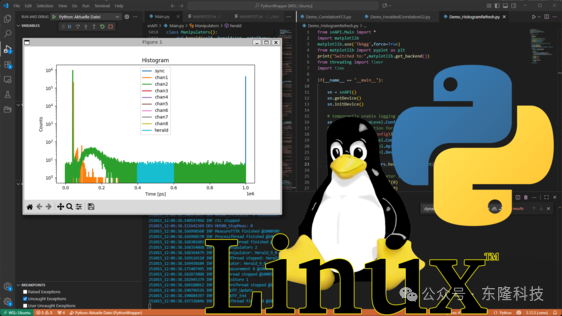
Core Advantages of snAPI on Linux
Consistent with the Windows version, the Linux version of snAPI supports the x86-64 architecture, fully leveraging the performance advantages of C++ at the lower level to achieve optimal speed and real-time performance, while providing users with the ease of use and versatility of Python.
The interface achieves 100% compatibility between the two operating system platforms, allowing users to easily migrate custom code without the need for redundant development.
In addition to device configuration and data acquisition, snAPI also offers various mature methods for processing and analyzing time-tagged photon data streams and TCSPC histograms, such as correlation analysis, coincidence counting, time gating, data filtering, and pre-announcement photon event processing.
The software conveniently encapsulates the read and write functions for PicoQuant’s native time-tagged data files and supports the unfolding processing of raw device data streams. With the help of the Matplotlib library, all processing and analysis results can be visually presented.
Free Download on GitHub
The Linux version of snAPI is provided completely free of charge, just like the Windows version, and you can download it directly from GitHub. The project is currently in an actively maintained phase with frequent updates. We warmly welcome users to propose new feature requests, and the team usually responds promptly.
Scan to Download for Free

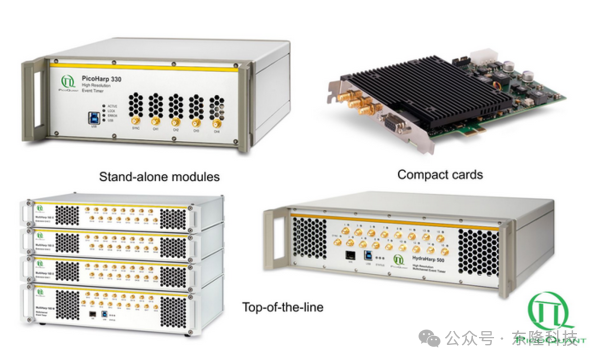
Supported Time-Tagged Devices
For initial users, simply equipping PicoQuant’s TCSPC devices, the corresponding library files/DLL, and installing Python along with snAPI will allow for a quick start.
 Wuhan Donglong Technology Co., Ltd. was established in 1997. Its products cover various aspects of scientific research and industrial applications, mainly involvingspectrum imaging, laser beam diagnostics, gas sensing, single photon counting, optical link measurement, and ultrafast ultra-strong laser systems across six major optical application fields. Since its establishment, Donglong Technology has adhered to the principle of“Service Creates the Future”, providing customers with prompt and high-quality services, earning the trust of a wide range of clients. Over the years, Donglong Technology has accumulated technical expertise and gathered a team of optical and electrical technical talents, capable of providing quality products and professional solutions tailored to customer needs. The company has established comprehensive and in-depth cooperation with many manufacturers in Europe, America, and Japan, and jointly established development, application, and service technology centers.Phone:027-87807177After-sales:027-87807123Email::[email protected]Website:www.etsc-tech.comAddress:Building A8, Future Intelligence City, No. 6 Beidou Road, Donghu New Technology Development Zone, Wuhan, Hubei Province
 Donglong Technology
Service Creates the Future