This article is reprinted from: Arm Community
In the continuously evolving Internet of Things (IoT) environment, software complexity is increasing, and edge devices require greater performance, energy efficiency, and security than ever before. The Arm® Cortex®-A series products meet this demand by bringing advanced computing capabilities to power-constrained devices, providing enhanced artificial intelligence (AI) processing capabilities, robust security, and optimized energy efficiency for diverse markets. The Cortex-A3xx series offers ultra-high-efficiency solutions and optimized performance for various segments, including consumer electronics and cloud services. More importantly, this CPU series provides a powerful and scalable solution for the rapidly growing and highly diverse IoT market, making it an ideal choice for edge AI applications.
Edge AI requires superior computing performance, stronger security, and greater software flexibility. As software becomes increasingly complex, the Armv9 architecture emerges to provide advanced machine learning (ML) and AI capabilities, along with enhanced security features. This architecture is now implemented in the ultra-high-efficiency series of Cortex-A3xx, laying a solid foundation for the next generation of edge AI applications.
Cortex-A320: The Smallest Implementation of the Armv9 Architecture
The Cortex-A320, released by Arm, is the first ultra-high-efficiency Cortex-A processor based on the Armv9 architecture. It is an AArch64 CPU based on the Armv9.2-A architecture. Its microarchitecture is derived from the Cortex-A520 and has been significantly optimized to improve area and power consumption.
The energy efficiency of the Cortex-A320 is over 50% higher than that of the Cortex-A520. This improvement is achieved through multiple microarchitecture updates, including narrow fetch and decode data paths, densely packed L1 cache, and reduced port integer register files.
Thanks to significant innovations in microarchitecture, such as high-efficiency branch predictors and prefetchers, as well as enhancements to the memory system, the Cortex-A320 has achieved over a 30% increase in scalar performance in the SPECINT2K6 benchmark compared to its predecessor, the Cortex-A35.
More importantly, by integrating enhanced Armv9 Neon and SVE2 vector processing technologies, the ML processing capability of the Cortex-A320 in INT8 general matrix multiplication (GEMM) is up to 10 times higher than that of the Cortex-A35. Additionally, with support for new data types such as BF16 and new dot product and matrix multiplication instructions, the ML performance of the Cortex-A320 is up to six times higher than that of the currently most popular Armv8-A CPU, the Cortex-A53.
The significant improvement in ML capabilities and extremely high area efficiency make the Cortex-A320 the most energy-efficient Cortex-A CPU core for ML applications.
Compared to Arm Cortex-M processors, the ML performance of the Cortex-A320 has also increased several times. For example, in GEMM performance, the Cortex-A320 is eight times better than the currently highest-performing Cortex-M CPU (Cortex-M85). This performance boost is attributed not only to the enhancements in AI processing provided by the Armv9 architecture but also to the significant improvements in memory access performance and frequency of the Cortex-A320.
Meanwhile, thanks to Arm’s A processor architecture, multi-core execution, and flexible memory management, the Cortex-A320 is a suitable option for upgrading the performance of Cortex-M series microprocessors.
Achieving Higher Energy Efficiency Through Microarchitecture Optimization
The Cortex-A320 is a single-issue, in-order execution CPU with a 32-bit instruction fetch, achieving an optimized eight-stage pipeline and featuring a compact forwarding network, resulting in a higher frequency than the Cortex-A520.
The Cortex-A320 offers cluster scalability from single-core to quad-core configurations. The CPU employs a simplified DynamIQ Shared Unit (DSU) DSU-120T, which supports clusters using only Cortex-A320. The DSU-120T is the smallest DSU implementation, significantly reducing complexity, area, and power consumption, thereby greatly enhancing the energy efficiency of entry-level products based on Cortex-A.
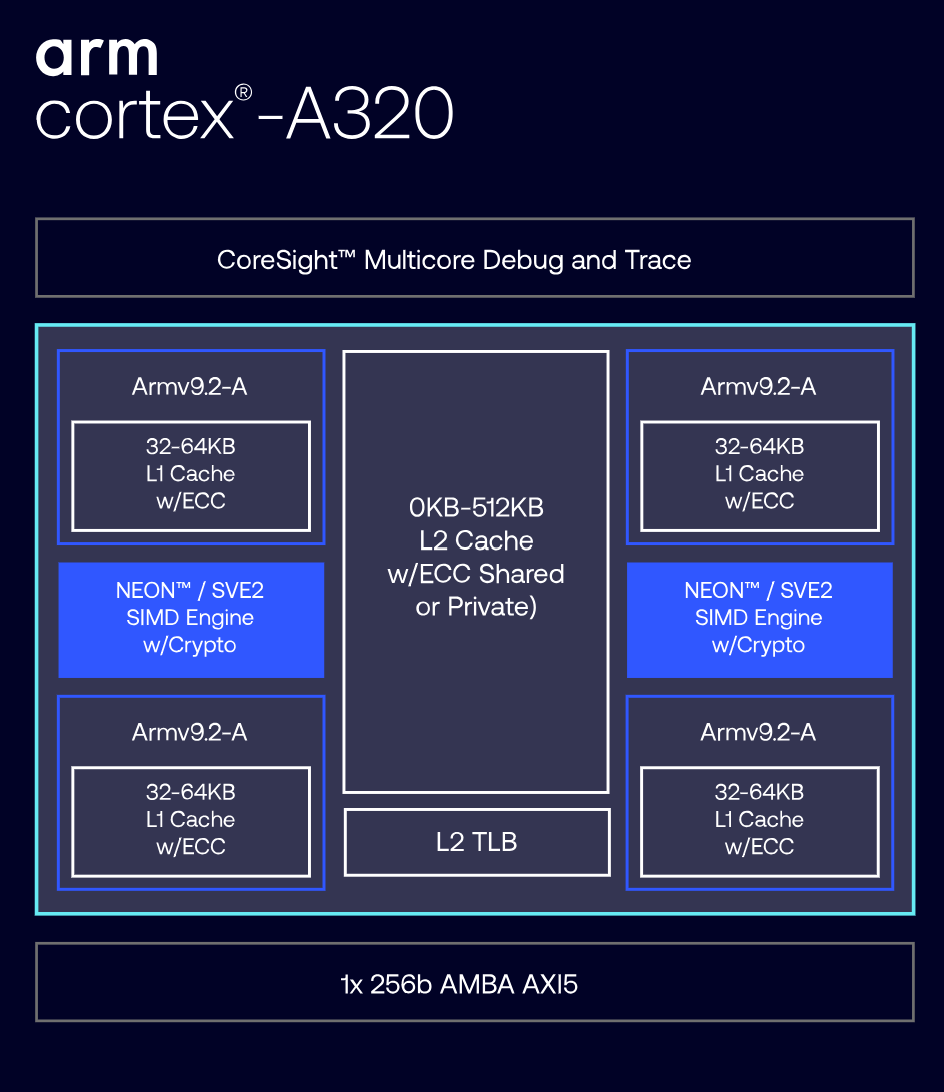
The Cortex-A320 supports up to 64KB of L1 cache and up to 512KB of L2 cache, and features a 256-bit AMBA5 AXI interface that can connect to external memory. The L2 cache and L2 TLB can be shared among Cortex-A320 CPUs, while the vector processing units implementing Neon and SVE2 SIMD technologies can be dedicated in single-core configurations or shared among two or four-core implementations.
Diverse Advantages for Different Markets
Thanks to extensive open-source Linux support, a robust security ecosystem, and key advancements achieved by the Armv9 architecture, the Cortex-A320 ensures compatibility with edge and infrastructure devices while providing excellent energy efficiency and scalability.
The updates to Neon and SVE2 vector processing technologies enhance ML performance, and in addition, the Armv9 architecture significantly strengthens security, which is crucial for IoT and embedded systems. The Cortex-A320 introduces important security features to the ultra-high-efficiency series of Cortex-A, including memory tagging extensions (MTE) that enhance memory safety, as well as pointer authentication (PAC) and branch target identification (BTI) that reduce jump-oriented programming and return-oriented programming attacks.
Secure EL2 is one of the key features of Armv9 adopted by the Cortex-A320, which helps securely execute software containers on edge devices by enhancing software isolation in TrustZone.
From entry-level general-purpose MPUs, smart speakers, and software-defined smart cameras to autonomous vehicles in factory workshops, automated edge AI assistants, AI human-machine interfaces, and robotic controllers, the Cortex-A320 can leverage these advantages across a wide range of applications. In addition to edge AI applications, the Cortex-A320 can also benefit numerous key segments, including smartwatches and smart wearable devices, as well as infrastructure devices such as server baseboard management controllers (BMC).
The Cortex-A320 is also well-suited for applications that previously used high-performance Cortex-M, such as battery-powered MCU use cases or applications running real-time operating systems (RTOS) that require performance scaling through symmetric multiprocessing, which is natively supported by Arm’s A processor architecture.
Furthermore, it can be used in RTOS applications that require Cortex-A memory management or address translation features to enhance software flexibility. For example, the Cortex-A320 is suitable for use cases that require downloading applications on MCU devices, as it needs a memory management unit (MMU) for code relocation across memory mappings.
Meanwhile, the wider addressing space makes the Cortex-A320 a high-energy-efficient solution for heterogeneous multi-core use cases, where higher-performance Cortex-A cores are combined with microcontroller-level cores. With the Cortex-A320, Arm’s partners can pair small architecture-compatible cores with larger Cortex-A processors, simplifying memory architecture.
On the other hand, due to its A processor architecture features, the Cortex-A320 can provide out-of-the-box Linux support and software portability for existing feature-rich operating systems such as Android. The Cortex-A320 offers excellent flexibility, suitable for numerous segments, applications, and operating systems.
Introducing the Armv9 Edge AI Heterogeneous Computing Platform
The Arm Ethos™-U85 NPU is designed to address common high-latency memory in Cortex-A systems and works well with the Cortex-A320 processor.
The Ethos-U85 driver has been updated, allowing the NPU to be directly driven by the Cortex-A320 without the need for a Cortex-M based ML island. This update not only improves latency but also eliminates the cost and complexity of using Cortex-M to drive the NPU for Arm’s partners.
Additionally, the memory access performance and enhanced memory system of the Cortex-A320 enable it to execute larger-scale ML models, such as large language models (LLMs) with over a billion parameters. Due to limited addressable memory space, these models are challenging to run efficiently on Cortex-M based systems.
The Ethos-U NPU meets the limited cost and energy consumption requirements of edge AI use cases by quantizing data types. ML operators and data types not supported by Ethos-U85 will automatically fall back to the Cortex-A320 for processing, utilizing the Neon/SVE2 engine for acceleration.
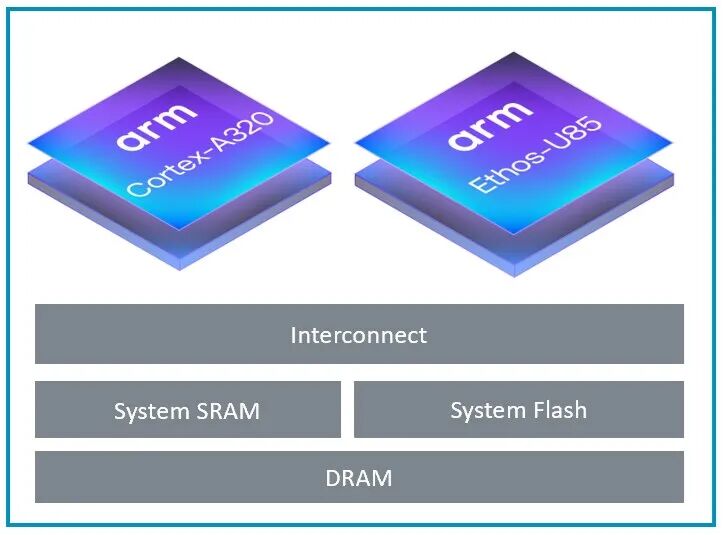
The Armv9 architecture has achieved significant improvements in ML performance, allowing the four-core Cortex-A320 to execute up to 256 GOPS at a frequency of 2GHz, measured at 8-bit MAC/cycle. Therefore, without the need for external accelerators, the Cortex-A320 can directly run advanced ML and AI use cases on the CPU. This saves system area, power consumption, and complexity for devices targeting various ML and AI applications, delivering performance of up to 0.25 TOP.
A Promising Future for Edge AI in a New Era
The Cortex-A320 brings the security and exceptional AI performance of the Armv9 architecture to the ultra-high-efficiency series of Cortex-A, providing software developers with new possibilities for developing and deploying more demanding use cases, ushering in a new era of edge AI devices. By combining Arm’s A processor architecture with the associated software ecosystem, and underpinned by high energy efficiency and flexibility, the Cortex-A320 offers outstanding scalability and diversity for various segments in the IoT field.
Disclaimer: Arm, Cortex, and Ethos are registered trademarks or trademarks of Arm Limited (or its subsidiaries).
END

Previous Highlights Recommended