 Hydrogels, as a hydrophilic three-dimensional network polymer, have shown great application potential in cutting-edge fields such as tissue engineering, drug delivery, and soft robotics in recent years. However, traditional hydrogels often suffer from poor mechanical properties and limited molding methods, making it difficult to meet the demands of complex application scenarios. Frontal polymerization (FP) is an efficient and self-sustaining polymerization method that rapidly converts monomers into polymers and has been widely used to prepare functional materials such as hydrogels and resins. However, existing FP typically requires high temperatures (above 80 °C) for polymerization, while biological cells generally die at 50 °C, which can easily damage temperature-sensitive components such as bioactive molecules, greatly limiting their biomedical applications. Meanwhile, with the rapid development of 3D printing technology, biohydrogels as printing inks have gradually attracted attention. However, there is still a significant lack of hydrogel systems that can be compatible with various printing methods (such as DIW and DLP), which has become a key bottleneck restricting the popularization of biological 3D technology. To address these challenges, Professor Chen Su’s team at Nanjing University of Technology designed a hydrogel precursor system composed of acrylic hydroxypropyl acrylate (HPA), N-vinylpyrrolidone (NVP), and polycaprolactone (PCL). This system achieves the rapid construction of an interpenetrating network structure (IPN) through low-temperature frontal polymerization (FP) and exhibits excellent adaptability for multimodal microfluidic 3D printing. The team first constructed the first network structure using PCL, and then initiated the copolymerization of HPA and NVP through FP to form the second network, achieving molecular-level physical-chemical dual crosslinking, significantly enhancing the mechanical strength and stability of the hydrogel. Through formulation optimization, the entire FP process can initiate polymerization at a super low temperature of 45.4 °C and rapidly convert monomers into polymers within 6 minutes, providing a new pathway for constructing high-performance biohydrogels under mild conditions. This hydrogel system not only exhibits a mild and efficient reaction process but also demonstrates significant advantages in processing performance. The team adjusted the content of PCL to achieve the precursor system’s adaptability to various microfluidic 3D printing technologies. Particularly in direct ink writing (DIW), the research team successfully achieved uniform extrusion and structural formation of the hydrogel on the DIW platform using a microfluidic bio 3D printer developed by Nanjing Beier Times Technology Co., Ltd.; at the same time, its good photopolymerization performance also made it perform excellently in digital light processing (DLP). The multimodal adaptability of this system not only significantly broadens the manufacturing means of hydrogels but also provides possibilities for the fine construction of functional devices. Furthermore, thanks to its rich hydrogen bond structure, this hydrogel can self-heal to 91.0% of its original mechanical strength within 10 hours under room temperature conditions, endowing the material with excellent durability and service life. This research breaks the triple limitations of traditional hydrogels in preparation temperature, processing methods, and application performance, achieving rapid molding, self-healing recovery, and organic unification of multimodal microfluidic 3D printing under mild conditions. Its outstanding structural control ability, process compatibility, and functional expansion potential provide forward-looking technical support and broad application prospects for cutting-edge fields such as biomedicine, tissue engineering, and soft robotics. The research results were recently published in the internationally significant journal Chemical Engineering Journal (DOI: 10.1016/j.cej.2025.164775) with the title: “Interpenetrating network hydrogels via low-temperature frontal polymerization and 3D printing.” Professor Chen Su, Professor Wang Caifeng, and Associate Professor Zhang Jing from the School of Chemical Engineering and the National Key Laboratory of Materials Chemistry Engineering at Nanjing University of Technology are co-corresponding authors. Master’s student Zhao Wei from Nanjing University of Technology is the first author. This project was supported by the National Natural Science Foundation Key Project, the National Key Research and Development Program, and the Jiangsu Provincial Higher Education Advantage Discipline Construction Project.
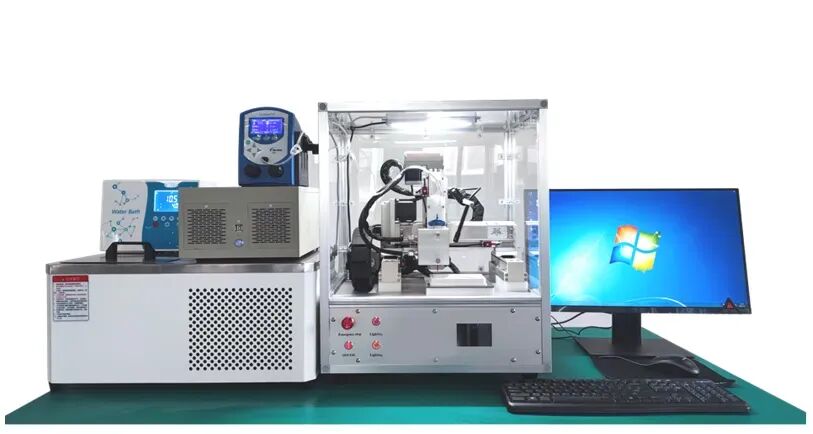 Figure 1. Microfluidic bio 3D printer (developed by Nanjing Beier Times Technology Co., Ltd.)
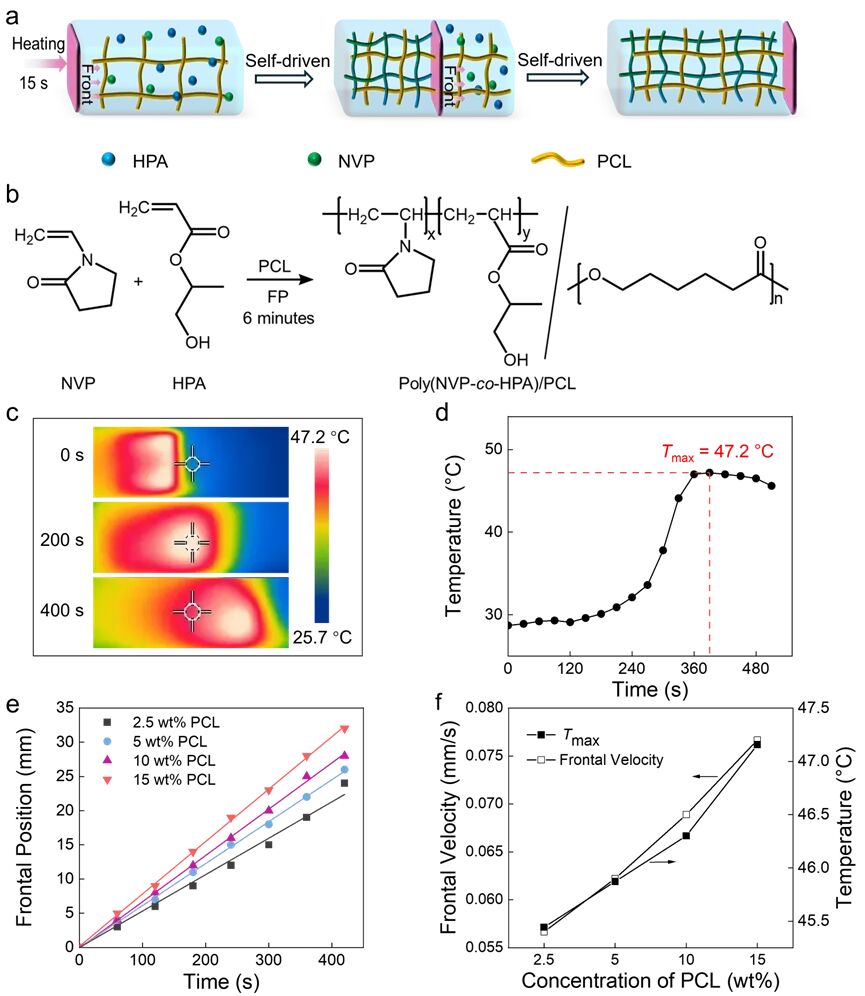 Figure 2. (a) Schematic diagram of the process route for preparing poly(HPA-co-NVP)/PCL IPN hydrogels via flat FP method. (b) In the presence of PCL, HPA and NVP form IPN hydrogels through FP within 6 minutes. (c) Infrared thermal imaging shows the reaction front of IPN hydrogels advancing steadily from left to right during synthesis. (d) Temperature-time curve of the polymerization process of IPN hydrogels. (e) End face position-time relationship diagram of IPN hydrogels prepared with different PCL contents. (f) End face rate and maximum temperature relationship with PCL concentration in IPN hydrogels.
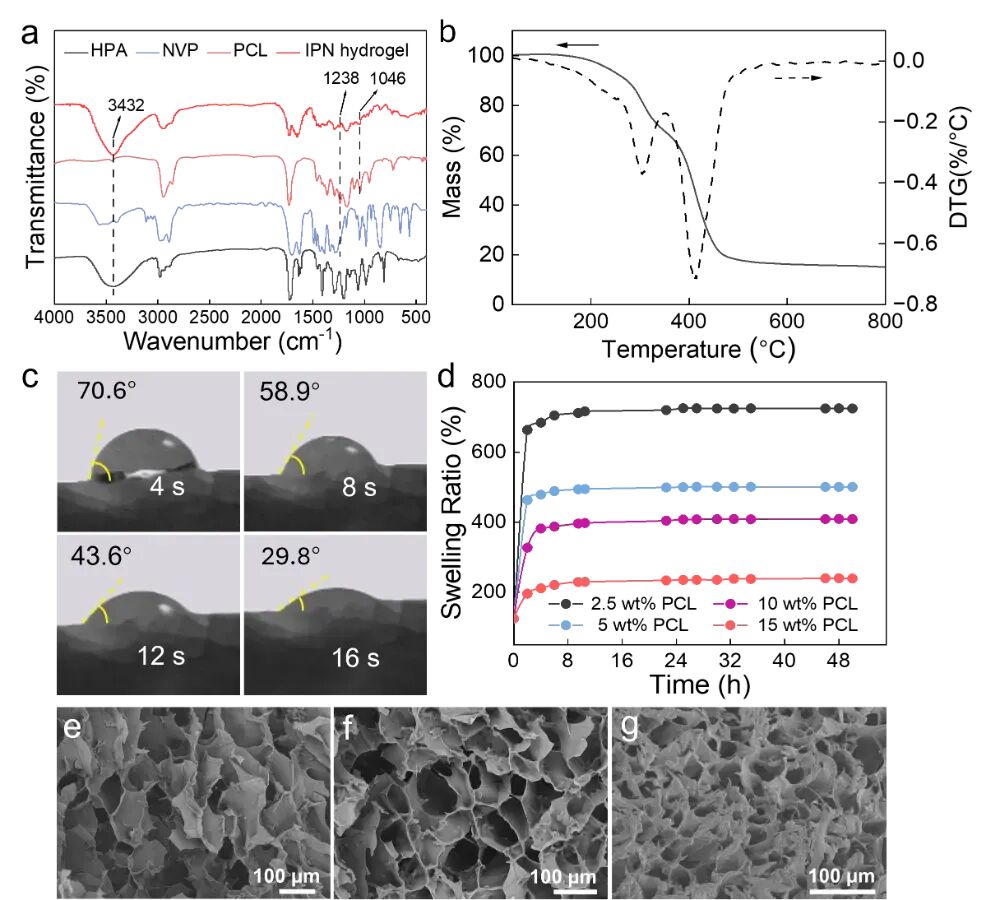 Figure 3. (a) FTIR spectra of HPA, NVP, PCL, and poly(HPA-co-NVP)/PCL hydrogels. (b) TG curves and corresponding DTG curves of poly(HPA-co-NVP)/PCL hydrogels. (c) Change of water contact angle of poly(HPA-co-NVP)/PCL hydrogels over time. (d) Water swelling behavior of poly(HPA-co-NVP)/PCL hydrogels prepared with different PCL contents.
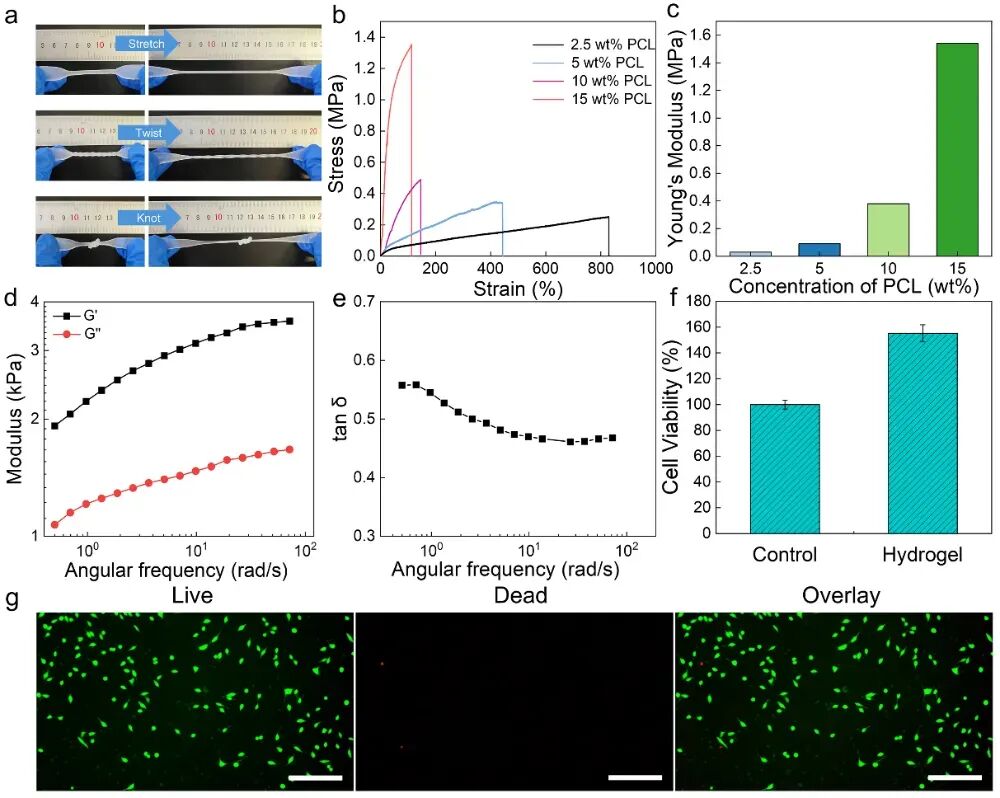 Figure 4. (a) Photos of poly(HPA-co-NVP)/PCL hydrogels under stretching, knotting, and twisting deformation. (b) Stress-strain curves of poly(HPA-co-NVP)/PCL hydrogels prepared with different PCL concentrations. (c) Young’s modulus of poly(HPA-co-NVP)/PCL hydrogels prepared with different PCL concentrations. (d) Storage modulus G’ and loss modulus G” of poly(HPA-co-NVP)/PCL hydrogels as a function of frequency. (e) Relationship between tan δ and frequency of poly(HPA-co-NVP)/PCL hydrogels. (f) Evaluation of cell compatibility of IPN hydrogels using the MTT method. (g) Determination of the vitality of L929 fibroblasts co-cultured with IPN hydrogels for 24 hours using live/dead fluorescence microscopy (scale bar: 200 μm).
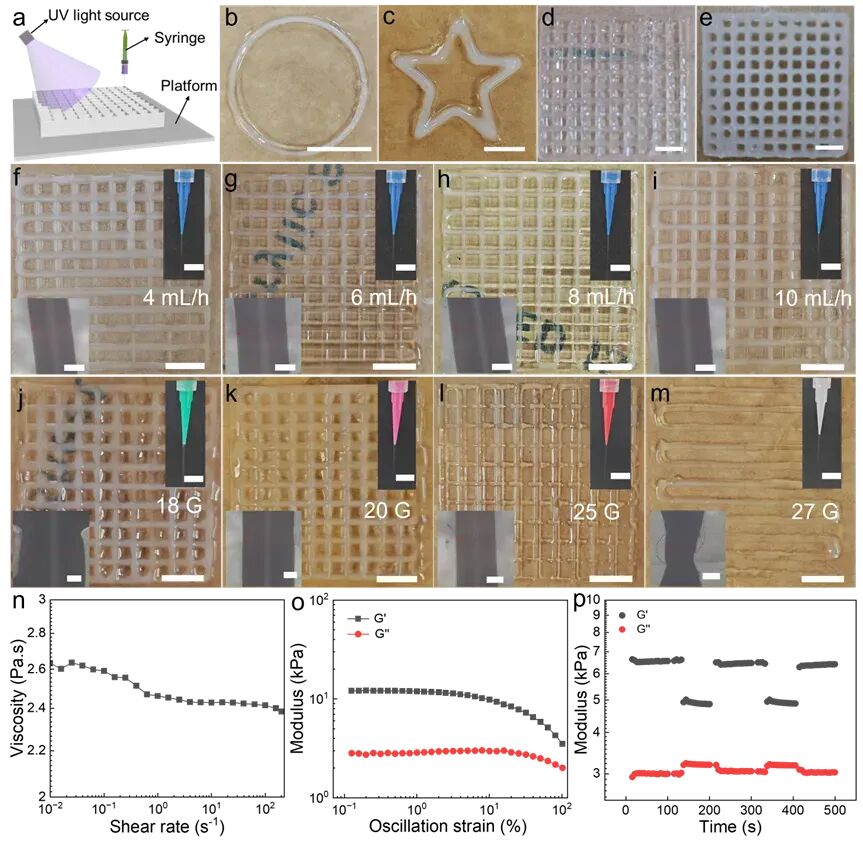 Figure 5. (a) Schematic diagram of the application of inks in DIW microfluidic 3D printing. (b) Circular, (c) star-shaped, (d) planar grid, (e) three-dimensional grid patterns (scale: 1 cm). (f-i) Photos of grids printed at different extrusion rates using a 22G nozzle, and (j-m) photos of grids printed using different nozzle sizes (scale: 1 cm). The inset in the upper right corner shows the lines extruded from the nozzle during printing (scale: 1 cm), while the inset in the lower left corner shows a microscopic image of the line diameter distribution (scale: 500 µm).(n) The viscosity of hydrogel inks as a function of shear rate (PCL = 20 wt%). (o) G’ and G” of poly(HPA-co-NVP)/PCL hydrogels (PCL = 20 wt%) during strain scanning process.(p) Time-dependent G’ and G” values obtained from step strain tests of poly(HPA-co-NVP)/PCL hydrogels (PCL = 20 wt%, high strain: 100%, low strain: 1%).
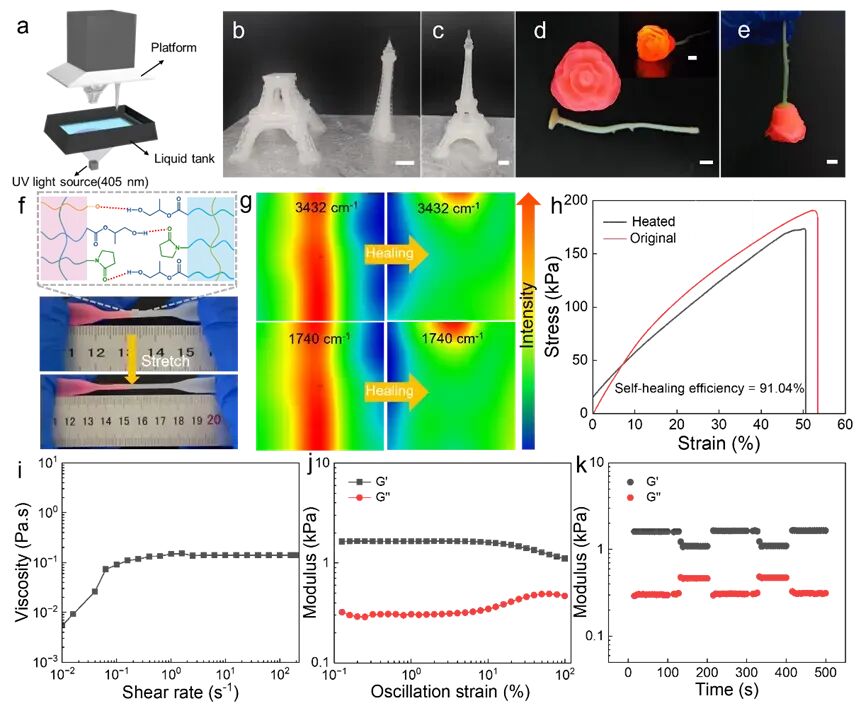 Figure 6. (a) Schematic diagram of DLP microfluidic 3D printing. (b) Photos of poly(HPA-co-NVP)/PCL IPN hydrogels printed via DLP 3D printing: (b) tower segment, (c) assembled whole tower, (d) rose segment, (e) assembled whole rose (scale: 1 cm). The green stem segment of the rose contains methyl green, and the red flower segment contains rhodamine b, with the inset showing red fluorescence under UV light. (f) Self-healing behavior of the hydrogel. (g) Micro-infrared images of the hydrogel before and after healing at 3432 and 1740 cm-1. (h) Stress-strain curves showing the tensile behavior of original and healed hydrogels. (i) The viscosity of hydrogel inks as a function of shear rate. (j) G’ and G” values of poly(HPA-co-NVP)/PCL hydrogels during strain scanning process.(k) Time-dependent G’ and G” values obtained from step strain tests of poly(HPA-co-NVP)/PCL hydrogels (PCL = 10 wt%, high strain: 100%, low strain: 1%).
 Paper link: https://www.sciencedirect.com/science/article/pii/S1385894725056116Source: Polymer Science FrontiersDisclaimer: The views expressed are solely those of the author. The author acknowledges their limitations, and any scientific inaccuracies should be pointed out in the comments below!