
Source: ArrowSeed Online
Author: Ganda
Published by IoT Think Tank
Please indicate the source when reprinting
—— 【Introduction】 ——
LPWA currently includes various technologies such as LoRa, Sigfox, Weightless, and NB-IoT. Among these, LoRa entered China in 2013, and it is expected that the shipment of Semtech’s SX1278 LoRa chip in China will exceed 10 million pieces this year. Therefore, let us take a moment this October to understand LoRa.
Challenges in IoT Connectivity Leading to LPWAN
Currently, there are several pain points in the application scenarios of IoT connectivity:
① Communication Distance: Most devices are located in complex building environments or sparsely populated areas, making it difficult for traditional wireless technologies to penetrate or reach them;
② Battery Power: Many IoT applications do not have continuous power supply conditions, such as geomagnetic sensors and water meters.
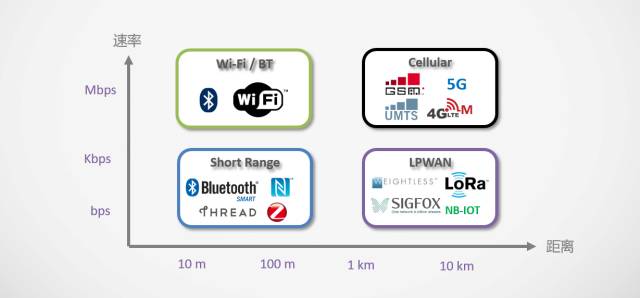
Comparison of Mainstream Wireless Communication Methods
In IoT applications, wireless technologies include GPRS, 3G/4G from operators’ wide area networks, as well as short-range LAN technologies like ZigBee, Wi-Fi, and Bluetooth. Although these wireless technologies are mature, their advantages and disadvantages are very apparent, as one can only choose between long range and low power consumption. LPWA (Low Power Wide Area) technology emerged in this context, designed specifically for long-distance, low-bandwidth, low-power, and massive connectivity IoT applications. LPWA currently includes various technologies such as LoRa, Sigfox, Weightless, and NB-IoT, with LoRa entering China in 2013 and expected shipments of Semtech’s SX1278 LoRa chip in China to exceed 10 million this year. Therefore, let us take a moment this October to understand LoRa.
LoRa Makes Distance and Power Consumption No Longer an Issue
LoRa is an enhanced wireless transmission technology that increases the coverage radius by 3-5 times compared to classic FSK technology. LoRa modulation technology significantly improves wireless transmission distance (i.e., increases link budget or reception sensitivity) without changing the transmission power.
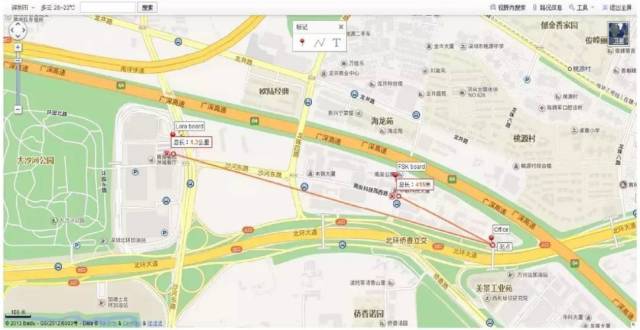
LoRa vs FSK Transmission Distance in Dense Urban Environments
LoRaWAN™ is an asynchronous ALOHA-based protocol, which means that nodes can sleep for varying durations based on specific application needs, whereas GPRS, 3G/4G synchronous protocol nodes must regularly connect and synchronize, which reduces battery life. GSMA has compared different LPWA low-power wide-area technologies, and LoRaWAN™ has a power consumption advantage of 3 to 5 times over other cellular technologies.
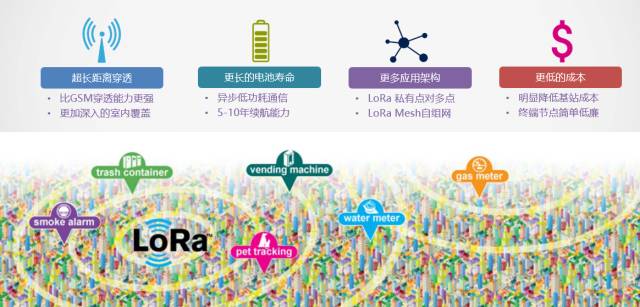
LoRa Excels in Coverage and Power Consumption
What Application Scenarios is LoRa Suitable For?
The most prominent feature of LoRa is its long-distance capability, breaking through coverage scenarios that previously required relays or demanding low power consumption with battery power. For example:
① Wireless Meter Reading, such as electric meters, water meters, gas meters, and heat meters;
② Slowly changing physical quantities (temperature, water pressure, PM2.5, geomagnetic sensors) with ultra-low power consumption sensors;
③ Wireless Alarms (smoke detectors, passive infrared detectors);
④ Remote I/O Controllers (light control, air conditioning control); ⑤ Wireless RS-485/Modbus Converters;
What Unique Advantages Does LoRa Have Compared to Classic FSK 433MHz Technology?
① Communication Distance: The distance increases by 3-5 times, which is the most intuitive feeling. Areas that were challenging to cover with 433MHz small wireless products can be fully covered by LoRa, making it the ultimate solution for users facing unreliable communication with 433MHz;
② LoRa Demodulation Technology Can Correctly Demodulate Data Even in Noise, with sensitivity reaching -148dBm;
③ LoRa Modem Itself Has Excellent Anti-Interference Characteristics, and supports automatic frequency hopping communication to resist instantaneous interference. Compared to traditional 433MHz chip fixed frequency communication, it not only improves reliability but also reduces frequency point occupancy time and external interference, meaning more rational use of communication channels.
Is the Communication Frequency of LoRa Wireless Communication Gateway Authorized?
According to the Ministry of Industry and Information Technology document “信部无[2005]423号”, LoRaWAN™ can use the micro-power wireless communication frequency range of 470-510MHz for free, but must meet the following conditions:
① The RF transmission power EIRP (Effective Isotropic Radiated Power) must be less than 50mW (or +17dBm);
② The transmission duration must not exceed 5000ms.
Note: For specific regulations, please consult the China Radio Management Bureau SRRC.

Previous Popular Articles (Click on the title to read directly):
-
“How Difficult is it to Make Smart Locks for Shared Bicycles?”
-
“Cognitive Computing, Blockchain IoT, IoT Security… Those Who Understand Will Control the Future”
-
“KUKA, ABB, FANUC, Yaskawa, the Four Industrial Robot Giants Have Long Been Stationed in the IoT Field”
-
“【Heavyweight】 IoT Industry Panorama Report, Opening the First Domestic IoT Industry Two-Dimensional Perspective Panorama”
-
“A Cartoon Tells You: Besides WiFi and Bluetooth, What Can the Recently Popular NB-IoT Do?”
-
“A Cartoon Tells You: What is LoRa, Which Everyone is Talking About Behind NB-IoT?”