|
Key Points Overview ▶ Virtualization technology aids hospitals in enhancing efficiency and reducing costs ▶ Storage QoS technology achieves refined storage management ▶ Using NFS protocol to support virtual machines enhances management efficiency ▶ Deduplication technology improves storage return on investment |
In the late 1960s, IBM developed a software called Virtual Machine Monitor on mainframes. This software acts as an abstraction layer above the computer hardware, dividing it into one or more virtual machines and providing multi-user simultaneous interactive access to the mainframe.
VMware introduced server virtualization products in 2001, bringing virtualization technology to the x86 platform. In 2006, Intel provided hardware-assisted virtualization technology on CPUs, addressing performance shortcomings of virtualization technology. Since then, virtualization technology has been adopted by an increasing number of enterprises, with VMware becoming the largest vendor in the enterprise virtualization market.
Virtualization Technology Aids Hospitals in Enhancing Efficiency and Reducing Costs
The biggest change brought by virtualization technology to hospital information construction is the reduction of operational complexity and the improvement of operational efficiency.
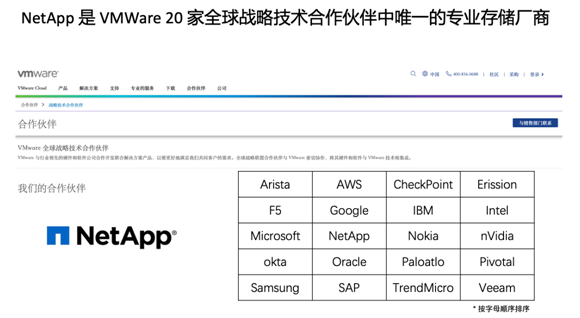
Lenovo Lingtuo’s parent company, NetApp, began collaborating with VMware in 2001 and became a global strategic technology partner of VMware in 2007. In fact, NetApp is the only specialized storage vendor among VMware’s 20 global strategic technology partners.
(VMware global strategic technology partner list: https://www.vmware.com/cn/partners/strategic-technology-partners.html)
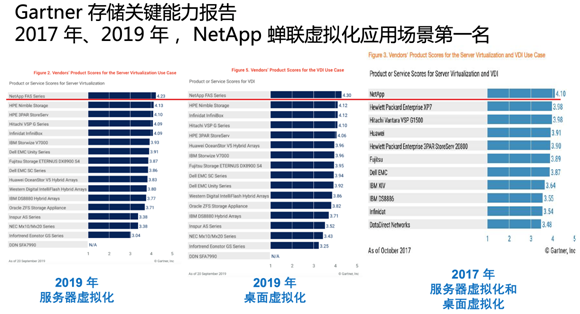
Moreover, the close cooperation between the two parties has also been recognized by third-party organizations. In the 2017 and 2019 Gartner “Storage Critical Capabilities Report”, NetApp was ranked first in server virtualization and desktop virtualization business scenarios for two consecutive times.
These achievements stem from numerous innovative technologies developed by NetApp, and Lenovo Lingtuo has also inherited this innovative gene into its products and technologies. As a smart data management solution and service provider jointly registered by Lenovo and NetApp in China, Lenovo Lingtuo is customer-demand oriented, relying on leading technology genes, combined with localized talent advantages, R&D innovation capabilities, business coverage, and service networks, to continually launch leading intelligent data management technologies, helping Chinese customers unleash the astonishing potential of data and comprehensively build modern IT architecture to accelerate digital transformation.
It is worth mentioning that one of Lenovo Lingtuo’s “three core advantages” is the rapid implementation of NetApp’s Data Fabric strategy in the Chinese market, serving local users with advanced IT technologies and products in a more appropriate way to help them better enhance the operational efficiency of virtualization platforms.
For example, rapidly deploying virtual machines in bulk.
Based on the technical characteristics of virtualization platform encapsulation, IT administrators can use encapsulated virtual machine templates to clone virtual machines in bulk, meeting business needs such as basic operating system environment construction, VDI desktop virtualization, and stateless web server virtual machine deployment in internet hospitals.
As early as the 2008 VMware VMworld conference, NetApp demonstrated a technology that deployed 5,440 virtual machines in 15 minutes and started them in 30 minutes using a FAS storage configured with a small number of mechanical hard drives.
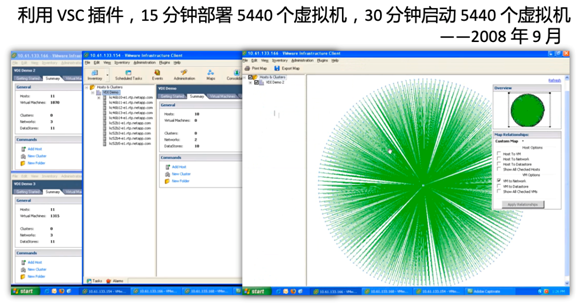
This technology demonstration utilized NetApp’s main storage deduplication technology, volume/LUN/file-based storage virtual cloning technology, and onboard secondary caching technology within the storage controller.
Moreover, all operations in this technology demonstration were completed in the VSC plugin integrated into the VMware vCenter management interface, allowing administrators to manage without entering the storage management interface.
Storage QoS Technology Achieves Refined Storage Management
The innovation of storage QoS technology lies in its ability to set upper and lower limits on storage IOPS performance and throughput performance at the volume level or even at the individual virtual machine level.
In the architectural design of virtualization systems, to achieve high availability, virtual machines must be stored in shared storage, and these virtual machines must share the performance and capacity resources of the shared storage.
By setting storage performance limits, administrators can effectively prevent the “bad neighbor effect”: that is, avoid a sudden performance demand from one virtual machine from excessively occupying storage performance resources, thereby affecting the performance of critical business virtual machines.
By setting storage performance lower limits, administrators can reserve storage performance resources for critical business virtual machines, ensuring that these virtual machines always have sufficient storage performance guarantees.
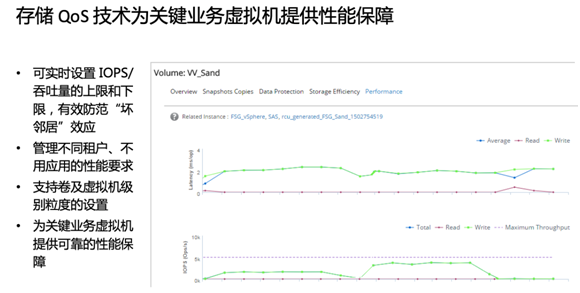
After applying storage QoS technology, the management of storage has shifted from vague management based on personal experience to planned management based on existing storage resources, greatly enhancing management efficiency.
Using NFS Protocol to Support Virtual Machines Enhances Management Efficiency
In addition to improving management efficiency, NetApp also simplifies IT infrastructure and reduces operational complexity by deploying virtual machines on high-performance NFS NAS storage volumes.
VMware has supported the NFS storage protocol since 2003. In the VMware vSphere 7.0 technical manual released on April 2, 2020, VMware outlined the functional differences of various storage protocols on vSphere, stating that NFS only lacks support for RDM raw device mapping and virtual machine clustering, which, from a technical principle standpoint, must utilize block storage devices such as FCSAN or IPSAN.
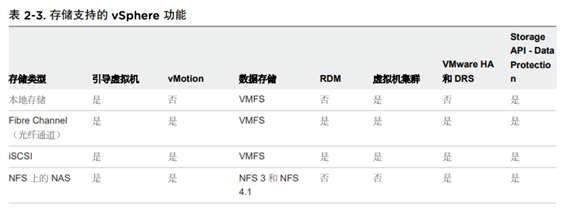
From the comparative analysis of the “Storage Supported vSphere Features” table, it can be found that in terms of support for vSphere features:
NFS + iSCSI = FCSAN
That is, in terms of support for vSphere features, the combination of NFS and iSCSI storage protocols based on Ethernet technology is equivalent to the FCSAN storage protocol. This provides a theoretical basis for simplifying the physical network infrastructure of data centers by replacing FC protocol with Ethernet protocol.
In terms of performance, it is undeniable that the expensive FCSAN still represents the pinnacle of performance for traditional storage systems—worth the price.
However, is the performance gap between FC, iSCSI, and NFS storage protocols really that large?
VMware’s 2009 white paper, “Comparison of Storage Protocol Performance in VMware vSphere™ 4”, compared the performance differences between 4Gb FC, 1Gb iSCSI, and 1Gb NFS storage protocols.
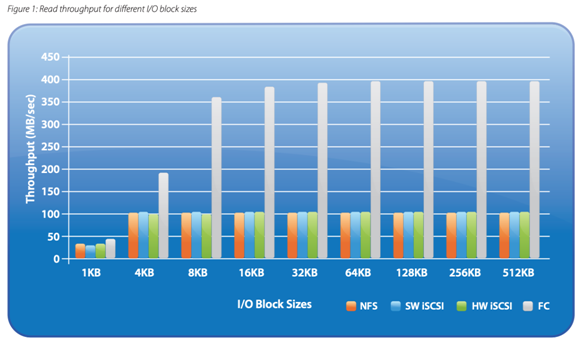
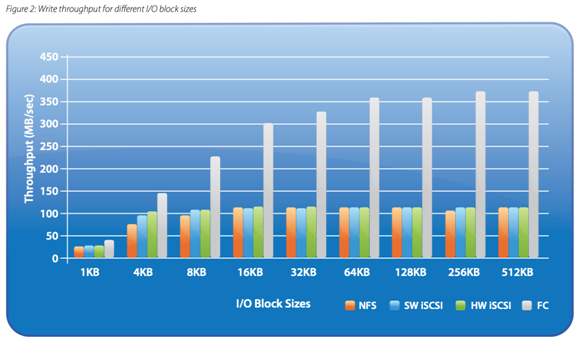
Interestingly, in the 1KB data block read/write performance tests, the storage bandwidth advantage is suppressed, where the performance of the FC storage protocol is the best, but the performance difference with NFS and iSCSI protocols is not significant. As the test data blocks increase in size, the bandwidth advantage of 4Gb FC becomes increasingly apparent. However, if the testing data for NFS and iSCSI is quadrupled, the performance gap between the three storage protocols becomes very limited.
With the development of technologies such as DCBx data center bridging, the performance differences between FCSAN, iSCSI, and NFS storage protocols are becoming smaller. Especially with the deployment of SSD all-flash storage, storage performance has often become excessive, making it more valuable to focus on the impact of different storage protocols on IT infrastructure and operational complexity.
On virtualization platforms, the first benefit of using NFS protocol to support virtual machines is the simplification of IT infrastructure. Data centers no longer need to purchase and deploy FCSAN switches and FCHBA cards, nor deal with complex issues related to fiber channel, WWN, zoning, and links between FC switches; they only need to maintain and operate the necessary Ethernet infrastructure.
At the same time, another benefit of using NFS protocol to support virtual machines is the ability to help hospitals better reduce procurement and operational costs of virtualization platforms. This is because the requirements for operational personnel are also lower—they only need to understand network protocols and network switch operational technologies.
Additionally, on virtualization platforms, NFS storage protocol provides greater management flexibility, including open access methods, online expansion and contraction of NFS data volume capacity, larger data volume capacity, and support for larger virtual machine scales.
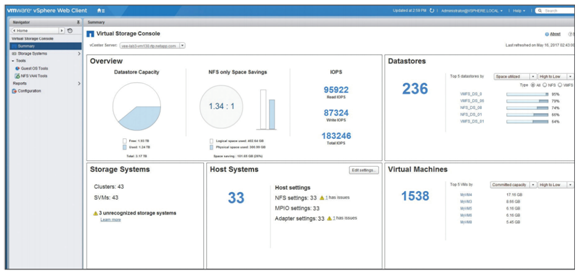
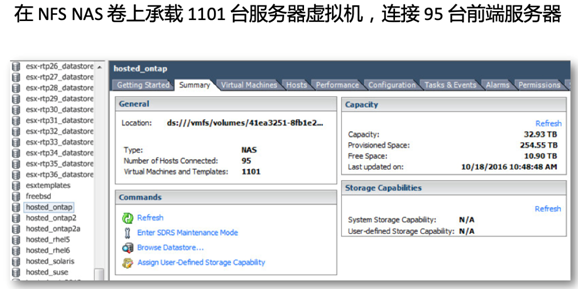
The image below illustrates a company hosting 1,101 virtual machines on a single NFS data volume, connecting 95 servers at the front end. This is a scale that FCSAN or iSCSI find difficult to achieve on a single LUN, as SAN storage has a limited number of virtual machines it can host on a single LUN.
When too many virtual machines are hosted on a single LUN, it can cause SCSI blocking due to excessive storage queue depth, leading to decreased storage performance and even preventing front-end hosts from accessing the storage LUN. This means that the more front-end hosts there are, the lower the throughput performance that SAN storage can achieve on a single LUN.
Deduplication Technology Improves Storage Return on Investment
Additionally, this image also showcases another powerful technology from NetApp—deduplication technology. The preparation space for 1,101 virtual machines is 254.55TB, but with the help of deduplication technology, the actual physical storage space used is only 22.03TB, achieving a storage efficiency ratio of 11.6:1.
NetApp released the world’s first main storage deduplication technology in 2007. It can achieve high-difficulty post-processing deduplication technology based on mechanical hard drives using only a small amount of storage controller resources. Currently, it is the only vendor that can provide both online and post-processing deduplication technology as well as online and post-processing data compression technology.
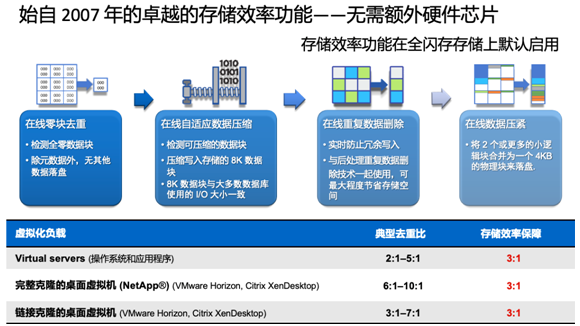
With its unique technological advantages, NetApp launched a 2:1 storage efficiency guarantee plan at the 2008 VMware VMworld conference and introduced the world’s first all-flash storage efficiency guarantee plan in 2016.
NetApp promises that on NetApp all-flash storage, without any additional testing and verification, and excluding the space saved by storage snapshot technology and thin provisioning technology, it directly guarantees a storage efficiency ratio of 3:1 for data that can be deduplicated and compressed.
If the above commitments cannot be met, NetApp will provide users with original factory engineer storage optimization services; if the promised storage efficiency capacity is still not met, they will provide users with the missing SSD capacity for free.
There are many similar technologies.
For example, the SnapCenter enterprise-level backup software, which has a 20-year history, provides second-level backups, second-level restores, and hourly full backups for massive virtual machines. Of course, that is another topic.
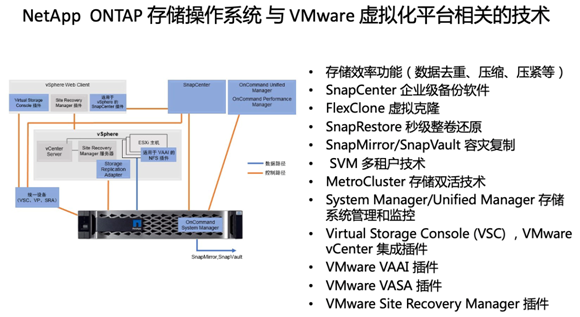
Currently, all products and solutions under the NetApp brand are provided by Lenovo Lingtuo.
(The author of this article is a senior technical consultant at Lenovo Lingtuo)
Click here to read the original article and learn about Lenovo Lingtuo’s healthcare industry solutions.