1084 – Sum of Proper Divisors
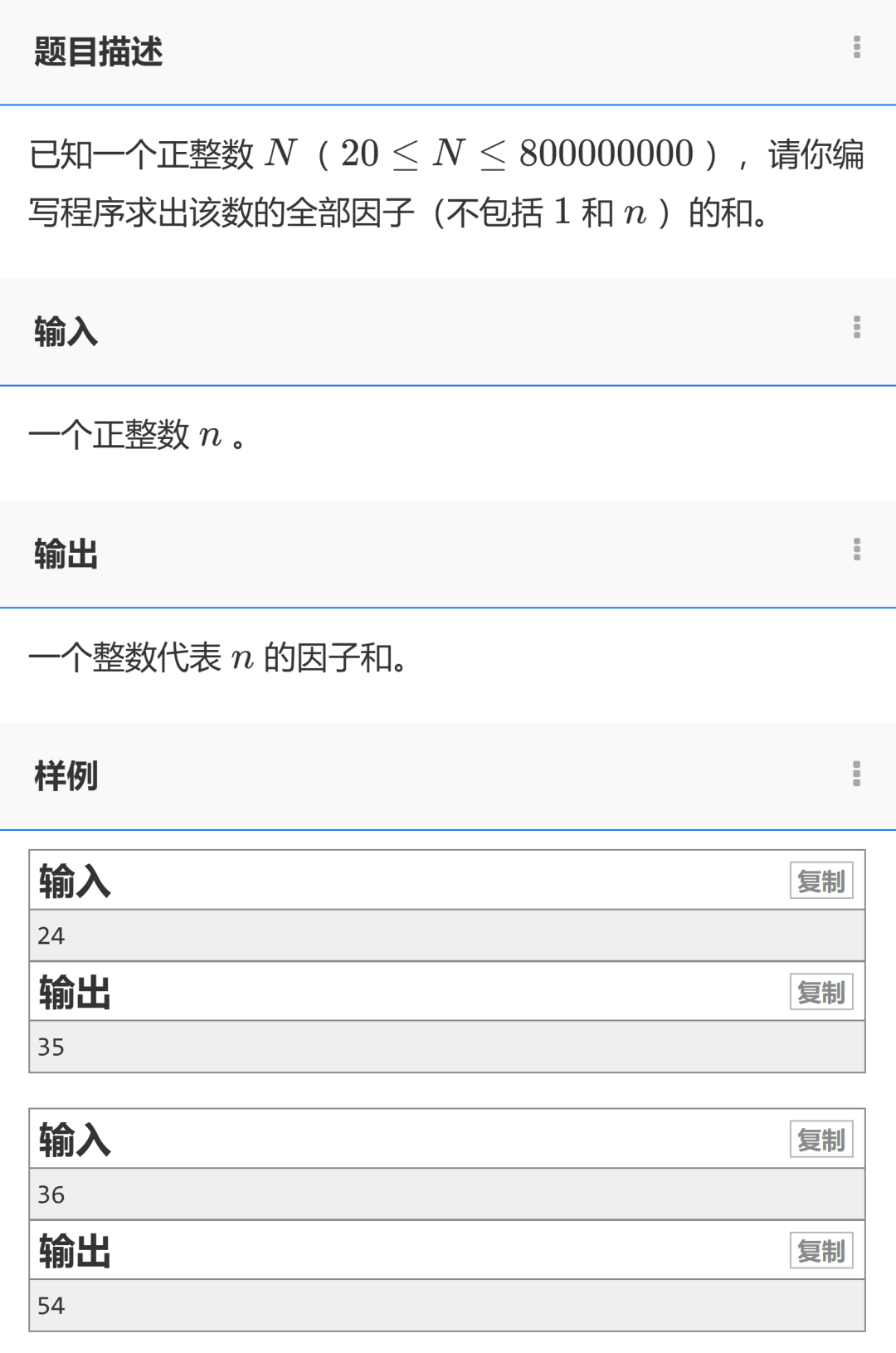
This program solves a mathematical problem: calculating the sum of all proper divisors of a number (excluding 1 and the number itself).
How does the program work?
-
First, the user inputs a number (for example, 20).
-
The program will do the following:
-
Add 4 and its corresponding 5 to the total sum.
-
Skip and do not add others.
-
Add 2 and its corresponding 10 to the total sum.
-
Start checking from 2 (since the problem requires excluding 1).
-
Check if 2 is a divisor of 20 (20 ÷ 2 = 10, divisible).
-
Check if 3 is a divisor (20 ÷ 3 ≈ 6.66, not divisible).
-
Check if 4 is a divisor (20 ÷ 4 = 5, divisible).
-
Stop checking when exceeding √20 ≈ 4.47.
Finally, the total sum is obtained: 2 + 10 + 4 + 5 = 21.
Special Note::
-
Use a loop to iterate from 2 to √n (mathematical optimization).
-
When encountering a divisible number:
-
If it is a square root (like 5 for 25), add it only once.
-
Otherwise, add both the number and its corresponding divisor (like 2 and 10 for 20).
-
Finally, return the accumulated total sum.
Reference Code
#include<bits/stdc++.h> // Include all standard library headers for simplified programming
using namespace std;    // Use the standard namespace to avoid writing std::
// Define the function to calculate the sum of divisors
int fun(int n) // n is the positive integer to calculate
{    int r = 0; // Initialize the sum to 0
    // Iterate from 2 to the square root of n (optimization key)
    for(int i = 2; i <= sqrt(n); i++)     {
        // Check if i is a divisor of n
        if(n % i == 0)         {
            // Handle the special case of square numbers (like 25 = 5 × 5)
            if(i == sqrt(n))             {
                r += i; // Add the square root only once
            }
            else // Normal divisor case            {
                r = r + i + (n / i); // Add i and its corresponding divisor
            }
        }
    }
    return r; // Return the final sum
}
// Main function
int main() {
    int n; // Store the user input number
    cin >> n; // Read input
    cout << fun(n); // Call the function and output the result
    return 0; // Program ends normally
}
1. Function of the Program
This program can calculate: given any positive integer, find the sum of all its proper divisors (excluding 1 and the number itself). For example:
-
Input 20 → Divisors are 2, 4, 5, 10 → Sum is 2 + 4 + 5 + 10 = 21.
-
Input 25 → Divisor is only 5 → Sum is 5.
-
Input 17 → No proper divisors → Sum is 0.
2. Core Component Analysis
① fun Function
-
<span>int r=0</span>: Initialize the sum. -
<span>for Loop</span>: Iterate from 2 to √n (mathematical optimization). -
<span>if(n%i==0)</span>: Check for divisors. -
Special case handling for square roots (like 25 = 5 × 5).
-
Normal case: add both i and n/i.
-
<span>return r</span>: Return the final result.
② Main Function
-
<span>cin>>n</span>: Read user input. -
<span>cout<<fun(n)</span>: Call and output the result.
3. Key Algorithm Explanation
Mathematical Optimization Principle:
-
If a is a divisor of n, then b = n/a is also a divisor.
-
When a exceeds √n, b will be less than √n.
-
Thus, checking only up to √n is sufficient to find all divisor pairs.
Example Process (n=20):
-
i=2:
-
20%2=0 → Not a square root → Add 2 and 10 → r=12.
i=3:
-
20%3≠0 → Skip.
i=4:
-
20%4=0 → Not a square root → Add 4 and 5 → r=21.
i=5 > √20 → Loop ends.
Return 21.
4. Important Concept Explanation
Divisor Pairs:
-
Each divisor a corresponds to a divisor b = n/a.
-
When a < b, we find both divisors simultaneously.
-
When a = b, this is a square number (like 25 = 5 × 5).
Square Root Optimization:
-
Checking up to √n allows finding all divisors.
-
Greatly reduces the number of iterations (from n to √n).
5. Important Considerations
-
Boundary Cases:
-
Inputting 1 should return 0 (the program handles this correctly).
-
Prime numbers will return 0 (like 17).
Number Range:
-
For large numbers, sqrt(n) may have precision issues.
-
Using i*i<=n can avoid floating-point operations.
Optimization Suggestions:
-
Pre-calculate sqrt(n) and store it in a variable.
-
Use a faster square root algorithm.
6. Learning Suggestions
Beginners can:
-
Simulate the operation process of small numbers with pen and paper.
-
Try modifying the program to print each found divisor.
-
Think: Why is it sufficient to check up to √n?
-
Challenge: How to modify the program to include 1 as a divisor?
This program effectively demonstrates:
-
The application of loop structures.
-
The use of mathematical optimization in practical programming.
-
Handling of boundary conditions.
-
The concept of function encapsulation.
I hope this detailed explanation helps beginners fully understand this program! If there are any questions, it is recommended to run the program and observe its behavior.