Please follow our WeChat public account and Toutiao account “Finger Motorcycle” to read the latest news on motorcycle maintenance and repair. Search for ID mscmoto directly in WeChat to follow!
The trend towards fuel injection in motorcycles is a necessary outcome of stricter environmental requirements. Fuel-injected motorcycles are highly electronic, and it is essential to understand the sensors in various parts during maintenance and use. Today, we will primarily introduce the temperature sensor, which mainly controls the fuel injection pulse width based on the engine temperature, affecting the air-fuel mixture concentration.
1. Function of the Temperature Sensor
It continuously detects the engine temperature and transmits it to the ECU in the form of an electrical signal. The ECU adjusts the fuel injection amount (pulse width) based on the changes in the electrical signal. If the connection wire from the temperature sensor to the ECU is broken or short-circuited, the ECU will automatically control the fuel injection amount and ignition timing based on the engine temperature of 80 degrees or 100 degrees【most air-cooled models at 80 degrees, water-cooled models at 100 degrees】.
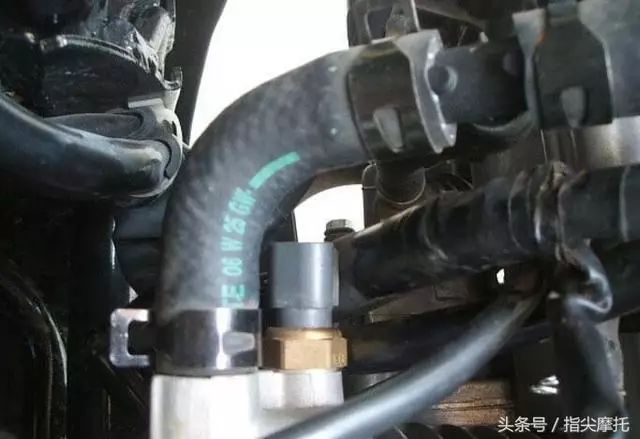
The temperature sensor is located at the bottom center of the image.
The engine temperature sensor is generally installed on the cylinder or cylinder head. For water-cooled engines, it is installed in the cooling system.
The WH110T water temperature sensor has three wires: green-blue, green-orange, and pink-white.
Honda’s JY series uses two negative temperature coefficient thermistors inside the water temperature sensor, transmitting data to both the ECU and the water temperature gauge. The green-blue wire goes to the water temperature gauge. As the engine water temperature rises, the resistance of the green-blue wire to ground decreases. If there is an issue with the water temperature gauge, the green-blue wire is the focus of inspection.
The other two wires connect to the ECU. When the coolant temperature changes, its resistance also changes. In the WH110T, the water temperature sensor converts the changes in coolant temperature into an electrical signal and provides it to the ECU, serving as the main basis for the control system to adjust fuel injection pulse width, ignition timing, and other control parameters based on engine temperature.
By inputting this sensor signal into the electronic control unit, the fuel injection amount can be adjusted according to the coolant temperature. The temperature signal sent to the ECU must be absolutely accurate. A voltage change of 0.02V can lead to a deterioration in engine performance. Therefore, the ground wire of the WH110T water temperature sensor is specially drawn from the ECU using a low-resistance wire to prevent deviations in the temperature signal transmission.
Thus, the accuracy of the water temperature sensor affects the fuel injection amount. When the air-fuel mixture is too rich or too lean, the water temperature sensor is one of the key inspection points.
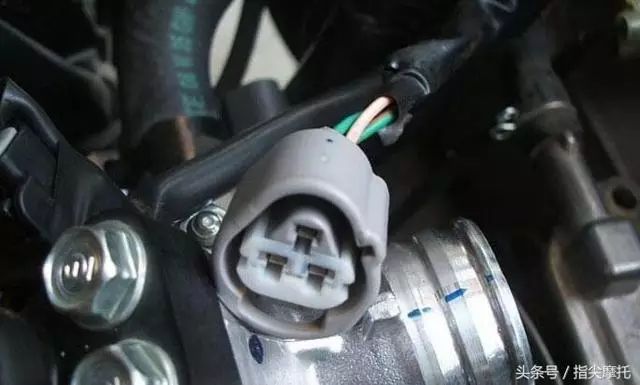
The connector of the water temperature sensor for the Wuyang Honda WH110T fuel-injected motorcycle.
2. Testing and Maintenance of the Temperature Sensor
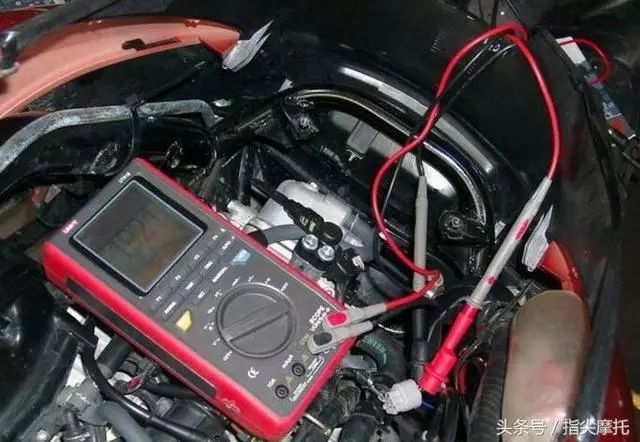
Turn off the ignition switch, disconnect the connector of the water temperature sensor, and use a multimeter to measure the resistance value of the green-orange wire and pink-white wire to the sensor (do not measure the green-orange wire and pink-white wire).
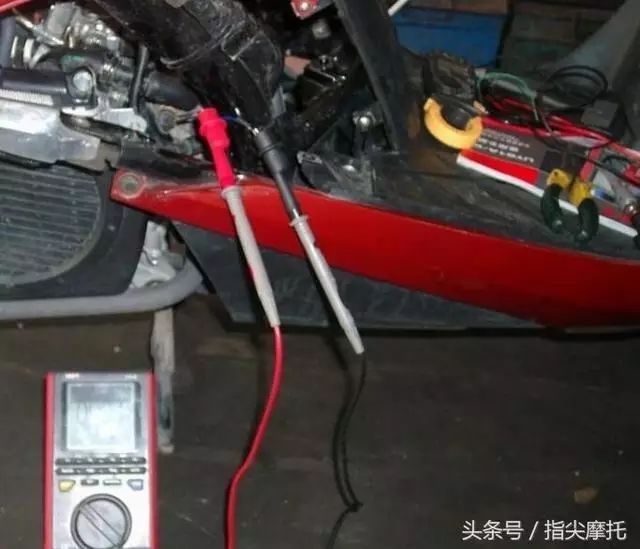
In a cold state, when the external environment temperature is around 20℃, the resistance value of the water temperature sensor or engine temperature sensor is generally between 2-3kΩ. When the vehicle is started, at a temperature of 80℃, the sensor’s resistance value should be between 200-400Ω.
If there are no issues, also check the voltage values on the connector’s green-orange wire and pink-white wire. Turn on the ignition switch and use a digital multimeter with an internal resistance of over 10 megaohms to measure the voltage on the green-orange wire and pink-white wire. When the connector is not plugged in, the voltage should be 5V (the voltage deviation should not exceed 0.5).
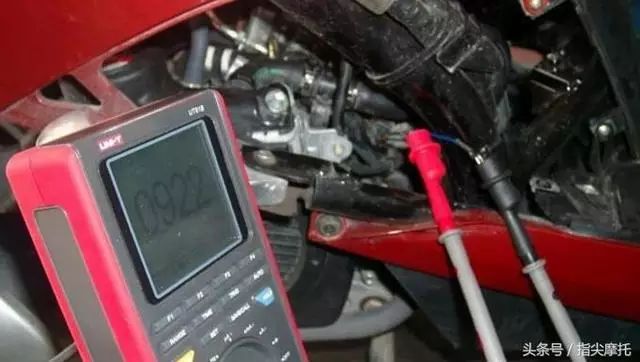
After plugging in, the voltage value should gradually decrease as the temperature rises, which is normal. Otherwise, the water temperature sensor needs to be replaced. Additionally, if the temperature transmitted by the water temperature sensor exceeds the maximum temperature specified by the ECU, the ECU will stop the fuel injector from working. If the vehicle cannot start due to high temperature, checking the fuel injector not working should also include inspecting the water temperature sensor.
Further Reading:
Why can’t a fuel-injected motorcycle start when tilted too much?
How is the crankshaft phase determined in a single-cylinder fuel-injected motorcycle?
What? Ultrasonic cleaning is so clean!
Finger Motorcycle
Official WeChat subscription account of Motorcycle China Network

WeChat ID: mscmoto

Long press the QR code to reward
Note: For detailed content, click the “Read Original” below the screen.