
The Ukraine crisis is a significant military conflict that marks humanity’s entry into the digital, informational, and intelligent era. It showcases a disruptive transformation in the forms and rules of warfare, continuously expanding the subjects and categories of war, with the social characteristics of warfare becoming more pronounced. War is not just about firepower attacks in the real world but also a fierce game of human cognition. Leveraging computational power and algorithms, the data-driven cognitive warfare has prominently manifested during the Ukraine crisis, allowing people to deeply appreciate the immense power of cognitive offense and defense in the intelligent era. Algorithmic cognitive warfare combines algorithmic warfare and cognitive warfare, supported by intelligence capabilities, utilizing the powerful strength of algorithms and the intelligence advantages under digital conditions to change human cognition.
Manipulating and influencing public sentiment through social media to affect decision-making has become a common tactic in algorithmic cognitive warfare. For example, in the United States, scandals like Cambridge Analytica’s use of big data to influence elections are not uncommon; externally, from color revolutions to the Ukraine crisis, various media have been used to manipulate and influence public consciousness. Looking at the practical applications of algorithmic cognitive warfare, while algorithms are indeed the core, intelligence information is the key to the effectiveness of algorithms, highlighting the importance of open-source intelligence work. Open-source intelligence is characterized by easy access, strong timeliness, diverse content, and rapid dissemination, but it also suffers from poor data consistency, low interpretability, and fragmentation. Traditional open-source intelligence analysis methods can no longer meet the demands of algorithmic cognitive warfare, necessitating research into utilizing new concepts and technologies from artificial intelligence, such as machine learning and knowledge graphs, to form rapid, accurate, and efficient intelligence products to meet the needs of future warfare’s hybrid multi-domain and intelligent development.
Open Source Intelligence Analysis Facing Algorithmic Cognitive WarfareMain Challenges
To fully leverage the immense advantages of open-source intelligence in algorithmic cognitive warfare, it is essential to exhaustively search for various open-source data. By mining and analyzing various types of data, a repository of activity patterns and relational databases of events should be formed to construct a target knowledge graph, assess targets, and make predictive inferences about events to formulate strategies. However, maximizing the effectiveness of open-source intelligence in algorithmic cognitive warfare faces the following three main challenges.
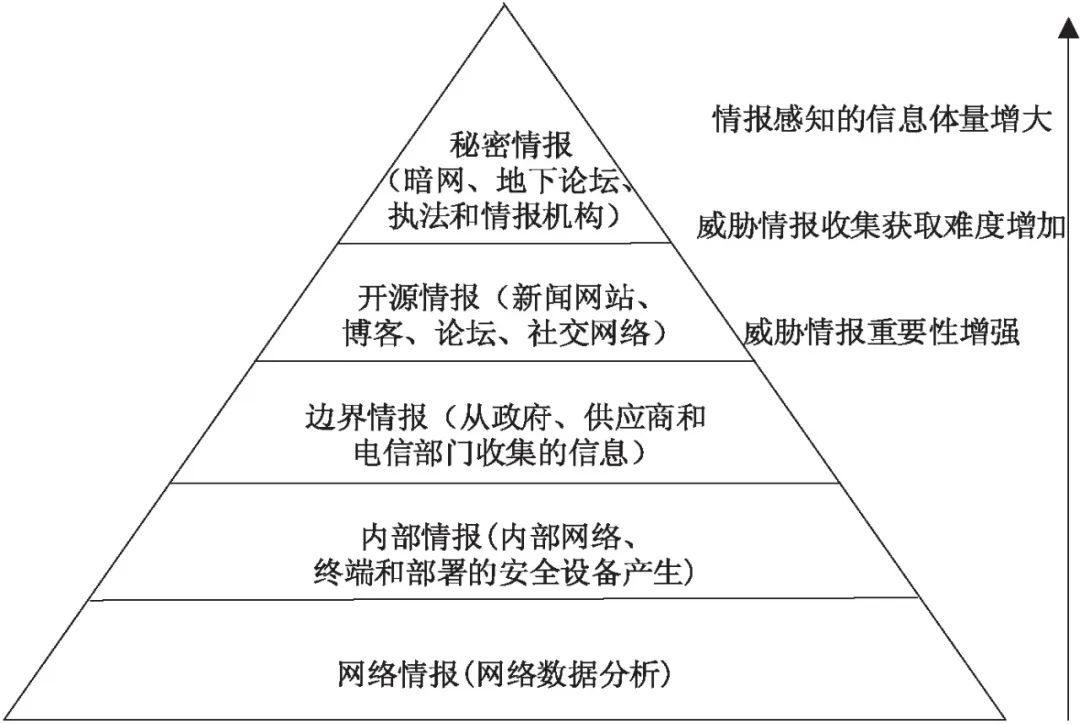
Threat Intelligence Volume, Acquisition Difficulty, and Importance Levels
Intelligence sources are numerous and severely homogenized.There are many channels for acquiring open-source intelligence, and with the emergence of various new media, information flows faster and more conveniently. A large number of disseminators and platforms tend to follow trends and hype hot events. The adversary exploits this characteristic to create hot news and topics, rapidly disseminating them through audio, video, text, and comments, resulting in the public seeing and hearing only repetitive content, thereby achieving the goal of altering public perception. Homogeneous open-source information requires intelligence collectors to comprehensively and meticulously filter, affecting the objectivity of intelligence assessments and potentially missing critical intelligence while increasing the difficulty of intelligence preprocessing.
Low quality of intelligence sources.Algorithmic cognitive warfare is an invisible war, with most raw data coming from unstructured data such as videos, audios, and texts on the internet. To win the war, deepfake technology is employed, making full use of impactful formats like short videos, live broadcasts, and speeches to elicit strong emotional responses from the public. As a result, the data collected amidst the information flood may carry deceptive and concealed elements, leading to significant deviations in the analysis results and greatly reducing the usability of the intelligence, potentially resulting in erroneous decisions.
Open-source intelligence information is prone to obsolescence.Real-time information from social media and other online platforms is often the first window for target identification, trend prediction, and threat warning. However, various public opinions on the internet are fast-paced, fragmented, and even ephemeral, with critical points of high intelligence value potentially hidden within less noticeable information. If not identified promptly, they can quickly be drowned in the information flood, making subsequent searches as difficult as finding a needle in a haystack. If the fleeting time window is missed, the adversary may achieve their strategic objectives under the radar, orchestrating operations right under the public’s nose in the information age.
Intelligent Open Source Intelligence Analysis FrameworkArchitecture
With the widespread application of algorithmic cognitive warfare in different conflict scenarios, new threats rapidly emerge, and the value extraction of open-source intelligence in algorithmic cognitive warfare will continue to rise. The rapid development of artificial intelligence technology continuously empowers open-source intelligence analysis, exploring the application of emerging technologies in artificial intelligence to the processes of open-source intelligence collection, analysis, and utilization. Utilizing intelligent technologies or methods such as machine learning, association rules, and neural networks can uncover implicit values from vast amounts of open-source data, providing effective intelligence for decision-makers and playing a crucial role in winning algorithmic cognitive warfare.
Collection Layer Collecting open-source intelligence data and preprocessing it is the foundational layer of intelligence analysis. Due to the different data formats, measurement units, and attribute descriptions used by various data sources, a series of preprocessing steps such as cleaning, deduplication, classification, and evaluation must be performed to obtain relatively complete and accurate data. Data cleaning can remove irrelevant advertisements, spam, etc.; deduplication can eliminate duplicate information from different sources, reducing data processing time and space; data classification can categorize and label data according to tasks or rules; data evaluation can eliminate false intelligence and rank the importance of intelligence sources.
Management Layer Distributing and managing various preprocessed data. The preprocessed data has different structures, and different structured data should be stored in different databases. For example, structured data like tables can be stored in relational databases, while unstructured data like videos, images, and texts can be stored in HDFS. When storing data, it is necessary to monitor the storage resources of each storage node in real-time. If a node becomes overloaded, data should be migrated to other nodes to achieve load balancing.
Various types of data contain a wealth of target feature information and have certain value. Therefore, when storing data, corresponding redundancy strategies should be employed to avoid data loss due to the collapse of a specific node. At the same time, most data have a certain confidentiality level, necessitating the establishment of access permissions, encrypted storage, and data isolation measures to enhance data security.
Analysis Layer The analysis layer reflects the value of algorithms and computational power in algorithmic cognitive warfare. By analyzing and processing large amounts of data, evidence of the adversary’s behavior patterns, intentions, and targets can be uncovered, constructing a knowledge graph that provides a basis for target identification, situational prediction, and threat assessment.
Application Layer The application layer is where the results of the analysis are utilized in operations. Based on evidence such as activity patterns and event associations, inferences and predictions about events can be made, assessing intentions and threat levels in conjunction with key areas and targets. Information can be precisely pushed according to different users’ needs and comprehension levels, achieving efficient utilization of information and maximizing cognitive effectiveness.
Intelligent Open Source Intelligence Knowledge Mining and Utilization
In the context of algorithmic cognitive warfare, the mining and utilization of intelligent open-source intelligence knowledge mainly involve analyzing and acquiring information about adversary target activity patterns, online behavior traces, and relational networks to construct knowledge graphs, which are then used to conduct offensive and defensive actions in algorithmic cognitive warfare.
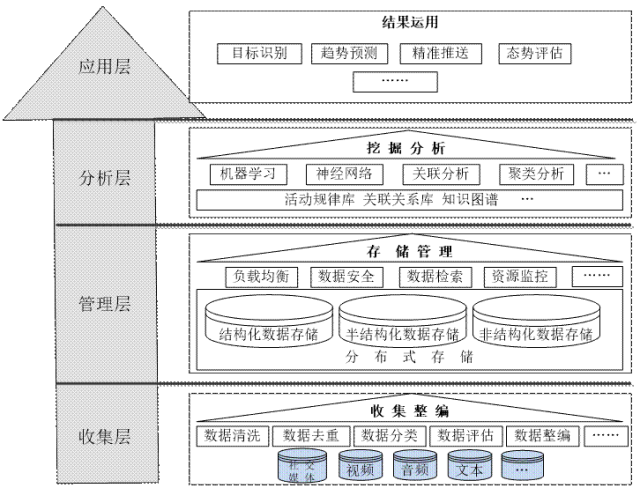
Intelligent Open Source Intelligence Analysis Framework
Intelligent Open Source Intelligence Knowledge Mining Methods of data mining include statistical analysis, clustering analysis, association rule mining, and sequential pattern mining. Statistical analysis can reveal target activity patterns, thereby discovering characteristics and behavioral habits of adversary targets; clustering analysis can cluster data based on different features, revealing different operational areas, organizational structures, or purposes of the adversary; association rule mining can uncover relationships and rules between data, revealing associated events and patterns behind adversary actions; sequential pattern mining can extract temporal relationships between data, predicting possible future actions of the adversary.
Revealing target activity patterns. Although algorithmic cognitive warfare exerts cognitive pressure on the general public through high-frequency, layered, precise, and diverse forms, there are still certain patterns behind it. Target activity patterns primarily include activity frequency, geographic area, timing, routes, and preferences. Clustering and classification analysis methods are mainly used to reveal the repetitive activity states of various targets at specific routes, areas, and times, mining out the regular characteristics of different types of targets and then synthesizing and summarizing the target activity patterns. For example, through open-source data of key individuals’ diplomacy, speeches, and actions, one can mine their personality traits and activity habits, assembling them into a database of target activity patterns.
Mining associations between target events. Precisely pushing specially designed content to the public is one of the key aspects of algorithmic cognitive warfare, and the pushed content is often not just a simple event but has certain associations with social activities, military actions, etc. Event associations are discovered links between different events, which can be mined from multiple dimensions, including the time, place, participants, stakeholders, and causal relationships of events. Association rule analysis is an important research method for mining event associations. In a big data environment, the role of association rule analysis is greatly enhanced, as it can find hidden associations or interrelations between data items in massive datasets. Utilizing association rule analysis can uncover the relationships between a specific event or target and other related matters, achieving predictive inference through an understanding of the mined association rules.
Before using association rule algorithms, it is necessary to fully understand the data and the mining analysis objectives, preparing the data according to the objectives and characteristics; selecting appropriate thresholds is crucial; if the value is too low, a large number of useless rules may emerge, affecting the algorithm’s execution efficiency. Conversely, if the value is too high, it may prevent finding rules, thus impacting the mining effectiveness; understanding association rules and visualizing them is also essential, providing sufficient explanations for the data according to needs and application contexts, transforming them into intuitive and comprehensible patterns.
Constructing knowledge graphs. The widespread dissemination of fabricated information is one of the important means of implementing effective algorithmic cognitive warfare. To accurately understand the adversary’s intent, one must grasp their complex internal connections, sequences of battlefield events, and dynamic changes. Knowledge graphs can establish target system relationships based on domain-specific knowledge related to the targets, forming a knowledge-centric situation. Constructing knowledge graphs primarily includes knowledge extraction, knowledge fusion, and knowledge storage.
Knowledge modeling refers to business abstraction and modeling according to certain patterns stipulated by knowledge graphs. It mainly involves defining entities, entity attributes, entity value types, and entity relationships in the target activity data’s textual content.
Knowledge extraction involves extracting entities, attributes, relationships, and event data from structured, semi-structured, and unstructured data managed at the management layer, constructing relationships between them to form a series of knowledge expressions. For example, in the knowledge graph of the algorithmic cognitive warfare intelligence perception system, target entities include individuals, equipment, etc.; attributes include physical characteristics, activity features, and interests of individuals, as well as models, performance parameters, and combat capabilities of equipment; relationships include interpersonal relationships, equipment deployment, and command relationships; events include the time and place of key individuals participating in major events, and the usage of equipment in significant wars.
Knowledge fusion involves associating and disambiguating knowledge from different sources under specified standards to reduce redundancy and errors, achieving a synthesis of knowledge, methods, and ideas, forming a unified target knowledge base. Entity association determines whether two or more entities belong to the same target and merges entities that belong to the same target; entity disambiguation eliminates ambiguity and resolves polysemy based on contextual relationships.
Knowledge storage involves storing the fused knowledge entities in a “graph” data structure, forming a knowledge graph.
Combining the target activity pattern repository and the association rule repository with the knowledge graph can visually present the trends of events, facilitating target identification and threat assessment. The results of knowledge utilization can also update the knowledge graph, continuously enriching and strengthening it, providing robust intelligence support for algorithmic cognitive warfare.
Utilization of Knowledge Results in Algorithmic Cognitive Warfare Algorithmic cognitive warfare is a complex system engineering process, supported by algorithms, data, intelligence, and media, enabling a steady and orderly advancement toward operational objectives.
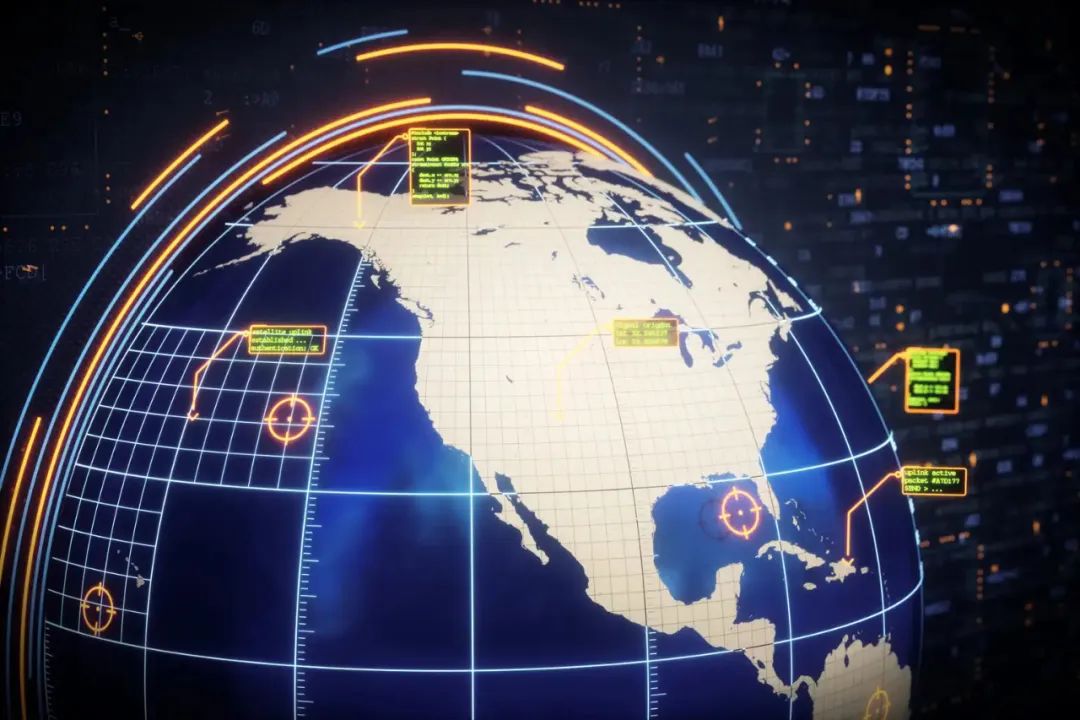
Knowledge Results in Algorithmic Cognitive Warfare Can Be Used for Threat Assessment
Trend Prediction. By utilizing evidence such as target activity pattern repositories, target association relationship repositories, and knowledge graphs, one can generate data on the characteristics and relationships between targets, target systems, and events, subsequently producing analyses of important event heat trends, diffusion paths, and developments, as well as multi-dimensional analyses of public sentiment and viewpoints during events. Methods like neural network modeling and time series can be employed to predict event development trends and target behavioral intentions, issuing early warnings.
Target Identification. By analyzing the semantics, behavioral patterns, and logical structures of adversary algorithms, one can identify adversary targets, intentions, and motivations. Methods for target identification include text analysis, image recognition, and speech recognition. Natural language processing techniques can analyze keywords, themes, and sentiments within texts, thus determining adversary intentions and targets; image recognition technology can identify objects, scenes, and faces in images, thereby inferring adversary action plans and targets; speech recognition technology can detect keywords and tones in speech, allowing for the assessment of adversary emotions and attitudes.
Threat Assessment. This is an important means of evaluating the adversary’s attack capabilities and potential harm. By analyzing adversary algorithms, one can assess their technical level, the scope and levels of different content attacks, and the potential damages they may cause. Threat assessment methods include quantitative and qualitative assessments. Quantitative assessments can be conducted through mathematical modeling to analyze the adversary’s attack capabilities and harm levels; qualitative assessments can be performed via expert opinions and case analyses to evaluate the threat levels posed by adversary algorithms.
Intelligent Open Source Intelligence AnalysisKey Issues to Address
Algorithmic cognitive warfare possesses intelligent advantages in suppressing adversary cognitive processes. Recent military conflicts characterized by intelligence have demonstrated the increasing importance of open-source intelligence, especially social media intelligence, in algorithmic cognitive warfare. In the future, the integration of artificial intelligence technology with open-source intelligence mining and analysis will deepen. Emerging technologies such as artificial intelligence serve as a double-edged sword, enhancing the capabilities of open-source intelligence analysis while potentially facing issues of deceptive intelligence. Therefore, three key aspects need to be addressed.
Technology-driven, human-assisted. Utilizing artificial intelligence technology can timely filter, capture, collect, and analyze open-source intelligence information, automatically generating standardized intelligence products and providing timely predictions for event developments. The computational speed and endurance of artificial intelligence have far surpassed the limits of the human brain; however, AI technology cannot fully replicate human behavior or perceive human emotions. In the face of the precise capabilities of algorithmic cognitive warfare, it struggles to analyze from multiple dimensions. Therefore, human intervention is still required in critical processes. Given the complexity of the sources and content of open-source intelligence information, enhancing human cognitive abilities through artificial intelligence technology is the direction for the development of open-source intelligence analysis in algorithmic cognitive warfare.
Hierarchical Management, Data Sharing. Open-source intelligence comes in various forms, with different intelligence analysis departments employing different collection methods and techniques, yielding varying dimensions and depths of intelligence. To address planned, iterative, and pervasive topics, a distributed large intelligence analysis system should be established, centered around “war target centers, all-source data analysis, and regulated classification sharing,” breaking down barriers between intelligence departments. A hierarchical data management mechanism should be established under secure conditions, coordinating different intelligence agencies to collect and analyze as comprehensive data as possible, achieving mutual sharing.
Enhancing Monitoring, Preventing Security Risks. Open-source intelligence analysis based on algorithmic cognitive warfare requires real-time monitoring of changes in public opinion environments, continuously scanning for abnormal information and tracking hot topics. However, when data accumulates to a certain degree, the operational habits of intelligence analysts may be discovered and exploited by adversaries, leading to potential security issues such as identity theft and malicious intrusions. Therefore, it is crucial to enhance security monitoring, threat warning capabilities during data entry, transmission, and analysis processes, employing artificial intelligence-based methods for data encryption and storage to ensure data security.
Conclusion
Algorithmic cognitive warfare has demonstrated immense power during the Ukraine crisis, with open-source intelligence and intelligent technology playing decisive roles. In the face of ubiquitous open-source data today, it is essential to strengthen the development of artificial intelligence-related fields and technologies, combining complex data, advanced technological advantages, and the proactive agency of analysts to fully exploit the intrinsic value of open-source intelligence data, overcoming the dilemmas in intelligence analysis during algorithmic cognitive warfare and further satisfying the intelligence needs of operations.
Copyright Notice: This article is published in the 2024, Issue 3 of the “Military Digest” magazine,Authors:Li Lingzhi, Li Hao, Please be sure to indicate “Originally from ‘Military Digest'” when reprinting.
Follow the public account for more information
Membership application Please reply “Individual Member” or “Corporate Member” in the public account
Welcome to follow the media matrix of the China Command and Control Society

CICC Official Website

CICC Official WeChat Account

Journal of Command and Control Official Website

International Unmanned Systems Conference Official Website

China Command and Control Conference Official Website

National Wargaming Competition

National Aerial Intelligent Game Competition

Sohu Account

Yidian Account