Click the card below to follow「AI Vision Engine」public account
( Please note: direction + school/company + nickname/name )

The current video understanding models excel at recognizing “what happened,” but they fall short in high-level cognitive tasks such as causal reasoning and future prediction, a limitation stemming from their lack of common-sense world knowledge. To bridge this cognitive gap, the authors propose a novel framework that synergistically integrates powerful visual foundation models (VFM) for deep visual perception with a large language model (LLM) as the knowledge-driven reasoning core.
The key technical innovation of the authors is a complex fusion module inspired by the Q-Former architecture, which distills complex spatiotemporal and object-centric visual features into concise, language-aligned representations.
This enables the LLM to effectively combine its reasoning process with direct visual evidence. The model is trained using a two-stage strategy, first undergoing large-scale alignment pre-training on video-text data, followed by instruction fine-tuning on a carefully curated dataset designed to stimulate high-level reasoning and prediction capabilities. Extensive experiments demonstrate that 2507 achieves state-of-the-art performance across multiple challenging benchmark tests.
Notably, it exhibits exceptional zero-shot generalization capabilities on unseen reasoning tasks, and the authors’ in-depth ablation studies validate the critical contributions of each architectural component.
This work pushes the boundaries of machine perception from simple recognition to true cognitive understanding, paving the way for smarter and more powerful AI systems in fields such as robotics and human-computer interaction.
unsetunset1 Introductionunsetunset
The surge in video data has made it a primary medium for information exchange and environmental perception, driving significant evolution in computer vision research (9; 55). Historically, the field has achieved remarkable success in discriminative tasks—from basic image recognition (6) to complex action and gesture recognition in videos (1). This progress is evident in specialized areas such as sign language translation, where hierarchical models demonstrate strong recognition capabilities (16; 18), as well as fine-grained sensing technologies like WiFi-based gesture and activity recognition, which are becoming increasingly robust and resilient to interference. However, this “recognition” paradigm primarily addresses the question of “what is happening in the visual scene.” Now, the field is shifting towards a more profound challenge: moving from perception to true cognition (60). This includes enabling machines to reason about “how events occur” and predict “what might happen next”—a task that requires a level of understanding far beyond statistical pattern matching.
The main obstacle to achieving this cognitive leap is the “knowledge gap.” Despite the current models being architecturally complex, they often operate in a closed world, lacking a vast knowledge base of common sense, physical intuition, and social knowledge that humans can easily apply. For instance, while a model may accurately classify a video clip as “a person picking up eggs and flour,” it often fails to infer the underlying intent, such as “this person is about to bake a cake.” This limitation becomes particularly pronounced when considering the demands of next-generation applications. High-level human-machine systems (62), emotional computing aimed at improving reliability by suppressing label noise (63), and even psychological understanding through language models (23) all require a deeper causal understanding of events. Similarly, while authors can now capture detailed physiological data through commercial devices, interpreting this data in the context of complex human activities necessitates high-level reasoning capabilities. Thus, the core challenge lies in endowing visual models with this external world knowledge.
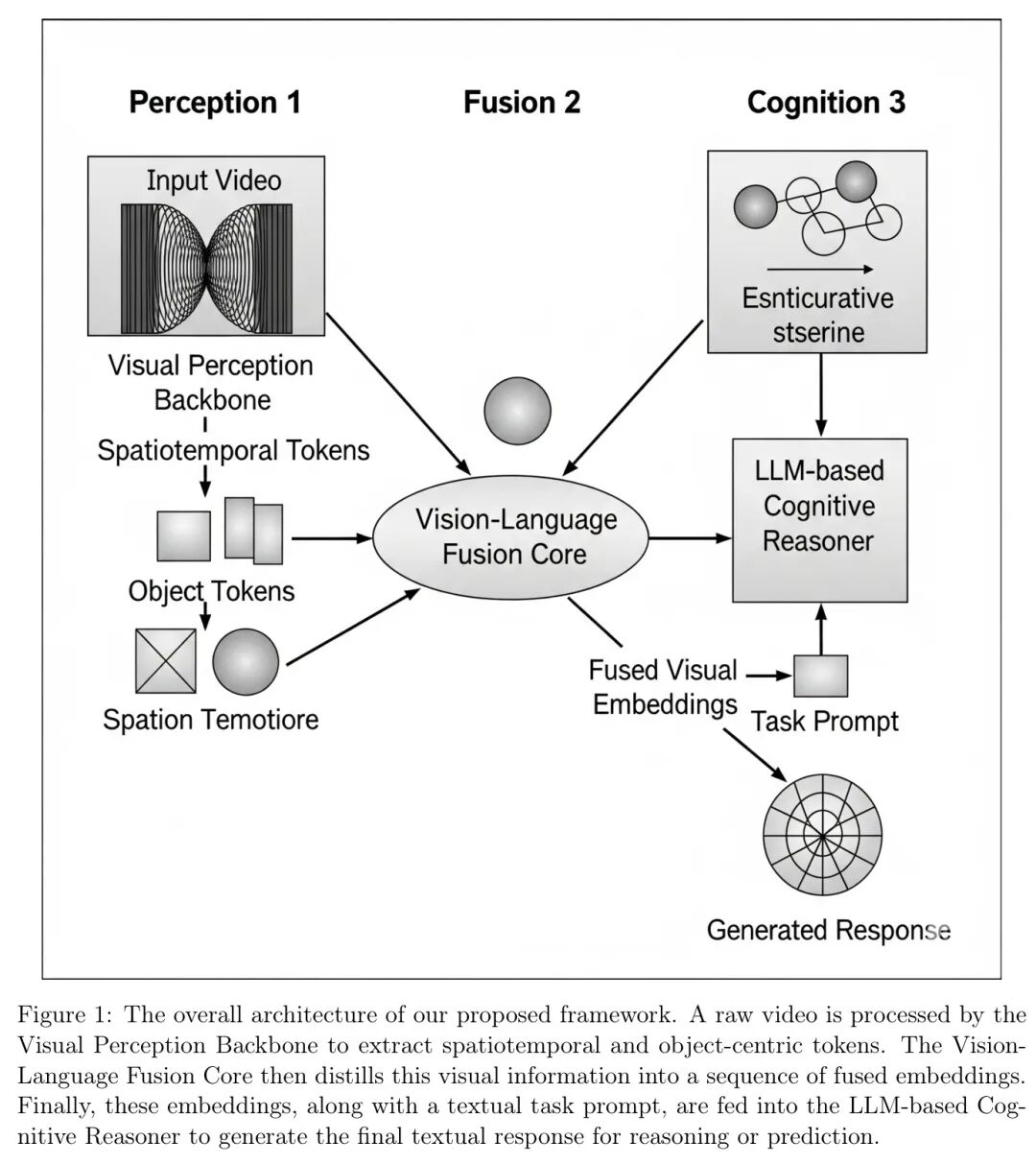
To bridge this gap, the authors propose a novel framework that synergistically integrates the capabilities of the two most powerful paradigms in modern AI: visual foundation models (VFMs) and large language models (LLMs). 2507 utilizes VFMs, such as those built on the principles of visual Transformers (6) and trained using multimodal supervision (41; 52), as the system’s “eyes.” These models excel at extracting rich spatiotemporal features and providing detailed pixel-level perception of the visual world. Simultaneously, the authors employ pre-trained LLMs, such as LLaMA (47), as the “brain”—a reasoning core endowed with vast world knowledge, causal relationships, and abstract concepts, as demonstrated in pioneering works like GPT-4 (4). The core of 2507 lies in a carefully designed fusion mechanism that transforms the continuous, unstructured visual evidence provided by VFMs into a discrete, language-compatible format that LLMs can process and reason about. This approach draws on the successful experiences of pioneering visual-language architectures like Flamingo (2) and BLIP-2 (33), but is explicitly tailored for complex event-level reasoning and prediction, going beyond simple description generation or direct question answering.
This work makes several important contributions to the field of cognitive video understanding. First, the authors introduce a novel and effective framework that integrates state-of-the-art visual foundation models with large-scale language models for the first time to perform high-level event reasoning and prediction, decisively surpassing simple recognition tasks. The core of this framework is the authors’ second contribution: the design of a lightweight yet powerful cross-modal fusion module. This component acts as an efficient information bottleneck, aligning rich visual features with the semantic space of the language model, which not only supports complex reasoning but also ensures that the model’s reasoning is grounded in direct visual evidence. To validate 2507, the authors’ third contribution is extensive experiments conducted on multiple challenging video reasoning benchmarks. The results show that 2507 significantly outperforms existing state-of-the-art methods and notably exhibits exceptional zero-shot capabilities in predicting future events, highlighting the profound benefits of transferring world knowledge from language models. The authors believe that the principles proposed in this paper also hold considerable potential for enhancing related multimodal tasks, such as visual dialogue (19) and audiovisual event analysis (67).
unsetunset2 Related Workunsetunset
Endowing machines with the ability to understand and predict events in videos is at the intersection of several key research areas in artificial intelligence. This section provides an overview of the current state of related research, starting from the foundations of visual representation learning, transitioning to the evolution of multimodal models, and finally focusing on the latest advancements in LLM-driven video understanding, specialized reasoning tasks, and embodied AI.
2.1 Foundations of Visual Representation Learning
The path towards meaningful video understanding begins with the extraction of powerful visual representations. Early successes were primarily due to convolutional neural networks (CNNs), which demonstrated exceptional capabilities in hierarchical feature extraction from images. However, the emergence of the Transformer architecture, particularly the visual Transformer (ViT) (6), marked a paradigm shift. By treating images as a series of patches, ViT can apply self-attention mechanisms to capture global context, which poses a challenge for CNNs with limited receptive fields. This architectural innovation laid the groundwork for the next generation of foundation models. For videos, this principle is extended into the temporal domain, resulting in powerful video foundation models like InternVideo (52), which learn generalizable representations from large-scale datasets by combining generative and discriminative objectives. The development of such backbone networks is itself a research area. Ongoing efforts to improve efficiency and effectiveness, such as through advanced model compression techniques like multi-object convex quantization (7), or designing dedicated architectures for specific tasks (e.g., crowd counting (17)).
2.2 From Recognition to Spatiotemporal Understanding
Building on these powerful visual backbone networks, research has evolved from simple classification to a more nuanced understanding of spatiotemporal dynamics. This evolution is reflected in tasks that require simultaneous localization of events in both space and time. Video localization, which involves finding specific video segments corresponding to a textual query, is a typical example. Recent studies such as (22) focus on developing efficient temporal filtering mechanisms to accurately identify these moments.
This goal is further extended to generating structured summaries of long videos, such as creating different chapters, a task addressed by large-scale datasets and models like VidChapters-7M (10). This fine-grained temporal understanding forms the basis of the authors’ work, as reasoning about causal relationships between events and making predictions requires precise grasp of “when” events occur. A related task, text-to-video retrieval, further emphasizes the importance of fine-grained alignment, with recent benchmarks like Ground-A-Video (27) pushing the current technical level of accurately matching semantic queries to video content.
2.3 The Rise of Visual Language Models (VLMs)
The true catalyst for high-level visual reasoning is the effective fusion of vision and language. The development of CLIP (41) demonstrates that a shared embedding space for images and text learned through large-scale contrastive pre-training can achieve remarkable zero-shot transfer capabilities. This breakthrough paved the way for a series of large-scale visual language models (VLMs). Early influential models like Flamingo (2) introduced gated cross-attention layers that inject visual features into pre-trained and frozen language models, showcasing impressive few-shot learning capabilities. This “frozen LLM” paradigm has been further explored in works like (48), highlighting the potential of this cost-effective approach.
Architectures like BLIP-2 (33) establish a modal bridge between frozen image encoders and frozen LLMs by introducing lightweight “Q-Former” modules, proving to be an efficient and parameter-economical strategy. The field continues to expand the scope of fusion, aiming to create fully perceptive models like VALOR (5) and LanguageBind (68), which not only align vision and text but also unify audio, depth, and thermal imaging data into a cohesive semantic space. This trend of multimodal fusion is not limited to mainstream sensors; innovative research has demonstrated the potential of fusing commercial WiFi signals with vision for tasks like emotion recognition (15), reflecting the broader principles of collaborative perception upon which the authors’ work is based.
2.4 LLMs for Video Understanding and Reasoning
The combination of powerful visual language models (VLMs) with the reasoning capabilities exhibited by large language models (LLMs) (47; 4) has given rise to the current research frontier: LLM-based video understanding. The first wave of models is typically defined as “video assistants,” focusing on achieving dialogue about video content. Models like Video-LLaMA (64), Video-ChatGPT (38), and Chat-UniVi (29) demonstrate how to connect video encoders with LLMs to answer questions, generate descriptions, and engage in dialogue about video content. LLaViDA (66) further explores methods to enhance this understanding through contextual learning.
Subsequently, research has shifted towards supporting more complex and structured reasoning. SeViLA (59) introduced a self-chaining question-answering approach that encourages models to decompose questions into smaller, more manageable steps. This aligns with a broader trend in the natural language processing field, such as training models along explicit reasoning paths (13). Perhaps the most innovative approach is ViperGPT (45), which empowers large language models to write and execute Python code that calls various visual APIs, effectively transforming large language models into cognitive coordinators that answer complex visual queries by combining modular tools. As the complexity of reasoning increases, the demand for handling longer contexts also grows. Models like LaVi-L (61) and memory-augmented Stammer (34) are specifically designed to tackle the challenges of long video understanding, which is crucial for tracking causal chains over extended periods.
This rapid progress has also prompted critical examinations of model limitations, particularly the “hallucination” problem, where models generate text that is factually incorrect or unfounded. Research like Woodpecker (58) now focuses on developing methods to detect and correct these hallucinations, a key step in building reliable systems. The ultimate goal is to create unified, arbitrary-to-arbitrary multimodal models like Emu2 (44), NExT-GPT (54), and Google’s Gemini (12), which aim to seamlessly handle and generate content across nearly all modalities. This includes extending reasoning into the third dimension, as explored by Chat-3D-v2 (56), and leveraging novel fusion architectures like AMAM’s modality-adaptive mind (30). The fusion principles explored in these works can even find analogies in other domains, such as the multi-perspective, multi-temporal architecture of SUTRA for speech processing (42), indicating a universal trend in multimodal AI.
2.5 Event Prediction and World Models
The “prediction” aspect of the authors’ work directly relates to the long-standing challenge of video prediction. Traditional methods often focus on low-level predictions, such as generating future pixels. Diffusion models, as demonstrated in MCVD (49), have recently shown great potential in generating high-fidelity future frames. However, the authors’ focus is on high-level semantic prediction. This aligns with research in human trajectory prediction, where models like V-STF (28) learn to predict future movements by integrating social and temporal cues.
The most ambitious vision in the prediction domain is embodied in the concept of “world models.” Pioneering works like DreamerV3 (20) demonstrate that agents can learn robust internal models of their environment dynamics, enabling them to “dream” or simulate future outcomes to effectively plan actions. This represents a shift from reactive prediction to proactive simulation. The recent Genie model (46) takes this idea further by learning to generate complete interactive, playable 2D worlds from a single image. Although the authors’ work does not construct explicit world models, it embodies the same spirit: leveraging accumulated knowledge to make informed predictions about future states. Generative models like VideoPoet (32) further demonstrate these models’ exceptional capabilities in implicitly learning deep predictive representations of the world from text to synthesize coherent dynamic videos.
2.6 Applications, Benchmarks, and Broader Context
The ultimate goal of video reasoning and prediction is to enable intelligent applications and systems. The primary beneficiaries are embodied AI and robotics. The paradigm has shifted from passive video analysis to training active agents capable of perceiving, reasoning, and acting in the physical world. Landmark models like RT-2 (3) and the general-purpose Octo transformer (40) demonstrate that a single visual-language-action model can be trained to control robots to perform various tasks. This requires not only understanding instructions but also organizing and planning complex actions, with agents like LEO (37) addressing this challenge. The importance of external knowledge in these embodied tasks is emphasized by specialized benchmarks like OK-VILA (43).
The development of this field heavily relies on challenging and well-designed benchmarks. The CLEVRER (57) dataset is specifically designed for causal and physical reasoning, while the Test of Time (39) focuses on assessing temporal understanding capabilities. The Ego-Exo4D dataset (11) pushes state-of-the-art technology to new heights by providing synchronized first-person and third-person perspectives of the same event, requiring more comprehensive, cross-perspective understanding. While many studies rely on traditional visual data, the parallel development of alternative sensing modalities is creating new opportunities. Technologies using commercial WiFi (14) and RFID (8) can now achieve fine-grained activity or even keystroke detection (26). These rich data streams, often generated in complex real-world environments, such as robotic vehicle perception (51), require equally complex or even higher-level reasoning models for meaningful interpretation. In healthcare, visual-based Parkinson’s tremor assessment (53) or WiFi-based lung function analysis (65) particularly necessitate a profound understanding of subtle temporal patterns.
Finally, training these large-scale models on diverse real-world data also presents its own challenges, prompting researchers to explore areas like federated learning to handle distributed data and heterogeneous networks, such as the Finch framework that enables neural architecture search in such environments (36; 35). The authors’ work sits at the intersection of these advancements, aiming to leverage foundation models and high-level reasoning to build a system that not only understands videos but also predicts their future, which holds broad implications for all these application domains.
unsetunset3 Methodologyunsetunset
In this section, the authors detail the architecture and technical foundations of the proposed video event reasoning and prediction framework. The authors’ core argument is that the synergistic integration of a powerful visual perception system with a knowledge-rich general language model (LLM) can unlock cognitive capabilities that a single component cannot achieve. The overall architecture is illustrated in Figure 1, designed as a logical flow from perception to fusion to cognition. It consists of three core stages: (1) a visual perception backbone network that decomposes videos into rich multi-level spatiotemporal features; (2) a visual-language fusion core that bridges the modal gap by transforming visual evidence into a language-compatible format; (3) an LLM-based cognitive reasoner that utilizes this fused representation to perform complex reasoning tasks. The authors will next describe these components in detail.
3.1 Visual Perception Backbone Network
The cornerstone of any video understanding system is its ability to extract salient and comprehensive features from raw pixel inputs. To this end, the authors’ visual perception backbone network is designed to capture not only the global dynamics of the scene but also the fine-grained details of key objects and their interactions.
3.1.1 Spatiotemporal Feature Extraction
The authors employ a pre-trained video foundation model, specifically a video version of the visual Transformer (ViT) architecture variant, such as InternVideo (52), as the primary spatiotemporal encoder. The input video is first divided into a sequence of non-overlapping temporal segments. Each segment is then sampled into frames. These frames are further decomposed into non-overlapping block grids and linearly projected into block embeddings. A special [CLS] token is added at the beginning of the sequence. The entire sequence is then processed through a series of Transformer blocks that apply self-attention mechanisms across both spatial and temporal dimensions. The output of the [CLS] token from the final Transformer layer corresponding to each segment serves as its high-level representation. The collection of these segment representations forms the global context feature set, .
where represents the th segment of the video, VideoTransformer denotes the forward pass through the visual backbone, and is the dimension of the visual features.
3.1.2 Object-Centric Feature Enhancement
Global features capture the overall scene dynamics, while high-level reasoning often relies on specific objects and their states. To provide the model with this structured information, the authors enhance the visual representation through object-centric features. The authors utilize a pre-trained, promptable segmentation model—anything segmentation model (SAM) (31) to process the key frames of the video. For each key frame, the authors employ an automatic prompt mechanism (e.g., grid-based point prompts) to generate a set of object masks , where is the number of detected objects. For each object mask , the authors extract its feature representation from the patch embeddings of the visual backbone using mask-based average pooling. This generates a set of object tokens for the entire video, .
where represents the pixel positions, PatchEmbed is the feature embedding of the image patches containing pixels, 6 is the number of pixels in the mask, and is the total number of significant objects detected across all key frames. The final visual representation passed to the next stage is the concatenation of global features and object-centric features:
3.2 Visual-Language Fusion Core
A fundamental challenge in multimodal learning is bridging the “modal gap” between continuous, high-dimensional visual features and discrete, symbolic language spaces. Simply projecting visual features into the language embedding space may be inefficient and introduce noise. To this end, the authors adopt a complex fusion module inspired by the Q-Former architecture in BLIP-2 (33), which acts as an information bottleneck, distilling the most relevant visual information for the LLM.
The fusion core consists of a small number of fixed, learnable query embeddings, , where is typically small (e.g., 32). These queries interact with visual tokens through a series of cross-attention layers, trained to extract visual information. In each layer, the learnable queries serve as queries (Q), while the visual feature tokens act as keys (K) and values (V). This process forces the queries to summarize the most salient features in the video relevant to the language description. The cross-attention mechanism is defined as:
represent the projections of Query, Key, and Value, while is the dimension of the keys.
After processing through multiple layers of cross-attention mechanisms and self-attention mechanisms (within the queries themselves), the resulting output queries represent a compressed, language-aligned summary of the video. These output queries are then projected into the LLM’s word embedding space through a linear layer.
where LinearProj is a learnable linear projection layer, is the embedding dimension of the selected LLM. These tokens, become the final visual representation directly appended to the LLM input sequence.
3.3 LLM-Based Cognitive Reasoner
Once the visual information has been effectively tokenized and aligned, the authors leverage a pre-trained large language model as their cognitive reasoner. The task of this large language model is to generate a coherent, text-based response based on the multimodal embedding sequence it receives as context, fulfilling user instructions regarding reasoning or prediction.
3.3.1 Prompt Engineering and Input Construction
The input to the LLM is a carefully constructed embedding sequence. It begins with tokenized visual information, followed by task-specific text prompts that have been tokenized and converted into their respective word embeddings. The text prompts are designed to elicit the desired cognitive behavior. For example:
. For event reasoning: The prompt might be, “The provided visual information depicts a series of events. Analyze the causal relationships between these events and provide a step-by-step explanation for the final outcome.”
. For future prediction: The prompt could be, “Based on the events observed in the video, predict the next three most likely events. For each prediction, provide a brief rationale and a confidence score between 0 and 1.” The final input embedding sequence fed into the LLM is “
3.3.2 Autoregressive Generation and Reasoning
The large language model (LLM) processes the input embeddings and autoregressively generates text responses . At each step , the model predicts the probability distribution of the next token based on all previously generated tokens and the input context.
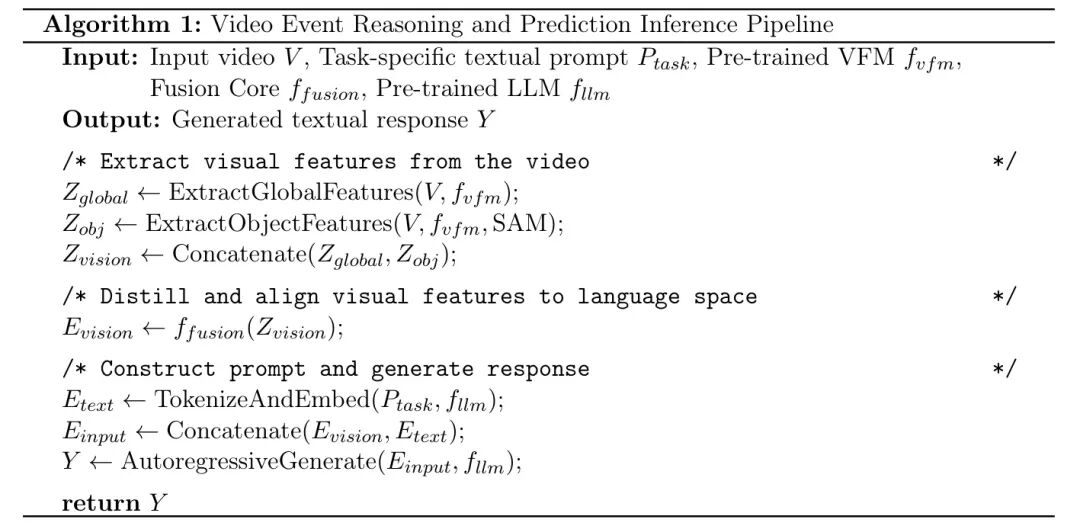
where represents all previously generated tokens. During reasoning, the authors typically employ decoding strategies such as nucleus sampling or beam search to generate fluent and high-quality text responses. The entire reasoning process is summarized in Algorithm 1.
3.4 Training Strategy and Objectives
Training such a complex multi-component model from scratch end-to-end is computationally infeasible and unnecessary, given the powerful capabilities of existing pre-trained models. Therefore, the authors adopt a more practical and efficient two-stage training strategy.
3.4.1 Stage 1: Visual-Language Alignment Pre-training
In the first stage, the authors aim to enable the visual-language fusion core to effectively transform visual information into a format understandable by the LLM. To this end, the authors freeze the weights of the visual perception backbone network and the LLM, training only the parameters of the fusion core (i.e., Q-Former and linear projection layer). The model is trained on a large dataset of video-caption pairs (e.g., WebVid-10M). The objective is the standard language modeling loss: predicting the true caption text conditioned on the visual features extracted by the fusion module.
3.4.2 Stage 2: Instruction-Based Fine-tuning
Once the fusion module is aligned with the two backbone networks, the authors enter the second stage, teaching the model to perform high-level reasoning and prediction tasks. In this stage, the authors use a carefully curated high-quality instruction-response dataset specifically for video reasoning and prediction. The authors unfreeze the LLM parameters (or adopt parameter-efficient fine-tuning techniques like LoRA (21)) and continue training the fusion core. The objective remains the language modeling loss, but this time it is computed on real reasoning or prediction text. This two-stage process ensures that the model first learns basic visual descriptions before mastering complex cognitive tasks.
In both stages, the overall training objective is to minimize the negative log-likelihood of the target text sequence . The loss function is defined as:
$$$ \mathcal{L}_{LM} = -\sum_{t=1}^{|Y^{*}|} \log P(y_t^{*} | E_{vision}, y_{
unsetunset4 Experimentsunsetunset
To rigorously evaluate the capabilities of the proposed framework in video event reasoning and prediction, the authors designed a comprehensive experimental scheme. This section details the datasets used for training and evaluation, the specific implementation details of 2507, the baseline methods it was compared against, and the diverse metrics used to measure performance across different aspects of the tasks.
4.1 Datasets
The authors’ two-stage training strategy requires a combination of large-scale web data for initial alignment and high-quality, task-specific data for instruction fine-tuning. The authors carefully selected a set of datasets for each stage and retained some for zero-shot evaluation benchmarks.
4.1.1 Training and Evaluation Datasets
The authors’ two-stage training strategy necessitates a carefully curated collection of datasets, starting with large-scale web data for initial alignment, followed by high-quality, task-specific data for instruction fine-tuning. In the first stage of visual-language alignment, the authors utilize the widely used WebVid-10M dataset, which contains over 10 million video-caption pairs, providing a broad foundation for learning general visual-semantic correspondences. To further enhance the model’s robustness and expose it to more diverse, “natural scene” situations, the authors supplemented it with the massive HD-VILA-100M dataset, which adds hundreds of millions of high-resolution video clips from the web.
Entering the critical second stage of instruction fine-tuning, the authors address the scarcity of high-quality reasoning data by constructing a rich, mixed dataset. The authors integrate established academic benchmarks, including NExT-QA (for its focus on causal and temporal reasoning) and ActivityNet-QA (for its large scale and diversity of temporal queries). Given the limitations of existing resources, the cornerstone of the authors’ fine-tuning data is the synthetically generated Causal-Vid-Instruct dataset. To create this dataset, the authors used a powerful teacher model (GPT-4V) containing 100,000 video clips (sampled from diverse sources like Ego4D (11)), prompting it to generate detailed causal explanations and reasonable future predictions. This synthetic data provides high-quality, targeted examples for the cognitive behaviors the authors aim to cultivate in 2507.
Finally, to rigorously evaluate the generalization capabilities of 2507, the authors specifically reserved several challenging benchmark datasets for zero-shot evaluation. These datasets include the duration test benchmark (ToT) (39), designed for diagnosing temporal reasoning, the synthetic CLEVRER dataset (57) for detecting emergent physical and causal intuitions, and the VCR benchmark (60) for assessing common-sense reasoning reflected in still frames extracted from videos. These evaluation datasets were not seen by the model at any stage of training.
4.1.2 Stage 2: Instruction Fine-tuning Datasets
This stage is crucial for teaching the model specific skills in reasoning and prediction. The authors construct a mixed instruction fine-tuning dataset by combining multiple existing academic benchmarks and supplementing it with synthetically generated data.
NExT-QA: This benchmark aims to evaluate the temporal and causal reasoning capabilities in videos. It contains approximately 5,000 videos and 52,000 question-answer pairs. These questions often require understanding the causal relationships between events (e.g., “Why did the character fall?”) or their temporal sequences (e.g., “What did this person do before picking up the phone?”). The authors reformatted these multiple-choice questions into instruction-following forms.
ActivityNet-QA: A large-scale dataset built on the ActivityNet dataset, containing 5,800 videos and 58,000 question-answer pairs. While many questions are descriptive, a significant portion requires temporal reasoning, making it a valuable resource for fine-tuning.
Causal Video Instructions (Synthetic): High-quality, instruction-based video reasoning data is scarce. To address this issue, the authors generated a synthetic dataset. The authors sampled 100,000 video clips from diverse datasets like Ego4D (11) and Something-Something v2. For each clip, the authors prompted a powerful proprietary teacher model (GPT-4V) to generate causal explanations and reasonable future event predictions in a “thinking chain” style. The prompt given to the teacher model was: “Observe the following video clip. First, provide a step-by-step causal explanation of the events. Second, predict what is most likely to happen after the clip ends.” The generated (video, instruction, response) high-quality triplets constitute the authors’ Causal-Vid-Instruct dataset, which is crucial for teaching the desired cognitive behaviors.
4.1.3 Evaluation-Specific Benchmarks
To evaluate the zero-shot learning and generalization capabilities of 2507, the authors conducted evaluations on multiple benchmark datasets that were completely unseen during training.
Time Test (ToT) (39): A recently proposed benchmark specifically designed to diagnose the temporal reasoning capabilities of models, including event ordering, duration comparisons, and time localization. Its focus on challenging temporal queries makes it an ideal testing platform for the authors’ reasoning claims.
CLEVRER (57): CLEVRER is a synthetic dataset that serves as a powerful diagnostic tool for testing causal reasoning and physical reasoning. It contains videos of colliding objects, where questions require understanding concepts like causality, object permanence, and collision dynamics. Success in this benchmark under zero-shot settings will provide strong evidence of the model’s emergent physical intuitions.
VCR (Visual Common Sense Reasoning) (60): The authors use the VCR benchmark to assess common-sense reasoning capabilities. For each video, the authors use the central frame and require the model to answer a challenging question and provide reasoning, testing its ability to transfer knowledge to image-based reasoning environments.
4.2 Implementation Details
4.2.1 Model Architecture
2507 is built upon powerful publicly available foundation models. The visual perception backbone is the InternVideo-B/16 model (52), which has demonstrated state-of-the-art performance across a wide range of video understanding tasks. The LLM-based cognitive reasoner is the instruction-tuned L1ama-3-8B-Instruct model, known for its strong reasoning and language generation capabilities. The authors’ visual-language fusion core, inspired by the Q-Former architecture, contains 32 learnable queries, a hidden dimension of 768, and 8 cross-attention layers for extracting visual information.
4.2.2 Training Details
The training process is divided into two distinct stages:
Stage 1 (Alignment Pre-training): The authors train the Fusion Core on the WebVid-10M and HD-VILA-100M datasets for a total of 4 epochs. The visual backbone network and LLM remain frozen. The authors use a global batch size of 2048, the AdamW optimizer with a learning rate of 1e-4,,, weight decay of 0.05. A cosine annealing learning rate schedule is employed, with a warm-up of 2000 steps. This stage is completed on a cluster of 32 NVIDIA H100 GPUs, taking approximately 8 days.
Stage 2 (Instruction Fine-tuning): The authors fine-tune the model on the combined instruction dataset for a total of 3 epochs. In this stage, the authors unfreeze the LLM and employ LoRA (21) for parameter-efficient fine-tuning, adapting it to the authors’ tasks while retaining its pre-trained knowledge. The authors set the LoRA rank, alpha , applied to all linear layers of the LLM. The Fusion Core remains trainable. The learning rate is reduced to 2e-5, using a smaller batch size of 256. This stage is completed on 8 NVIDIA H100 GPUs, taking approximately 48 hours.
4.2.3 Comparison Baselines
To demonstrate the advantages of 2507, the authors conduct a comprehensive comparison with a range of state-of-the-art models.
General Video Language Models: The authors compare it with leading video dialogue models, including VideoLLaMA (64) and Video-ChatGPT (38).
Reasoning Models: For reasoning tasks, the authors compare it with models designed for structured reasoning, such as SeViLA (59) and tool-enhanced ViperGPT (45).
Prediction-Oriented Models: For future prediction, the authors compare it with strong baseline models proposed in (1) and adjust the video generation model MCVD (49) to generate textual descriptions of its predicted future frames.
For all baseline models, the authors use their officially released code and available pre-trained weights, following their recommended evaluation protocols to ensure fair and direct comparisons.
4.3 Evaluation Metrics
Evaluating the nuanced tasks of reasoning and prediction requires a multifaceted approach that goes beyond simple accuracy. The authors adopt a combination of automatic metrics and human-centered evaluations.
4.3.1 Metrics for Closed-Ended Tasks
For tasks formatted as multiple-choice questions (e.g., NExT-QA and VCR), the authors report standard accuracy, which measures the percentage of correctly answered questions.
4.3.2 Open-Ended Generation Metrics
For the authors’ primary task—generating free-form text for reasoning and prediction—the authors use a range of metrics:
N-gram-based metrics: The authors report standard corpus-based metrics, including BLEU, ROUGE, METEOR, and CIDEr. These metrics measure the n-gram overlap between generated text and reference text. While useful, they often fail to capture semantic correctness and logical coherence.
Embedding-based metrics: To address the limitations of n-gram overlap, the authors adopt BERTScore, which calculates the cosine similarity between word embeddings of generated text and reference text, providing a more accurate measure of semantic similarity.
LLM as a Judge: Recognizing that automated metrics are insufficient for assessing reasoning quality, the authors adopt the paradigm of “LLM as a judge.” The authors use GPT-4o as an impartial evaluator. The authors carefully design a detailed prompt that asks the judge model to score the generated responses on three key dimensions, with scores ranging from 1 to 10: (1) Factual Basis: Does the response align with the visual evidence in the video? (2) Logical Coherence: Is the reasoning sound and easy to understand? (3) Insightfulness: Does the response provide non-trivial insights or predictions? The authors report the average scores on a large randomly sampled test set.
4.3.3 Human Evaluation
The ultimate authority on quality lies in human judgment. The authors conduct a human evaluation study on a randomly selected subset of 200 test instances. The authors present the videos along with the outputs of 2507 and two strong baselines in a blind random order to human annotators. Annotators are asked to rank the outputs based on overall quality, considering correctness, coherence, and detail. The authors report the win/loss/tie percentage of the model relative to the baselines.
unsetunset5 Results and Discussionunsetunset
In this section, the authors provide a comprehensive empirical evaluation of the proposed framework. First, the authors report the main quantitative results, comparing 2507 with current state-of-the-art baseline models across a range of reasoning and prediction benchmark tests. Next, the authors demonstrate the model’s generalization capabilities through zero-shot evaluations on unseen tasks. Subsequently, the authors conduct a series of in-depth ablation studies to dissect the model and validate the contribution of each architectural component. Finally, the authors provide qualitative examples to visually demonstrate the model’s behavior and discuss the significance and inherent limitations of the authors’ work.
5.1 Main Quantitative Comparisons
The authors first evaluate the overall performance of 2507 against existing methods on standard benchmarks for video reasoning and open-ended generation. The results are summarized in Tables ?? and ??, consistently demonstrating the advantages of 2507.
5.1.1 Performance on Video Reasoning Tasks
As shown in Table ??, on the authors’ reasoning-centric multiple-choice question answering benchmarks like NExT-QA and VCR, 2507 achieves new state-of-the-art levels. On NExT-QA, which assesses causal and temporal understanding capabilities, 2507 achieves the highest accuracy, significantly outperforming general video LLMs like VideoLLaMA (64) and Video-ChatGPT (38). The authors attribute this performance improvement to two key factors. First, the authors explicitly include object-centric features, providing the model with more structured and specific representations of entity interactions, which are often crucial for answering “why” type questions. Second, the authors used the synthetically generated Causal-Vid-Instruct dataset during the fine-tuning process in the second stage, directly exposing the model to patterns of causal language, which is a significant advantage compared to models primarily trained on descriptive captions.
Compared to reasoning-centric models like SeViLA (59), which employs a self-chaining reasoning process, the performance of 2507 indicates that combining a powerful pre-trained LLM with rich visual input enables it to perform implicit reasoning more effectively than explicitly decomposing problems. Furthermore, 2507 outperforms ViperGPT (45), which is an innovative approach that utilizes LLMs to generate code. While ViperGPT excels in queries that can be answered through the combination of existing visual tools, 2507 stands out in tasks requiring a holistic common-sense understanding of non-scripted events, which are difficult to resolve through a series of API calls.
5.1.2 Performance on Open-Ended Generation and Prediction
The true test of 2507’s cognitive capabilities lies in its ability to generate free-form, coherent text for reasoning and prediction. In Table ??, the authors report results on their open test set using a range of metrics. In terms of n-gram-based scores (BLEU, ROUGE-L, CIDEr), 2507 is highly competitive, indicating its fluency in generating grammatically correct and relevant text. However, these metrics are known to have limitations. On semantic similarity metrics like BERTScore, 2507 shows even more significant advantages, confirming that its generated results are not only syntactically similar but also semantically closer to the truth.
The most compelling results come from the authors’ evaluation using LLM as a judge. 2507 consistently receives the highest scores across three dimensions: factual basis, logical coherence, and insightfulness. High scores on the factual basis dimension validate the effectiveness of the authors’ visual-language fusion core, which successfully extracts and maintains fidelity to the visual evidence. Leading scores on the logical coherence dimension showcase the power of leveraging large-scale LLMs like Llama-3, which can organize visual information into a coherent argumentative structure. Most importantly, superior scores on the insightfulness dimension indicate that 2507 can go beyond mere description to engage in non-obvious reasoning and creative predictions, a direct benefit of the vast world knowledge embedded in the LLM. This contrasts with many baseline models, whose outputs, while often correct, tend to be more descriptive and less reasoning-oriented.
5.2 Zero-Shot Generalization Performance
A key goal of the authors’ work is to build a model with generalizable reasoning capabilities, rather than merely overfitting to patterns in the fine-tuning data. To evaluate this, the authors assess the model on two challenging benchmarks, CLEVRER and the duration test (ToT), without any training on specific tasks. The results are shown in Table ??.
On the CLEVRER dataset (57), which tests physical reasoning and causality in synthetic 3D environments, 2507 achieves surprisingly high accuracy in zero-shot settings. It significantly outperforms all video dialogue baseline models, which often struggle to grasp the fundamental physical laws of collisions and object permanence. This suggests that the combination of large-scale video pre-training with the inherent (albeit imperfect) physical knowledge of LLMs enables 2507 to develop emergent intuitions about physical laws.
Similarly, on the time test (ToT) benchmark (39), which aims to diagnose temporal reasoning capabilities, 2507 exhibits strong zero-shot capabilities. It successfully answers complex questions about event order, duration, and relationships, with performance far exceeding models not explicitly designed for such fine-grained temporal analysis. This success indicates that 2507 has learned abstract principles and sequences of time from training, rather than relying on cues from specific datasets. This generalization capability is crucial for real-world applications, as systems must continuously encounter and interpret new scenarios.
5.3 Ablation Studies
To dissect 2507 and quantitatively validate the authors’ architectural choices, the authors conduct a series of in-depth ablation studies, with results summarized in Table ??. The findings indicate that each component plays a synergistic and indispensable role. The most critical component is the authors’ visual-language fusion core; replacing the authors’ Q-Former-inspired module with a simpler mean pooling and linear projection method (without the fusion core) leads to a dramatic drop in performance. This indicates that the fusion module is not just a projector but a crucial information bottleneck that effectively filters and transforms visual data for LLM use. Furthermore, when object-centric features are removed (no object features), the importance of structured visual input is validated. This results in a significant drop in performance on tasks requiring fine-grained causal reasoning about entity interactions, confirming the authors’ mixed feature extraction strategy. The necessity of the authors’ two-stage training protocol is also validated. Models trained only on alignment (without stage 2 fine-tuning) can generate basic descriptions but completely fail on reasoning tasks, highlighting the importance of instruction fine-tuning for eliciting cognitive behaviors. Similarly, models trained without the authors’ synthetic causal video instruction dataset (no synthetic data) exhibit weak interpretative and predictive capabilities, confirming the value of high-quality, targeted instruction data. Finally, replacing the authors’ LLM with a smaller backbone network (smaller LLM) results in reasoning outputs lacking coherence and detail, further reinforcing the conclusion that the ultimate capabilities of the framework are closely tied to the strength of its cognitive core.
5.4 Qualitative Analysis and Visualization
Quantitative metrics provide a measure of overall performance, but qualitative examples can reveal deeper insights into the model’s strengths and weaknesses. The authors present several examples in Figures 2 and 2.
In a successful example of causal reasoning, as shown in Figure ??(a), the input video depicts a person reaching for a book on a high shelf and accidentally knocking over a flower pot. The baseline model provides a simple description: “A person reaches for a book, and the flower pot falls.” In contrast, 2507 generates a detailed, causal explanation: “The person reaches for the top shelf, causing their elbow to bump into the flower pot. This contact provides enough force to cause the flower pot to lose balance and subsequently tip over and fall to the ground due to gravity.” This demonstrates 2507’s ability to construct a complete causal chain from observed events.
In another prediction-focused example (Figure ??(b)), the video shows a chef carefully seasoning a steak and placing it into a hot oil pan. 2507 predicts: “The chef is likely to sear each side for a few minutes to form a crust, then may place it in the oven to finish cooking.” This prediction is not only accurate but also demonstrates domain-specific knowledge (about searing and finishing cooking a steak), which is clearly derived from the common sense embedded in the LLM.
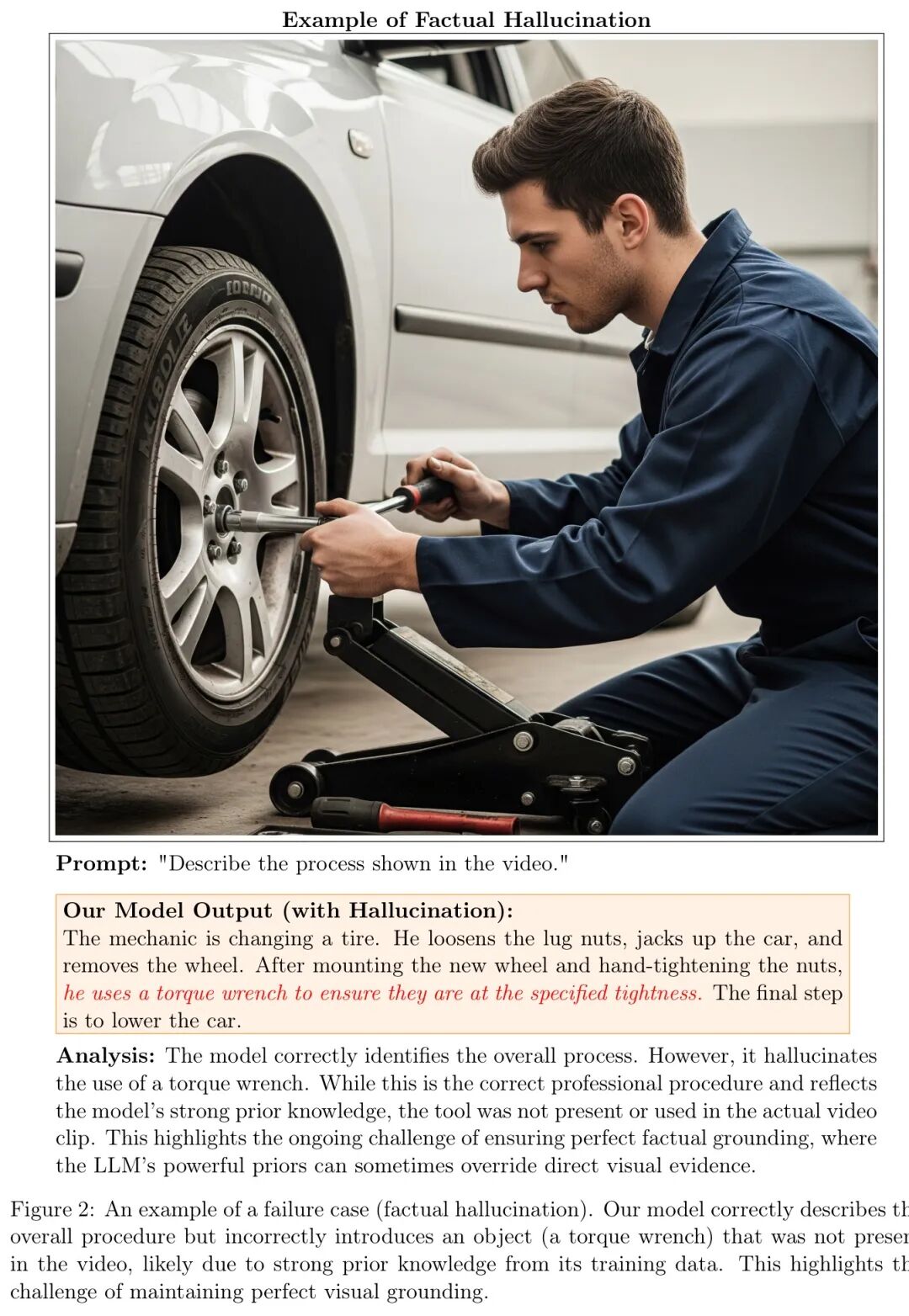
However, 2507 is not without its flaws. Figure 2 illustrates a common failure mode: factual hallucination. In a video showing a technician changing a tire, 2507 correctly identifies most steps but hallucinates details: “..after tightening the nuts, the technician uses a torque wrench to ensure they reach the specified tightness.” While this is the correct professional procedure, the torque wrench was neither present nor used in the video clip. Such errors, as shown in (58), occur when the strong prior knowledge of large language models overrides immediate visual evidence. This highlights the ongoing challenge of achieving perfect and robust visual foundational understanding, which remains a key area for future research.
5.5 Discussion and Limitations
The collective results indicate that 2507 represents a significant advancement in video understanding. [.] Despite these promising results, the authors acknowledge several clear limitations that point to directions for future research. A primary consideration is the enormous computational costs involved in training and reasoning, a common challenge for foundation models. Future work should explore advanced model compression techniques (7) and more efficient architectures to democratize these capabilities. Additionally, the advanced reasoning capabilities of 2507 stem from the authors’ synthetic instruction dataset, leading to a reliance on their teacher model and potentially inheriting its biases. Developing methods that fine-tune using more diverse, human-curated data or through reinforcement learning directly from human feedback would be a valuable next step. The ongoing issues of factual basis and hallucination, while somewhat mitigated, also warrant further attention. As the authors’ qualitative analysis shows, ensuring that every statement is perfectly grounded in visual evidence remains an open question, indicating a need for tighter fusion mechanisms or post-hoc verification modules. Finally, the current benchmarks present a clear gap between the unstructured, long-text complexities of real-world videos. Extending 2507 to handle video inputs lasting several hours and reasoning about the kind of ambiguous social dynamics found in datasets like Ego-Exo4D (11) will be a significant and exciting challenge for the field.
5.6 Discussion and Limitations
The collective results indicate that 2507 represents a significant advancement in video understanding. [.] Despite these encouraging results, the authors acknowledge several limitations that clearly point to directions for future research. A primary consideration is the enormous computational costs associated with training and reasoning, a common challenge for foundation models. Future work should explore advanced model compression techniques (7) and more efficient architectures to make these capabilities more accessible. Additionally, the advanced reasoning capabilities of 2507 stem from the authors’ synthetic instruction dataset, leading to a reliance on their teacher model and the potential inheritance of its biases. Developing methods that fine-tune using more diverse, human-curated data or through reinforcement learning directly from human feedback would be a valuable next step. While the issues of factual basis and hallucination have been somewhat alleviated, they also require further attention.
Describing the process shown in the video.
The technician is changing a tire. He loosens the nuts, lifts the car, and removes the wheel. After installing the new tire, he tightens the nuts by hand. The final step is to lower the vehicle.
Analysis: The model correctly identifies the overall process. However, it fabricates the use of a torque wrench. While this is the correct professional procedure and reflects the model’s strong prior knowledge, the tool was neither present nor used in the actual video clip. This highlights the ongoing challenge of ensuring complete factual grounding, where the strong prior knowledge of large language models sometimes overrides direct visual evidence.
It inherits its potential biases. Developing methods that fine-tune using more diverse, human-curated data or through reinforcement learning directly from human feedback would be a valuable next step. While the issues of factual basis and hallucination have been somewhat alleviated, they also require further attention.
unsetunsetReferencesunsetunset
[1]. Video Event Reasoning and Prediction by Fusing. World Knowledge from LLMs with Vision Foundation Models
Click the card above to follow「AI Vision Engine」public account