By Wu Ying, Li Yu, Gong Yiduo, Zheng Junwei, Zhou Fangyuan, Tian Tong Law Firm
This article contains12,021words, estimated reading time21minutes
On January 1, 2019, the International Chamber of Commerce (ICC) International Court of Arbitration proposed in its “Guidelines for Parties and Arbitral Tribunals on Participation in Arbitration Under the ICC Arbitration Rules” (“ICC Guidelines”) that ICC arbitration awards issued after January 1, 2019, may be made public two years after the case is closed, following a confidentiality review, to further enhance the transparency of arbitration.
Accordingly, the ICC, in collaboration with its technical partner Jus Mundi, began to publish arbitration awards gradually starting from June 1, 2021. As of August 16, 2021, seven awards have been published. The ICC North Asia Office for Arbitration and Alternative Dispute Resolution, in cooperation with arbitration colleagues, will launch a series of columns titled “Insights on ICC Rulings” to analyze the published arbitration awards, aiming to “unveil the mysterious veil” of arbitration awards.
This issue is authored by the Tian Tong arbitration team, including Wu Ying, Li Yu, Gong Yiduo, Zheng Junwei, and Zhou Fangyuan, providing an overview and analysis of the first public award (ICC Case No. 23611/DDA) (click “Read the Original” to access the arbitration award of this case). This award has undergone a confidentiality review, concealing the identities of the parties involved.
Overview of ICC Arbitration Case No. 23611/DDA
This case involves disputes regarding the validity and performance of a distribution agreement. The arbitration is governed by Belgian law, with the seat of arbitration in Belgium, and Mr. Jérôme Barbet, a French national, serves as the sole arbitrator. The arbitration procedure is based on the ICC Arbitration Rules effective from March 1, 2017. In the ruling, the tribunal clarified issues such as the application of Article 101 of the Treaty on the Functioning of the European Union (prohibited monopolistic behavior and exceptions), the legal consequences of invalid specific provisions, and the exercise of the tribunal’s authority as an amiable compositeur.
Moreover, there are few factual disputes in this case, and the legal disputes are relatively focused. According to the content of the award, the arbitration procedure did not include evidence disclosure and production phases, nor was there a schedule for witness testimonies and cross-examination, and the hearing concluded on the same day. The arbitration procedure was relatively compact, taking only 12 months from the submission of the arbitration application to the issuance of the award, with arbitration costs controlled at $100,800, fully demonstrating the flexible characteristics of international arbitration procedures, which can be advanced in an efficient and economical manner.
Regarding how to effectively manage arbitration and control the time and cost of arbitration, the ICC has published several reports and recommendations for parties to reference, such as the ICC Arbitration Commission’s report on “Techniques for Controlling Time and Costs in Arbitration,” the guide “Effective Management of Arbitration – A Guide for In-House Counsel and Other Party Representatives,” and the “ICC Guidelines.”1. Basic Facts of the CaseThe claimant is a company specializing in the research, design, manufacture, and sale of ophthalmic devices with European CE certification, while the respondent is a company providing professional support, marketing services, and advanced technology to the medical industry, including the sale of ophthalmic medical products.The claimant and respondent signed a Distribution Agreement in 2016, stipulating that the respondent would act as the claimant’s non-exclusive distributor in Region A for the duration specified in the contract, promoting and selling the claimant’s intraocular lenses (IOLs) products. The initial term of the Distribution Agreement was three years (from January 1, 2016, to December 31, 2018), but it could be automatically renewed under agreed conditions. Before signing the Distribution Agreement, the claimant had designated another company (Company B) as the exclusive distributor in Region A. As consideration for Company B relinquishing its exclusive distributor status and allowing the respondent to become the distributor in Region A, the respondent agreed to bear a portion of the compensation fee (Compensation Fee) that the claimant owed to Company B under Article 10 of the Distribution Agreement.Disputes arose between the parties during the performance of the Distribution Agreement. The respondent claimed that Company B used the compensation fee to lower product prices to a level that was “unsustainable” for the respondent starting from May 2017, resulting in the respondent losing existing customers and struggling to acquire new ones, causing significant losses. As a result, the respondent refused to pay the compensation fee of €350,000 and product payment of €1,374,080 due under the Distribution Agreement for the year 2018. The respondent had no objection to the amount of unpaid product payment and compensation fee, but argued that the Distribution Agreement was invalid due to a violation of Article 101 of the Treaty on the Functioning of the European Union, and the respondent had no obligation to pay the compensation fee for 2018 and should offset the amount of compensation fee already paid for 2016 and 2017, totaling €550,000, plus statutory interest, against the product payment. The claimant argued that the respondent’s claims were unfounded and demanded the respondent pay the compensation fee for 2018 and the unpaid product payment as agreed.
2. Arbitration Procedure of the Case
The Distribution Agreement stipulates that any disputes arising from the agreement shall be finally resolved by arbitration in accordance with the ICC Arbitration Rules (2017 revised version) by a sole arbitrator appointed in accordance with those rules, with the seat of arbitration in Brussels (Belgium) and the language of arbitration being English, with the tribunal acting as an “amiable compositeur”.
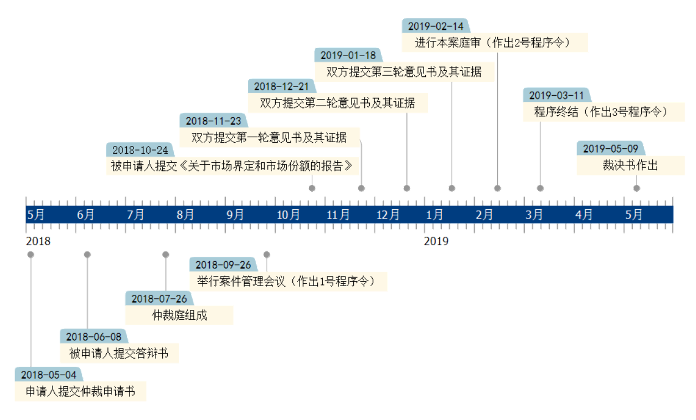
On May 4, 2018, the claimant submitted an arbitration application to the ICC Secretariat, requesting the respondent to pay the outstanding compensation fee, product payment, interest, breach of contract damages, arbitration costs, and expenses. The Secretariat notified the respondent on May 9, 2018. On July 26, 2018, the ICC appointed Mr. Jérôme Barbet as the sole arbitrator for this case based on the recommendation of the French National Committee. The main timeline of the arbitration procedure is illustrated below, with the entire process from the submission of the arbitration application to the issuance of the award taking approximately 12 months:
1. Case Management Conference (CMC)
According to Article 24(1) of the ICC Arbitration Rules (2017 revised version), “The tribunal shall convene a Case Management Conference to consult with the parties on the procedural measures that may be taken under Article 22(2) when drafting the terms of reference.” After its formation, the tribunal organized the parties to hold a Case Management Conference to agree on procedural matters for this case, which is a common practice in international arbitration. Before the conference, the tribunal usually sends a notice to all parties informing them of the matters to be discussed at the meeting. The matters typically discussed in the first procedural meeting include: timelines for key procedural phases of the arbitration (such as the schedule for submitting written statements, whether and when to conduct document disclosure, whether and when to submit expert reports and witness testimonies, etc.), the format and other requirements for submitting written documents, translation of documents, court interpretation, pre-hearing meetings, hearing methods, and arrangements for time and place, etc. If new developments occur during the arbitration process, the tribunal may convene further Case Management Conferences or modify the procedural timetable after consulting with the parties in other ways. The Case Management Conference can typically be conducted via telephone or video conferencing.
According to the first procedural order issued by the tribunal after the Case Management Conference, this arbitration did not set up evidence disclosure and production phases, nor were there arrangements for the exchange of witness testimonies and cross-examination, with the hearing lasting only one day. Moreover, the overall exchange of written submissions presented characteristics of the Memorial Style, meaning both parties submitted their submissions and attachments simultaneously, with three rounds of exchanges. Such procedural arrangements are closely related to the characteristics of this case (i.e., there were few factual disputes and the legal issues were relatively focused). In other words, international arbitration procedures can be “customized” according to the characteristics of the case to advance in an economical and efficient manner.
Notes:
[1] The timeline established by the first procedural order is as follows: by October 24, 2018, the respondent must submit an expert report explaining the relevant market shares of the products; by November 21, 2018, both parties will submit their first round of opinions and evidence, including their respective arbitration claims and counterclaims; by December 21, 2018, both parties will submit their second round of opinions and evidence; by January 18, 2019, both parties will submit their third round of opinions and evidence; and by January 31, 2019, both parties will conduct the hearing at the claimant’s lawyer’s office in Brussels, Belgium.
[2] The exchange of written submissions in international arbitration typically follows either the Memorial Style or Pleading Style. The Memorial Style tends to fully submit evidence and witness testimonies in the early stages of the written exchange, presenting a relatively complete picture of the case early on, with fewer overall exchanges but a larger initial workload; the Pleading Style involves more rounds of exchanges, with witness testimonies generally not provided in the early stages, thus allowing more preparation time for witnesses and experts, but often requiring the tribunal to understand the overall situation of the case more completely after multiple rounds of exchanges.
2. Procedural Orders
Procedural orders are common documents in international arbitration, through which the tribunal manages and determines procedural issues. After holding the first Case Management Conference with the parties, the tribunal issues the first procedural order to determine the procedures and timelines. As the arbitration process progresses, the tribunal may supplement or amend previous procedural orders through second, third, and other subsequent procedural orders after consulting the parties.
The tribunal issued three procedural orders in this case, including:
(1) The first procedural order issued based on the discussions at the Case Management Conference on September 26, 2018, which established the timeline for the respondent to submit the expert report, the submission of three rounds of written opinions and evidence by both parties, and the hearing time and place;
(2) During the hearing on February 14, 2019, the parties discussed the timeline for submitting an opinion on arbitration costs, and the tribunal established the subsequent timeline for submitting opinions on arbitration costs through the second procedural order on that day;
(3) On March 11, 2019, after both parties submitted their opinions and responses according to the case timeline, the tribunal issued the third procedural order, announcing the conclusion of the procedural matters required for the ruling, and no further materials, opinions, or evidence may be submitted by the parties unless specifically requested and authorized by the tribunal.
3. Terms of Reference
The Terms of Reference is a “feature” of the ICC arbitration procedure (see Article 23.1 of the ICC Arbitration Rules (2017 revised version)), aiming to define the scope of the arbitration case. It includes party information, notification addresses, each party’s requests and amounts, a list of issues to be decided, arbitrator information, and applicable special procedural rules (such as amiable composition). The Terms of Reference must be signed by the parties and the tribunal and submitted to the arbitration court; thereafter, unless permitted by the tribunal, the parties may not submit new arbitration requests. Usually, before the first Case Management Conference, the tribunal sends a draft of the Terms of Reference to both parties for them to complete and exchange for discussion at the Case Management Conference. In this case, both parties signed the Terms of Reference at the first Case Management Conference, defining the scope of the arbitration. However, in cases with significant disputes between the parties, the scope of the Terms of Reference may not be determined until a later time.
4. Translation
The language of arbitration in this case is English, and both parties submitted documents in French and Spanish during the arbitration process. Submitting documents in languages other than the arbitration language is common in international arbitration, and whether translation is needed depends on the language backgrounds of the parties and the arbitrator. In this case, the arbitrator is French, and he requested both parties to provide English translations for the Spanish documents but respected the parties’ agreement on whether an English translation was needed for the French documents and did not impose a mandatory requirement for English translations.
3. Arbitration Requests and Counterclaims
In international arbitration, the claimant or respondent sometimes lists subsidiary claims in drafting their arbitration request (or counterclaim), which are based on the same facts and disputes but are mutually exclusive or contradictory to the preceding request. In case the preceding request is not supported, the subsidiary claims can be supported, aiming to resolve disputes in one go and avoid the risk of losing due to the finality of arbitration. In this case, both the claimant and respondent adopted this approach.
1. Claimant’s Arbitration Requests
(1) Request the tribunal to order the respondent to pay all overdue principal amounts of €1,724,080 (product payment of €1,374,080 and compensation fee of €350,000) under the Distribution Agreement, and interest calculated at an annual rate of 8% from the due date of each invoice until fully paid; if the tribunal finds that the Distribution Agreement or Article 10 regarding the compensation fee is invalid, the claimant requests the tribunal to order (a) the respondent to pay the product payment of €1,374,080 and corresponding interest (if the Distribution Agreement is found to be entirely invalid, the statutory interest rate of 8% applies; if Article 10 of the Distribution Agreement is found invalid, the agreed interest rate of 8% applies), and (b) reject the respondent’s request to offset the amounts of compensation fees already paid against the debt owed under the product payment;(2) The respondent compensates the claimant for losses caused by its breach of contract, estimated based on fairness and good faith principles at €15,000;(3) The arbitration costs and the claimant’s legal expenses (attorney fees and costs) for this case.2. Respondent’s Counterclaims
(1) Request the tribunal to dismiss part of the claimant’s arbitration requests: request the tribunal to (a) declare the Distribution Agreement invalid, (b) determine that the compensation fee stipulated in Article 10 of the Distribution Agreement has not matured, and the respondent has no obligation to pay the compensation fee of €350,000 for the year 2018, (c) offset the compensation fees already paid by the respondent against the debt incurred by the respondent under the Distribution Agreement for the purchase of products; if the tribunal does not declare the Distribution Agreement invalid, the respondent requests the tribunal to (a) determine that Article 2.2 of the Distribution Agreement is invalid, (b) determine that Articles 10 and 2.2 of the Distribution Agreement are inherently inseparable, and thus the compensation fee has not matured, and the respondent has no obligation to pay the compensation fee of €350,000 for the year 2018, (c) offset the compensation fees already paid by the respondent against the debt incurred by the respondent under the Distribution Agreement for the purchase of products;
(2) Request the tribunal to dismiss the claimant’s claim for damages provisionally set at €15,000;
(3) Request the tribunal to rule that each party bears (a) its own attorney fees and expenses incurred in the arbitration process, and (b) 50% of the arbitrator’s fees, expenses, and ICC administrative fees.
Compared to domestic arbitration, subsidiary claims are less common in international arbitration, and some tribunals may require the claimant or respondent to clarify their requests or counterclaims due to unclear arbitration requests.
4. Main Controversies and Tribunal’s Findings
The facts of this case are relatively clear, and the respondent does not dispute the amounts claimed by the claimant for the compensation fee and overdue product payment invoices. The main controversies between the parties focus on whether Article 2.2 and Article 10 of the Distribution Agreement are invalid due to a violation of Article 101 of the Treaty on the Functioning of the European Union, and the effect of the validity of the remaining provisions of the contract when specific provisions are found to be invalid.
1. Article 101 of the Treaty on the Functioning of the European Union
The Distribution Agreement is governed by Belgian law. Since Belgium is a member of the European Union, EU regulations also apply to this case. In fact, the main focus of the disputes between the parties is on the restrictions set forth in Article 101 of the Treaty on the Functioning of the European Union and the circumstances under which exemptions may apply.
Article 101(1) of the Treaty prohibits agreements, decisions, or concerted practices that have the object or effect of preventing, restricting, or distorting competition within the internal market. According to Article 101(2), such agreements, decisions, and concerted practices are automatically void. Article 101(3) provides for exemptions, namely agreements, decisions, and concerted practices that contribute to improving the production or distribution of goods or promoting technical or economic progress while allowing consumers a fair share of the resulting benefit.
In addition, the EU Block Exemption Regulation (Commission Regulation (EU) No 330/2010) also provides that specific vertical agreements between enterprises may be exempt from being deemed violations of Article 101(1) of the Treaty (provided that the supplier’s or buyer’s market share does not exceed 30%), as well as circumstances where exemptions do not apply, such as the existence of “hardcore restrictions” (Article 4 of the Block Exemption Regulation) or specific restrictions (Article 5 of the Block Exemption Regulation).
Regarding the burden of proof in the disputes over violations and exemptions, according to Article 2 of Commission Regulation (EC) No 1/2003, the party or authority claiming a violation of Article 81(1) of the Treaty on European Union (which corresponds to Article 101(1) of the Treaty on the Functioning of the European Union) bears the burden of proof, while the party claiming the benefit of an exemption under Article 81(3) of the Treaty (which corresponds to Article 101(3) of the Treaty) bears the burden of proving that the exemption conditions have been met.
2. Controversy Focus 1: Validity of Article 2.2 of the Distribution Agreement
Article 2.2 of the Distribution Agreement stipulates that “the distributor is only allowed to import, sell, and distribute the products of the agreement within the agreed area, and only under the [respondent’s] brand. The distributor has no right to sell or distribute the products in any country outside the agreed area. The distributor commits not to advertise the products outside the agreed area, nor to establish sales offices or branches outside the agreed area, and generally shall not actively solicit orders from customers outside the agreed area (or accept orders).” The respondent claims that the claimant’s market share has exceeded 30%, and that Article 2.2 of the Distribution Agreement constitutes a “hardcore restriction” as defined in the Block Exemption Regulation, thus the agreement does not enjoy the benefits of exemption under the Block Exemption Regulation, and this provision is therefore invalid due to a violation of Article 101(1) of the Treaty on the Functioning of the European Union. The tribunal found that Article 2.2 of the Distribution Agreement was invalid due to a violation of Article 101 of the Treaty for the following main reasons:
Determination of Market Share:Regarding the definition of the relevant market, the respondent proposed to subdivide the intraocular lens market into five subcategories and determine market shares for each. The tribunal, in conjunction with relevant EU guidelines and case law, found that the respondent failed to prove that the five subcategories of the intraocular lens market constituted separate relevant markets, thus not supporting the respondent’s claim. Furthermore, the tribunal explicitly required the respondent to submit an expert report to clarify the claimant’s market share in the first procedural order, but the respondent only provided a report prepared by its lawyer regarding “market definition and market shares.” In the absence of independent verification information, the tribunal determined that the respondent had failed to prove that the claimant’s relevant market share in Region A or the European Economic Area exceeded 30%.
Determination of Hardcore Restriction:The tribunal determined that Article 2.2 of the Distribution Agreement constitutes a “hardcore restriction” on active sales and passive sales as defined in the Block Exemption Regulation, and thus does not enjoy the exemption benefits provided by the Block Exemption Regulation.
Determination of Provision Validity:The tribunal noted that the lack of exemption benefits under the Block Exemption Regulation does not automatically render Article 2.2 of the Distribution Agreement invalid; the validity of this provision must be determined in conjunction with Article 101 of the Treaty on the Functioning of the European Union. The EU Guidelines on Vertical Restraints indicate: “Agreements containing ‘hardcore restrictions’ can be presumed to fall within the prohibitions of Article 101(1) of the Treaty on the Functioning of the European Union.” The tribunal believed that although the Guidelines do not have legal binding force, existing EU competition law and Belgian law do not contain conflicting provisions. Therefore, the tribunal adopted the opinion of the Guidelines, presuming that Article 2.2 of the Distribution Agreement falls within the prohibitions of Article 101(1) of the Treaty. Moreover, the claimant also failed to prove that Article 2.2 of the Distribution Agreement had pro-competitive effects, and thus it does not apply to the exceptions provided in Article 101(3) of the Treaty. Consequently, the tribunal ultimately concluded that Article 2.2 of the Distribution Agreement should be deemed invalid.
Notes:
[3] Given that Article 2.2 of the Distribution Agreement stipulates that the distributor may only sell within the agreed territory and has no right to sell products outside the agreed territory, the tribunal determined that this provision constitutes a “hardcore restriction” on active sales.
[4] According to the Guidelines on Vertical Restraints, passive sales generally refer to sales made in response to individual customers’ unsolicited requests, including delivering goods or services to those customers. The tribunal found that Article 2.2 also constitutes a “hardcore restriction” on passive sales, as it prohibits the distributor from accepting orders from customers outside the agreed region.
3. Controversy Focus 2: Validity of Article 10 of the Distribution Agreement
The respondent claimed that the compensation fee stipulated in Article 10 of the Distribution Agreement has a restrictive effect on competition, and that Company B utilized the compensation fee to initiate a “price war,” resulting in the respondent’s expulsion from the relevant market. The claimant, however, argued that the Distribution Agreement reflects the true intentions of both parties and that the respondent has not provided evidence to show that this provision violates Article 101(1) of the Treaty or that the respondent has suffered any verifiable specific losses. Moreover, competition law does not protect any specific market participant, and the compensation fee stipulation is at most a neutral provision without restrictive effects on competition.
The tribunal held that the respondent bears the burden of proof regarding the restrictive effect of the compensation fee stipulated in Article 10 of the Distribution Agreement, but the respondent failed to meet this burden. The tribunal, in conjunction with further analysis of Article 101(1) of the Treaty, found that Article 10 of the Distribution Agreement does not constitute a monopoly agreement by object (restrictions of competition by object) or by effect (restrictions of competition by effect), and thus does not violate Article 101 of the Treaty.
Notes:
[5] The effect limitation includes actual and potential effects, and determining whether an effect limitation exists requires a comprehensive assessment of its cumulative impact on competition from both economic and legal perspectives. The tribunal found that the respondent failed to provide relevant evidence proving that Company B initiated a “price war,” nor could it demonstrate that Company B raised prices after the respondent ceased selling products. In fact, the compensation fee mechanism may even promote competition for new entrants, thus the compensation fee stipulation does not constitute an effect restriction.
4. Controversy Focus 3: Impact of Specific Provisions’ Invalidity on Remaining Provisions
The respondent argued that the invalidity of Article 2.2 should lead to the overall invalidity of the Distribution Agreement; even if it does not lead to the overall invalidity of the agreement, the inseparability of Article 10 and Article 2.2 means that when Article 2.2 is invalid, Article 10 should also be deemed invalid. The tribunal did not support the respondent’s argument. It considered that (1) the respondent explicitly agreed to the restrictions set forth in the agreement when signing the Distribution Agreement; (2) Article 19.1 of the Distribution Agreement stipulates that the invalidity of any contractual provision does not lead to the invalidity of other provisions or the entire Distribution Agreement; (3) the respondent had no actual plans to expand the market outside Region A, nor did it apply for or actually engage in any passive sales outside Region A, and the claimant’s CEO had previously indicated to the respondent that there were no restrictions on the respondent’s passive sales outside Region A. Considering the above circumstances, the tribunal concluded that Article 2.2 of the Distribution Agreement is severable, and its invalidity does not lead to the overall invalidity of the Distribution Agreement or Article 10.
5. Interest Calculation
The Distribution Agreement clearly stipulates the period of interest calculation and rate for the respondent’s overdue payments:
(1) Article 5.4.2 of the Distribution Agreement stipulates that the respondent’s overdue payments automatically accrue interest at an annual rate of 8% from the due date;
(2) Articles 5.4.1 and 10 of the Distribution Agreement have clearly defined the payment deadlines for product payments and compensation fees. To facilitate the tribunal’s calculations, the claimant tabulated the corresponding interest for each unpaid invoice, while the respondent did not comment on the interest portion of the request.
After calculating the total amount of overdue product payments based on the invoices and bills provided by the claimant, the tribunal found the total overdue amount to be €1,415,167, exceeding the claimant’s arbitration request by €41,087 (the claimant’s arbitration request for product payments was €1,374,080). The tribunal deemed it unfair to require the respondent to bear the interest corresponding to the amount exceeding the claimant’s arbitration request, and thus, exercising the amiable compositeur power granted by Article 19.8.2 of the Distribution Agreement, ruled that the respondent need not pay the interest corresponding to invoice number 18001180 amounting to €41,376, although that invoice amount had come due.
6. Breach of Contract Damages
Regarding the respondent’s breach of contract, the claimant claimed €15,000 in damages. However, the claimant did not specify which provision of Belgian law this request was based on, nor did it provide evidence to prove the specific amount of employee and management expenses incurred due to the respondent’s breach. Therefore, the tribunal did not support this request from the claimant.
5. Amiable Composition
The amiable composition system in international commercial arbitration allows the tribunal to make decisions based not strictly on legal provisions but on principles of fairness, equity, and good faith, effectively granting the arbitrator greater discretion. The amiable composition system respects the parties’ autonomy, but generally requires the parties’ consent to apply. For instance, Article 21.3 of the ICC Arbitration Rules (2017 revised version) states: “The tribunal shall only have this power if the parties agree to authorize the tribunal to act as an amiable compositeur or to make decisions based on fair and reasonable principles.” Article 28(3) of the UNCITRAL Model Law on International Commercial Arbitration states: “The tribunal shall only decide according to the principles of fairness and good faith or as an amiable compositeur if expressly authorized by the parties.”In this case, Article 19.8.2 of the Distribution Agreement stipulates: “The tribunal may act as an amiable compositeur,” and the tribunal also invited both parties to express their opinions on the applicability of this provision during the arbitration process. The tribunal reviewed each of the aforementioned rulings based on the specific circumstances of this case, including the respondent’s clear breach by failing to pay the product payment, the evidentiary status of both parties, and their performance during arbitration, to determine whether the results of applying legal provisions were consistent with the “fairness” principle, while also considering the EU law restrictions on monopolistic behavior. After review, the tribunal concluded that the findings were “fair” [6]. From the tribunal’s perspective, although it has significant discretion as an amiable compositeur, the exercise of that discretion is still based on respecting the contractual stipulations, evidentiary circumstances, and mandatory provisions.Notes:[6] The tribunal found: 1. Regarding the arbitration request for unpaid product payments: the respondent did not raise any objections regarding the payment obligations for the product payments, and the claimant delivered the products without any objections from the respondent regarding quantity or quality, thus the tribunal found the claimant’s request for payment to be fair; 2. Regarding the counterclaim to declare Article 2.2 of the Distribution Agreement invalid: the claimant’s CEO had previously indicated on April 11, 2018, that passive sales by the respondent were not restricted, thus the restriction on passive sales does not apply in this case, and in the absence of proof by the claimant that Article 2.2 of the Distribution Agreement is subject to exempt circumstances, the tribunal found it fair to declare Article 2.2 invalid as an amiable compositeur; 3. Regarding the arbitration request and counterclaim for the compensation fee: given that the respondent failed to prove any actual impact of Article 2.2 of the Distribution Agreement on its business, and the respondent raised no objections to the unpaid product payments, the tribunal found that the respondent failed to fulfill its duty of good faith performance, and the application of relevant legal rules would not lead to an unfair outcome; 4. Regarding the damages claim: although the respondent failed to fulfill its duty of good faith performance, the claimant did not prove the specific amount of employee and management expenses incurred due to the breach, thus the tribunal’s refusal to support the claimant’s claim for €15,000 in damages is fair; 5. Regarding the interest claim: the claimant’s claimed interest corresponding to the principal amount exceeded the arbitration request by €41,087, and the tribunal found it unfair to require the respondent to bear the interest corresponding to the amount exceeding the claimant’s arbitration request.
6. Cost AllocationAccording to Article 38 of the ICC Arbitration Rules (2017 revised version), the tribunal has the authority to determine the costs to be borne by each party and the proportion of those costs. In this case, the tribunal considered the following factors and ultimately ruled that the respondent bears all costs (totaling $100,800):(1) The majority of the claimant’s arbitration requests were supported; (2) The claimant advanced the arbitration process in a swift and economical manner, complying with the procedural timetable set by the tribunal without increasing arbitration costs; (3) The respondent’s failure to pay product payments constituted a clear breach.Additionally, the tribunal considered the following factors and decided that the respondent should bear its attorney fees and should compensate the claimant for approximately 94% of the attorney fees incurred (amounting to €120,000):(1) Had the respondent fulfilled its obligations under the Distribution Agreement, the claimant would not have initiated this arbitration process, nor would any attorney fees have been incurred; (2) Some of the respondent’s counterclaims were supported (specifically, the request to declare Article 2.2 of the Distribution Agreement invalid), thus the claimant should bear a portion of the attorney fees; (3) The majority of the respondent’s counterclaims were not supported, and the respondent only requested that each party bear its own attorney fees without asking the tribunal to rule for the claimant to compensate its attorney fees; (4) The tribunal also considered the nature of both parties’ arbitration requests, the number of written opinions submitted, and the oral arguments during the hearing.Based on the above analysis and reasoning, the tribunal ultimately supported the claimant’s main arbitration requests and dismissed the majority of the respondent’s counterclaims, ruling as follows:(1) Article 2.2 of the Distribution Agreement signed between the respondent and the claimant is invalid; (2) The respondent shall pay the claimant €1,724,080 (compensation fee for 2018 and unpaid product payments); (3) The respondent shall pay the claimant interest calculated at an annual rate of 8% from the due date of each invoice until all amounts are paid (excluding the interest on invoice number 18001180); (4) The respondent shall bear all arbitration costs (including the tribunal’s fees and expenses and ICC’s administrative fees), amounting to $100,800; (5) The respondent shall compensate the claimant €120,000 for attorney fees; (6) Other arbitration requests and counterclaims by the parties are dismissed.
Conclusion
The facts of this case are relatively clear, with few legal disputes, and both parties cooperated with the advancement of the arbitration process, allowing it to proceed in an economical and efficient manner. The entire case took 12 months, with total arbitration costs amounting to approximately $100,000.
This case reflects the basic procedures of ICC arbitration, including common steps in international arbitration such as Case Management Conferences, procedural orders, and Terms of Reference. Additionally, it highlights a particular aspect of the ICC’s appointment of arbitrators, namely, the recommendation of the arbitrator by the national committee; the arbitrator in this case was indeed recommended by the French National Committee. Since the disputed contract was signed in 2016 and the amount in question slightly exceeded $2 million, the expedited procedure provided in the ICC Arbitration Rules (2017 revised version) did not apply [7]. If the expedited procedure had been applicable, the time taken to issue the award could have been shorter, and the costs possibly lower [8]. Furthermore, this case also involves the exercise of the tribunal’s authority as an amiable compositeur, demonstrating that while fairness principles are employed, they are still based on respecting contractual provisions, the parties’ evidentiary circumstances, and mandatory provisions.
Notes:
[7] The ICC Arbitration Rules (2017 revised version) introduced the expedited procedure to simplify arbitration and reduce fees. This procedure automatically applies to cases with amounts in dispute not exceeding $2 million, unless the parties decide not to adopt it; however, this procedure only applies to arbitration agreements reached after March 1, 2017. For arbitration agreements signed on or after January 1, 2021, the ICC Arbitration Rules (2021 revised version) expanded the scope of applicability of the expedited procedure to cases with amounts in dispute not exceeding $3 million, and higher amounts may also opt for the expedited procedure based on agreement.
[8] According to the ICC Arbitration Rules (2021 revised version), the threshold for applying the expedited procedure increased to $3 million.Disclaimer
This article and its content are for communication purposes only and do not represent legal opinions, advice, or decision-making basis issued by Tian Tong Law Firm or its lawyers. If you need legal advice or other professional analysis, please contact the host of this article. Any text, images, audio, video, or other content in this article may not be reproduced without authorization. For reproduction or citation, please contact the public account backend for authorization, and clearly indicate the source, column, and author information when reproducing.
“Cross-Border Legal Insights” is written/hosted by Attorney Gu Jia and alternates with the “Arbitration Circle” column every Friday. We hope to use this column to focus on significant foreign-related legal issues under Chinese law, share practical experience in cross-border dispute resolution, introduce the latest legal developments and dynamics in advanced judicial districts abroad, and build an interactive platform for the legal and business communities in China and abroad. If you have any thoughts, opinions, or suggestions, please feel free to leave a comment at the end of the article.
To submit articles to the “Cross-Border Legal Insights” column, please send an email to:
To view past articles, please click the following links:
-
Applicable Foreign Law and Clarification Rules in Foreign-Related Cases – How to Promote the Clarification of Foreign Law in the Process of Representation in Foreign-Related Cases
-
Case Review: Does the Agreement for “Prior Friendly Negotiation” in the Arbitration Clause Affect the Jurisdiction of the Tribunal?
-
Rules for Handling Special Jurisdiction Objections in Foreign-Related Cases – The “Inconvenient Court” Principle and Parallel Litigation Constituting Repetitive Litigation Claims
-
Rules for Determining Jurisdictional Courts in Foreign-Related Cases – Taking Disputes Related to Companies Whose Domicile Is Not Within China’s Territory as an Example
-
Cross-Border Securities Disputes – Initial Exploration and Outlook on Related Issues
-
Fair Value in Simplified M&A Procedures: A Brief Analysis of Section 238 of the Cayman Islands Companies Act
-
Logical Basis for Legal Review of Foreign-Related Contracts by Corporate Legal Advisors
-
Main Principles of Third-Party Funding in Dispute Resolution
-
A Brief Discussion on the Four Revisions in the Arrangement of Mutual Recognition and Enforcement of Arbitration Awards between the Mainland and Hong Kong Special Administrative Region
-
Completion of the China-EU Investment Agreement Negotiations: Outlook on Investor-State Dispute Resolution Provisions from the Perspective of Appeal Mechanisms
-
Online Hearings in International Arbitration in the Post-Pandemic Era (Part II)
- Online Hearings in International Arbitration in the Post-Pandemic Era (Part I)
- The Supreme People’s Court’s Application of “Soft Law”: Perspectives from Foreign Observers
- Document Disclosure in International Arbitration: What You Need to Know
- Hot Legal Issues and Case Studies between China and the United States (Part V): The Case of the Economic Espionage Act
- Considerations on the Reform of Investment Agreement Arbitration: Why Repair When No Harm Has Occurred?
- The Risks of Cross-Border Enforcement of Judgments under the Asymmetric Jurisdiction Clause between Mainland China and Hong Kong SAR
- The Rise of Prepayment Arrangements in the International Commodity Market
- The COVID-19 Pandemic: “Force Majeure,” “Frustration of Contract Purpose,” and the Principle of “Inability to Perform”
- An Overview of Overseas Investment by Chinese State-Owned Enterprises
- A Journey of Self-Discovery: From “Forest Sports School” to Harvard Law School
- Case Analysis: Reexamining the Governing Law Issues of Arbitration Agreements
-
Research on Legal Issues in Free Trade Zones (Part II): Latest Practices in Clarifying Foreign Law
-
Research on Legal Issues in Free Trade Zones (Part I): Commercial Mediation
-
Hot Legal Issues and Case Studies between China and the United States (Part III): The China Bank Case
-
Hot Legal Issues and Case Studies between China and the United States (Part II): The Huawei Meng Wanzhou Case
-
Hot Legal Issues and Case Studies between China and the United States (Part I): The TikTok Case
-
The Reasons for Disagreements Among Expert Witnesses
-
The Binding Effect of Arbitration Clauses on Non-Signatory Parties – A Brief Discussion on the Boundaries of “Equitable Estoppel”
-
My Experience in the U.S. “Bar Review”
-
Learning from Others: A Brief Discussion on the Diversified Resolution Mechanisms for Financial Disputes in International Arbitration
-
Notices in International Engineering Projects
-
Ideals and Reality: The Path of Revising China’s Arbitration Law
-
Guidelines for Chinese Lawyers in International Arbitration Job Searches
-
Preliminary Exploration of the Standards for Challenging Arbitrators (Part I) – Analysis Based on the Database of Arbitrator Challenges from the London Court of International Arbitration (LCIA)
-
Preliminary Exploration of the Standards for Challenging Arbitrators (Part II) – Analysis Based on the Database of Arbitrator Challenges from the London Court of International Arbitration (LCIA)
-
Is the “Betting Agreement” Imported?
-
The “Butterfly Effect” of Foreign Arbitration Institutions Managing Arbitration Cases in China
-
A Brief Discussion on the Independence of Letters of Guarantee
-
Economic Sanctions and International Arbitration
-
A Brief Discussion on Jurisdiction in Cases of Fraudulent Letters of Guarantee
-
Revealing the Deposition in U.S. Civil Litigation (Part I)
-
Revealing the Deposition in U.S. Civil Litigation (Part II)
-
Revealing the Deposition in U.S. Civil Litigation (Part III)
-
The “Fourfold” of Demand Guarantees in International Business Practice (Part I)
-
The “Fourfold” of Demand Guarantees in International Business Practice (Part II)
-
When “Made in China” Encounters International Commercial Arbitration
-
Vis Moot – A Launchpad for an International Commercial Arbitration Career
-
Hello, I am an Expert Witness in International Arbitration
-
Are U.S. Sanctions Grounds for Exemption from Commercial Contracts?
-
Saying “No” to the Adjudicator – A Brief Discussion on Challenging International Arbitrators
-
Enforcement of Settlement Agreements Reached in Mediation – Discussing the Pros and Cons of the Singapore Convention
-
“Culinary Conversations” in Cross-Border Hearings
-
“Six Keys to Winning International Arbitration” – ICC’s London Arbitration Case (Part II)
-
“Six Keys to Winning International Arbitration” – ICC’s London Arbitration Case (Part I)
-
The Role of Chinese Lawyers in International Arbitration
-
Using U.S. Discovery Procedures to Collect Evidence for Litigation and Arbitration Cases in Other Countries – Section 1782 of the U.S. Federal Code
-
A Brief Discussion on the Appointment Practices of Arbitrators at the Hong Kong International Arbitration Centre
-
Rui Anmu: The Necessity and Prospects of Establishing a China International Commercial Court – Speech at the International Commercial Dispute Resolution Summit Forum under the “Belt and Road” Initiative
-
How to Enter the International Arbitration Circle and Build Networks?
-
How to Effectively Control the Costs of International Commercial Arbitration?
-
Cross-Border Recovery of Non-Performing Assets by Mainland Financial Institutions: The Hong Kong Litigation Perspective
-
Opening Remarks: “There Will Be Times When the Long Wind Breaks the Waves, and the Clouds Will Sail to the Sea”