A prime number is a natural number greater than 1 that has no positive divisors other than 1 and itself. Determining whether a number is prime is a classic case in C language, involving a combination of loops and conditional statements.
Implementation Idea
The basic idea for checking whether a number<span>n</span> is prime:
- A prime number must be greater than 1
- Check divisibility of n from 2 to (the square root of n)
- If there exists a number that divides n, then n is not prime; otherwise, n is prime
Optimization: It is sufficient to check up to<span>√n</span> because if n has a factor greater than<span>√n</span>, it must have a corresponding factor less than<span>√n</span>.
#include <stdio.h>
#include <math.h>  // Using sqrt() function
// Function to check if a number is prime, returns 1 if true, otherwise returns 0
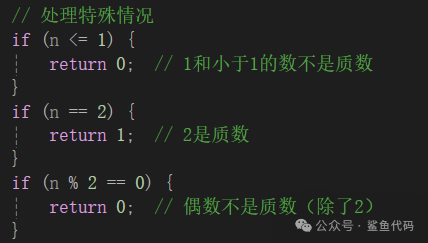
int isPrime(int n) {    // Handle special cases    if (n <= 1) {        return 0;  // Numbers 1 and less are not prime    }    if (n == 2) {        return 1;  // 2 is prime    }    if (n % 2 == 0) {        return 0;  // Even numbers are not prime (except 2)    }
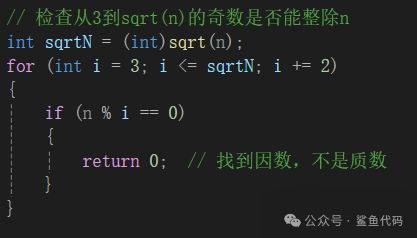
    // Check odd numbers from 3 to sqrt(n) for divisibility
    int sqrtN = (int)sqrt(n);    for (int i = 3; i <= sqrtN; i += 2)     {        if (n % i == 0)         {            return 0;  // Found a divisor, not prime        }    }
    return 1;  // No divisors found, is prime}
int main() {    int num;    while (true)    {        printf("Please enter an integer: ");        scanf_s("%d", &num);
        if (isPrime(num)) {            printf("%d is prime\n", num);        }        else {            printf("%d is not prime\n", num);        }    }    return 0;}
Code Analysis
1. Special Case Handling
- Numbers less than or equal to 1 are not prime
- 2 is the only even prime number
- All other even numbers are not prime (can be excluded directly)
2. Loop Check
- Only need to check up to the square root
<span>n</span>(using the<span>sqrt()</span>function) - Only check odd numbers (since even numbers have been excluded)
- Step size of 2 (
<span>i += 2</span>), improves efficiency
Optimization Explanation
This implementation has two significant optimizations compared to the most basic method:
-
Excluding Even Numbers: All even numbers except 2 are not prime, so they can be excluded directly, reducing the number of checks by half
-
Checking Up to the Square Root: For a number n, if it has a factor greater than √n, it must have a corresponding factor less than √n, so it is sufficient to check up to √n
Conclusion
Through this example, we learned:
- The mathematical definition and logic for determining prime numbers
- How to implement prime number checking using loops and conditional statements
- The basic idea of program optimization (reducing unnecessary calculations)
- Function encapsulation and invocation
This program, while simple, is a great example for learning logical thinking in C language.