Tips: Deepseek explains the differences between Event, Incident, and Accident.Supplementing the previous content, the answer from Deepseek is as follows:By incorporating Logs into the framework of Event/Incident/Accident in cybersecurity SOC operations, a more complete analysis chain can be constructed. Below is a precise interpretation of the relationships among the four concepts, along with an understanding from the SOC perspective:
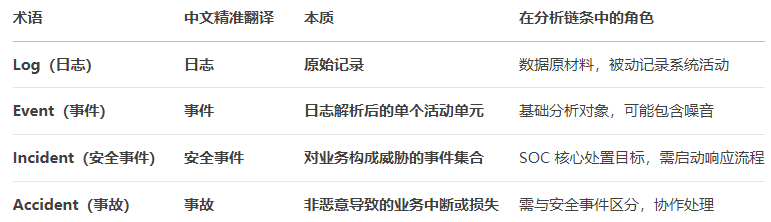
1. Core Concepts: Chinese Interpretation and Positioning
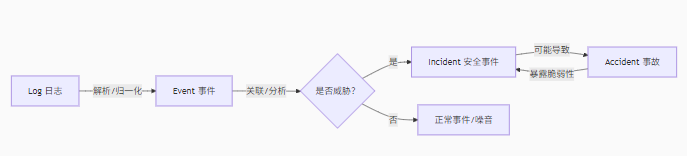
2. Logical Relationships Among the Four in SOC Operations
3. In-Depth Analysis from the Cybersecurity SOC Perspective
(1) Logs: The “Raw Material” for Security Analysis
-
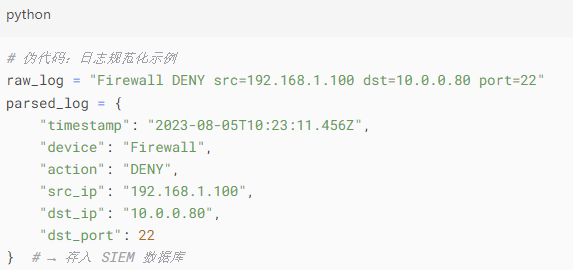
What is it? Raw records generated by systems, devices, and applications (e.g., system logs, network traffic, audit records). Example:

SOC Perspective:
-
Data Source: Logs collected by SIEM/SOAR systems are normalized (Parsing & Normalization).
-
Challenges:
-
Massive volume (TB level daily), heterogeneous formats (Syslog/JSON/CSV), containing a lot of useless information.
-
Need to establish a Log Governance Strategy (retention period, sensitive field anonymization).
-
Key Actions:
(2) Event: The “Semantic” Result of Logs
-
What is it? An activity unit with business significance formed by parsing a single log (e.g., “User login failed”, “Firewall denied connection”).
-
SOC Perspective:
-
Events are the smallest unit of SIEM correlation analysis (e.g., correlating 10 “login failed” events from the same IP within 5 minutes).
-
Analysis Basis:
-
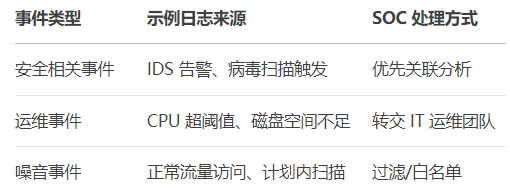
Classification Examples:
(3) Incident: Threats Requiring Response
-
What is it? A scenario composed of multiple correlated events that poses an actual or potential threat to CIA (Confidentiality/Integrity/Availability).
-
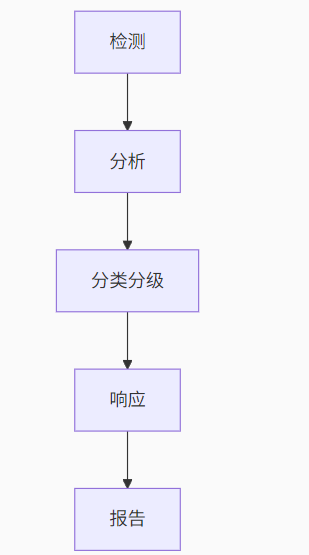
SOC Key Processes:
-
Automation: Blocking IP and isolating hosts through SOAR.
-
Manual: Investigating attack paths and preserving evidence.
-
Rule Example:
<span>Same IP triggers >50 "WAF SQLi block events" within 2 minutes → generates SQL injection security incident.</span> -
Detection Phase:
-
Response Actions:
(4) Accident: Non-Malicious Business Interruptions
-
What is it? Business losses caused by non-malicious reasons such as human error or equipment failure (e.g., accidentally deleting a database, power outage in the data center).
-
SOC Collaboration Points:
-
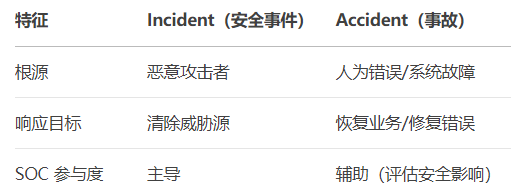
Distinguishing Intent:
-
Operations personnel mistakenly opened a firewall port (Accident) → exploited by hackers (transformed into an Incident).
-
Server hardware failure leading to data loss (Accident) → triggers a “data availability security incident” (Incident).
-
Typical Scenarios:
4. Collaborative SOC Practical Scenarios Among the Four
Case Study: Ransomware Incident Chain
-
Log Layer: Firewall records
<span>Outbound connection to 45.76.XXX.XXX on port 443</span>. -
Event Layer:
-
SIEM generates event:
<span>[Suspicious Outbound] IP=10.0.0.12, Port=443</span>. -
EDR generates event:
<span>[File Encryption] Process=malware.exe, Files=200+</span>. -
Incident Layer:
-
The correlation engine binds the two → creates a ransomware security incident (Severity: Critical).
-
SOAR automatically isolates the host and blocks the C2 server IP.
-
Accident Layer:
-
Business system crashes due to file encryption (business accident).
-
Root cause analysis: Operations did not patch the Apache vulnerability (operations accident).
5. Summary: Key Insights for SOC Operations
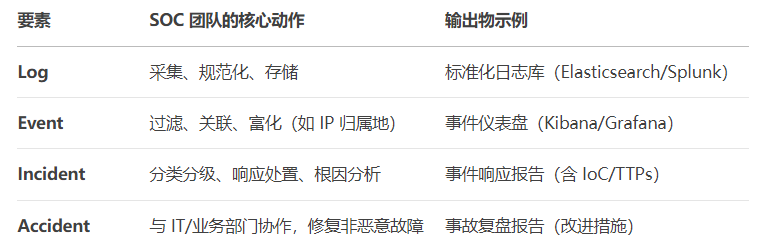
 Golden Rule: Log → Event → Incident is the “Detection Pipeline” of SOC, aiming to reduce MTTD (Mean Time to Detect) and MTTR (Mean Time to Respond); Accident is the “Intersection of Security and Business”, which needs to break the vicious cycle of Accident → Vulnerability → Security Incident through Root Cause Analysis (RCA).For more details on Kaspersky SOC operation solutions, please contact:Lu Wenjie – 156 6269 0813Gao Jin – 186 6376 106