(By Suraj Gajendra, Vice President of Products and Solutions, Arm Automotive Division) In the automotive industry, vehicles are becoming increasingly intelligent and interconnected, defined by artificial intelligence (AI). Features that were once only deployed in high-end models, such as real-time driver monitoring, predictive maintenance, and adaptive in-vehicle infotainment (IVI) systems, are now rapidly becoming standard equipment in new models. At the same time, automotive development is becoming more complex, with tighter schedules and evolving safety standards, leading to higher demands for scalable computing capabilities.
Automakers and chip suppliers need a modular, safety-capable, software-ready computing platform that combines high performance with energy efficiency, while also reducing integration risks and shortening development times for various vehicle models.
Almost all automakers worldwide benefit from Arm’s foundational technology. In light of this advantage, Arm has launched a computing platform specifically designed for the next generation of vehicles (i.e., AI-defined vehicles) — the Arm Zena Compute Subsystem (CSS).
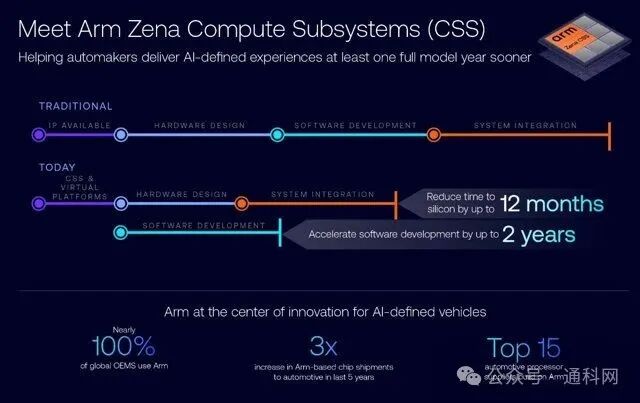
The newly integrated CSS will shorten chip development cycles.
The first generation of Zena CSS is a standardized, pre-integrated, and pre-validated computing platform based on the latest market-validated Armv9 Automotive Enhanced (AE) technology. This computing platform combines low power consumption, high performance, and validated IP, along with dedicated safety islands and runtime safety engines, plus reference firmware and software support, forming a complete CSS for chip realization. This comprehensive solution allows automakers to act faster from concept to mass production, reducing costs and risks while creating a more differentiated and intelligent driving experience.
The typical automotive development cycle lasts three to five years, but Zena CSS can significantly shorten the delivery process for automotive hardware and software. As the automotive industry moves towards AI-defined vehicles, intelligence will be distributed across different areas, and features and workloads can be executed at the edge through over-the-air (OTA) updates. Zena CSS provides a unified computing foundation with scalability and security capabilities, empowering automakers to maintain their pace of innovation and achieve large-scale implementation of innovations.
The various subsystems of Zena CSS include the following components and features:
• High-performance computing with a 16-core Arm Cortex-A720AE CPU cluster;
• CPU consistency and inter-chip I/O connectivity provided by CMN S3AE;
• A safety island using Arm Cortex-R82AE for real-time processing;
• A runtime safety engine for secure OTA updates;
• System-level security and root of trust enabled by Arm TrustZone;
• Verified RTL designs and reference firmware;
• Optional integration of graphics processing units (GPUs) and image signal processing (ISP) driven by Arm Mali GPU and Mali-C720AE;
• Easy integration of accelerators and partner-specific logic components to meet the increasingly diverse workload demands of advanced AI system-on-chip (SoC) designs.
Compared to starting chip design from IP, Zena CSS pre-integrates hardware and firmware components, potentially shortening the chip development cycle by up to 12 months. Zena CSS can also extend applications to IVI, central computing, and L2+ advanced driver assistance systems (ADAS), allowing automakers to flexibly deploy across various vehicle series and performance levels without redesigning the computing stack or starting safety certification from scratch. Furthermore, the Arm computing architecture, prevalent throughout the automotive ecosystem, enables automakers to reuse and port many components of their software, including firmware, middleware, operating systems, and applications, across Zena CSS-based SoCs from different vendors.
Reducing Development Costs and Complexity for Automakers
Zena CSS helps reduce both upfront and ongoing engineering burdens. This is especially important for the time-sensitive and feature-rich automotive industry. Zena CSS offers the following benefits to help lower costs and complexity during the development process:
• Compared to traditional IP-based chip design, Zena CSS can reduce chip engineering workload by up to 20%, allowing teams to focus on developing differentiated features for AI-defined vehicle workloads;
• Through software standardization, it can reduce cross-platform porting workload by up to 30%, saving software development time and costs.
These benefits can lower the overall development costs of vehicle platforms, while the consistent Arm architecture provides scalability across ADAS, central computing, and IVI use cases, applicable to both single-chip and chiplet designs.
Widely Trusted in the Industry, Built for Functional Safety
The latest Arm AE technology with built-in safety features has been widely deployed in the automotive market. On this basis, Zena CSS integrates dedicated safety hardware such as safety islands and runtime safety engines within its subsystems. These safety-capable, pre-validated hardware components are architecturally connected to the main computing core cluster of Zena CSS, enabling secure boot and supporting features such as fault detection and management, while also helping to reduce costs and shorten certification processes.
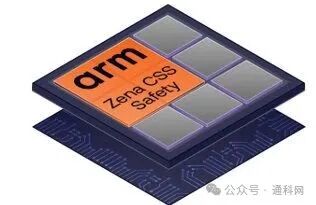
By integrating a safety island specifically driven by Cortex-R82AE, Zena CSS can be widely deployed in safety-critical use cases, including ADAS and domain controllers. At the same time, the software ecosystem can innovate and differentiate on this mature and secure foundation, while also supporting software reuse and porting to accelerate deployment processes.
Accelerating Development and Completion through Arm Technology-Based Virtual Platforms
Following the launch of an IP-focused virtual platform last year, Arm partners such as Cadence, Siemens, and Synopsys have introduced a virtual platform supporting the Zena CSS compute subsystem level. The new virtual platform has been proven to enable smoother integration and accelerate time-to-market, especially in safety-critical areas. This allows engineering teams to perform hardware-software co-design and validation early without waiting for physical chips, potentially shortening development cycles by up to two years. For AI-defined vehicles, developers can validate AI workloads and edge-side inference behavior in a real simulation environment through the virtual platform.
By combining RTL simulation with virtual platforms, automakers can build confidence in the Zena CSS computing architecture before the chip is ready, effectively reducing risks and costs. Meanwhile, the Armv9 architecture’s instruction set architecture (ISA) is consistent from cloud to edge, allowing for software testing in the cloud before actual deployment in vehicles, thereby accelerating the development and validation of chip and software solutions.
Comprehensively Integrated Standardized Firmware and SOAFEE Blueprint
The design intent of Zena CSS is to support open and scalable software development to meet modern and future automotive applications. Arm is opening the Zena CSS reference firmware to the entire ecosystem, and every component, including safety features, has been pre-validated and fully integrated.
Zena CSS is closely aligned with SOAFEE (Scalable Open Architecture for Embedded Edge), which has developed multiple blueprint projects applicable to real automotive scenarios, including the Autoware Open AD Kit blueprint project promoting autonomous driving features, the latest blueprint project designed by DENSO for mixed critical safety requirements, and the blueprint project designed by Panasonic Automotive Systems for developing and deploying digital cockpit and IVI solutions.
Thanks to Arm SystemReady (Arm’s certification and compliance program) and other industry-standard APIs, these SOAFEE blueprint projects can run seamlessly on top of Zena CSS, providing automakers with true flexibility in software decisions. In fact, the new automotive extension of Arm SystemReady will be fully open to the ecosystem by the end of 2025, ensuring that operating systems and software stacks for automotive applications can run seamlessly on different hardware.
By providing standardized firmware and software based on Zena CSS, Arm can offer a full-stack solution that enables the software ecosystem to build and create differentiated applications in the automotive market while supporting software reuse and porting to accelerate cross-platform application and feature deployment. Through this pre-built ecosystem for Zena CSS, Arm is committed to helping all automotive partners achieve their goals more easily and reduce risks, with SOAFEE playing a key role in this ecosystem.
Designed for the Future of AI-Defined Vehicles
The transition towards AI-defined vehicles is underway. From real-time sensor fusion to natural language processing in the cabin, AI has become a core capability across various domains in automotive. However, new challenges accompany the development of these intelligent features, including heterogeneous computing demands, real-time inference at the edge, and ongoing large-scale updates driven by AI and software.
Vehicles are no longer defined solely by hardware but are shaped by intelligent systems that can learn, adapt, and improve over time. Zena CSS is born for this transformation, capable of achieving scalable performance, commercial differentiation, simplified integration, and supporting software portability to meet the arrival of the AI-defined vehicle era. With a rich partner ecosystem, virtual platform, and open standards support, Zena CSS provides the foundation for accelerating industry development and scaling the delivery of smarter vehicles.
The future of vehicles is defined by AI, and Arm is the cornerstone of automotive computing platforms.