Hey, have you ever stumbled while reading ancient poetry? For instance, when you encounter the character “仄”, it feels like a mischievous little devil, its pronunciation is elusive. Many people instinctively pronounce it as “zé” like “泽”, or “cè” like “侧”, but don’t! It is actually pronounced “zè”, short and forceful, like the slight incline of a mountain path. Today, let’s talk about this character, and I guarantee you’ll want to read more poetry, appreciating the wisdom of the ancients.
1. Pronunciation and Homophones
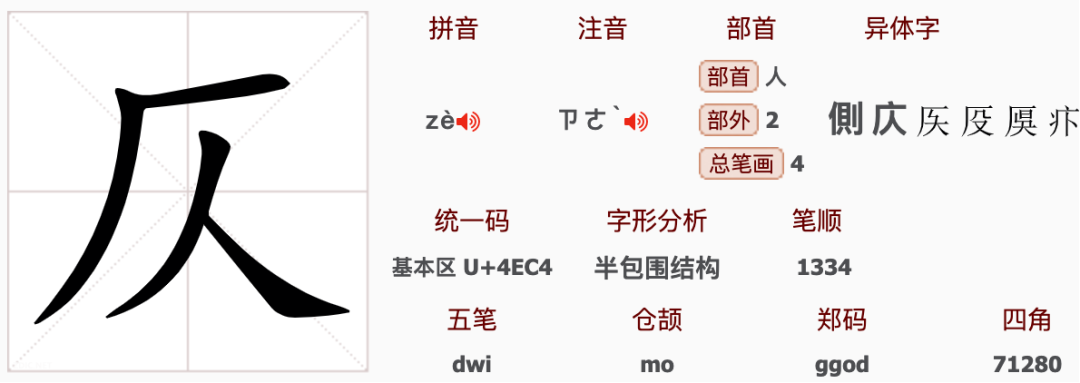
Pronunciation:zè
Homophones:– 昃 (zè): Refers to the sun leaning westward, as in “日昃” or “昃食”. It gives a sense of time passing, as if the afternoon sun is casting long shadows. – 昗 (zè): Rare, but also pronounced this way, often related to slanting.
Traditional Character:仄
Character Formation:Ideogram; composed of “人” (person) under “厂” (factory)
This pronunciation carries a compact rhythm, like footsteps moving along a narrow path. When the ancients created this character, they likely aimed to capture that moment of instability.
2. Structural Analysis
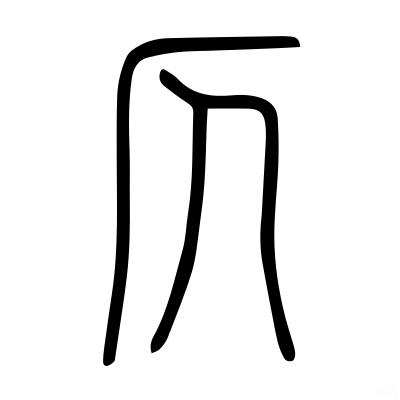
The character “仄” is composed of “厂” and “人”, belonging to ideograms. The top “厂” resembles a cliff or slope, while the “人” below suggests a person precariously standing in a narrow or slanted place. Overall, it gives a sense of instability, cleverly expressing the meanings of “uneven” and “slanting”. When the ancients designed this character, they must have observed mountain paths or the angles of eaves, combining them vividly so that one can easily understand the sense of confinement.
3. Detailed Explanation
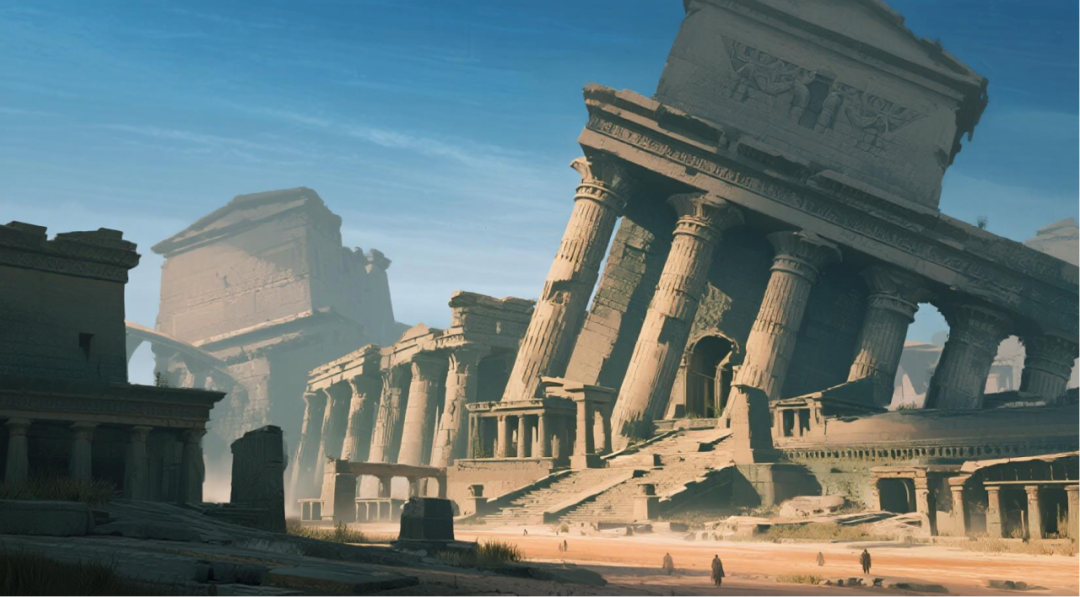
Primary Meaning:Slanting, uneven
In ancient times, the core meaning of “仄” was that things were slanted or uneven, like a hillside or narrow alley. The “Shuowen Jiezi” states: “仄, side and oblique.” Here, “仄” describes a path that is slanted, not wide and direct. When the ancients walked, they had to be cautious when encountering a slanted path, often passing sideways. It is not only a physical tilt but also carries a hint of life’s little helplessness.
For example, in the “Book of Songs, Greater Odes, Han Yi”, there is a phrase “仄陋之室”, depicting a simple and slanted house, exuding a sense of poverty yet resilience. When the ancients used “仄”, they often associated it with everyday scenes: muddy paths after rain are slippery, and one can easily slip; or narrow alleys where neighbors brush past each other, exchanging glances. Thus, the core meaning is “slanting”, capturing the imbalance of all things in the world, simple yet relatable.
4. Misuse and Confusion
“仄” and “侧” are phonetically similar and often confused. In ancient texts, some people mistakenly wrote “仄径” as “侧径”, but “仄” emphasizes the dynamic of slanting more. Some versions of Song Dynasty poetry mixed them up, but later corrections clarified this, reminding us to pay attention to the original meaning of words when reading poetry.
5. Ancient Records and Interpretations
“Book of Songs, Lesser Odes, Picking Vetch”:“In the past, I went, the willows swayed. Now I think, rain and snow fall. Walking the path slowly, thirst and hunger accompany me. My heart is sorrowful, no one knows my grief.” (Note: Although “仄” is not directly used, the slanting tone runs through, enhancing the rhythm)
Interpretation and Understanding:The use of the slanting tone here gives the verses a rhythmic rise and fall, reflecting the soldier’s sorrow. Under the Spring and Autumn style, it contains a silent accusation against war, resonating with readers.
“Erya, Explanation of Terms”:“仄, side also.”
Interpretation and Understanding:Guo Pu observes “仄” as slanting, emphasizing an incorrect state. This reflects the ancients’ delicate grasp of word meanings, teaching people to observe the small inclinations in life.
“Wenxin Diaolong”:Discusses the balance of tones, emphasizing the role of the slanting tone in literature.
Interpretation and Understanding:Liu Xie views “仄” as a modulation of literary style, teaching how to use words to create rhythm, reflecting the wisdom of ancient literary theory.