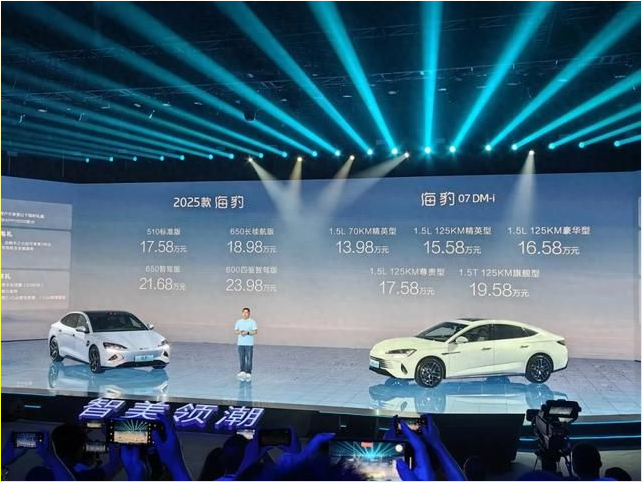
Instead of following a gimmicky route, the focus is on data validation. In mid-August, the Ministry of Industry and Information Technology released a new vehicle declaration information, with the model code EF3, measuring 5048mm in length and a wheelbase of 3011mm, officially classified as a C-class sedan. The most notable feature is the set of “four motors with a total power of 810kW, equivalent to 1102 horsepower”, and the starting price of 219,800 Yuan quickly ignited public opinion. Many people directly exclaimed, “BYD is bringing million-level performance into the 200,000 Yuan range,” but based on current market performance, this possibility seems unlikely.
For example, in June of this year, the price of the Yangwang U9 was 1.688 million Yuan, with sales of only 27 units, which is lower than the sales of the Seal 07 DM-i model. The e⁴ four-motor system and Yunliang-X suspension together account for nearly 60% of the total vehicle cost. If the same level of hardware is directly applied to the EF3, the single system cost would exceed 80,000 Yuan, leaving no profit margin at the 219,800 Yuan price point. Therefore, I prefer to view it as an early validation vehicle, with the price being merely a registration figure and not the final market guidance price.
Seeing 1102 horsepower indicates that this powertrain likely continues to use Yangwang’s integrated silicon carbide electric drive and domain control platform. The issue is that the peak power of a single motor in Yangwang is 220kW, and the four-motor combination provides a 0-100 km/h acceleration time of 2.36 seconds. If the EF3 only focuses on “horsepower stacking” without implementing the 800V silicon-carbon system and 1152A drive module, the 0-100 km/h acceleration will likely fall within the 3-second range, still lagging behind the BMW i5 M60. The performance must be sufficiently “ferocious,” and the final 0-100 km/h test results will tell the tale.
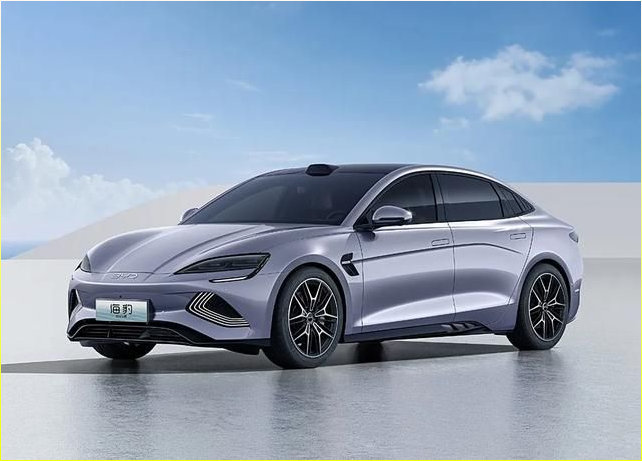
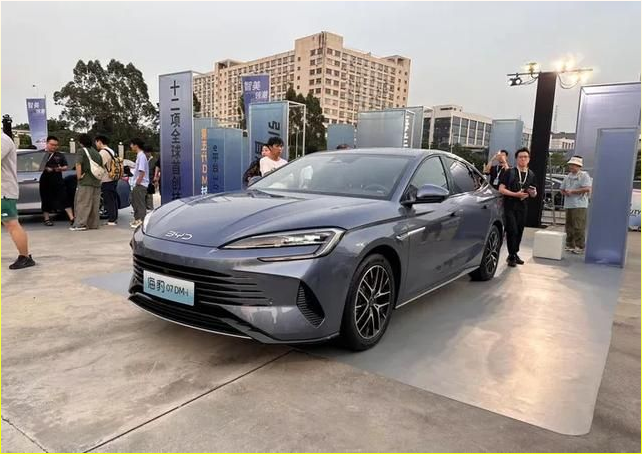
The new car features a double wishbone + rear five-link independent suspension, which is a traditional high-performance direction. Notably, the declaration images show that the shock absorbers have reserved positions for electronic control valves, with the Yunliang-C production rate exceeding 70%. If this combination of double wishbone + Yunliang-C + lidar is finalized, it would indeed be rare within the 250,000 Yuan price range. The price can already compete with the high-end intelligent driving version of the Xiaomi SU7.
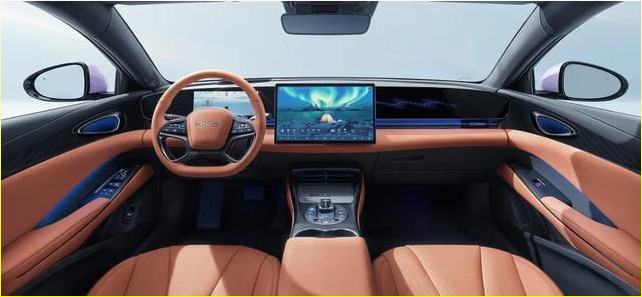
In terms of configuration, according to publicly available information, the EF3 will be equipped with 31 sensors across the entire range, including one 128-line lidar, three millimeter-wave radars, six surround-view cameras, and twelve ultrasonic radars, with computing power provided by the Orin X at 254 TOPS. Some believe that as long as Huawei can open up ADS 3.0 authorization, the Han and Tang models will have “no business with the M7.” If the EF3 can indeed integrate Huawei’s or self-developed urban navigation functions, it would directly impact competitors like the Galaxy E8 and Lynk & Co Z10 in the same price range.
Battery specifications are also noteworthy. The documents indicate a battery capacity of 86.4kWh, with a CTLC range of 625km and an energy density of 186Wh/kg. If it still uses the lithium iron phosphate blade battery scheme, the single-pack cost is about 0.55 Yuan/Wh, totaling 47,000 Yuan. In contrast, the Xiaomi SU7 Max uses a CATL ternary large battery with a capacity of 101kWh, which costs 20,000 Yuan more but is priced at 299,900 Yuan. For the EF3 to maintain a foothold at 219,800 Yuan, it will inevitably need to “cut back” on configurations outside of the three electric systems. From personal experience, BYD has already given it their all, and one could say they have completely gone for broke!
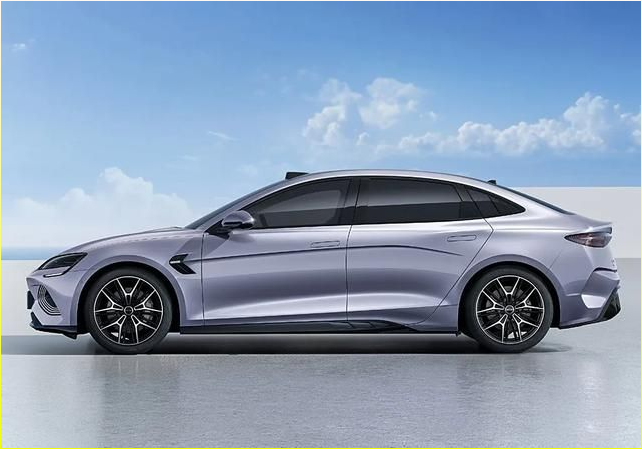
A netizen commented, “If the Han and Tang had Huawei’s intelligent driving, they would be invincible,” which received 30 likes. I understand this expectation. However, beyond just stacking intelligent driving features, consumers are also concerned about charging efficiency. The entry-level version supports peak fast charging of 350kW, allowing for a 450km charge in 15 minutes; while the high-end 800V version increases charging power to 420kW, enabling a 500km charge in just 10 minutes. It must be noted that the penetration rate of 800V charging stations nationwide is currently only 6.3%, so fully leveraging this advantage will depend on the subsequent development of the charging network.
Regarding range, some netizens complained, “A tank of fuel for two thousand kilometers is unnecessary.” I agree. If the EF3 insists on a pure electric high-performance route, a range of 625km already covers 90% of commuting scenarios. The real issue troubling users is the old problem of a 15%-20% drop in battery performance during winter. BYD has chosen to focus on the heat pump system and battery preheating rather than blindly pursuing “1000+ km range,” which is commendable.
Speaking of price, a comment that received 8 likes, “If BYD makes its own batteries, why are electric car prices still high?” is quite typical. BYD’s blade battery material self-supply rate is close to 80%, but most of the four motors and lidar systems still need to be sourced externally, so cost reduction cannot simply be solved by saying “self-produced.” If the final market price falls within the 260,000-280,000 Yuan range, I believe it aligns better with supply chain logic.
The market landscape must also be considered. With sales of 82,000 units in half a year, the BYD Han remains at the top of the mid-to-large new energy vehicle segment, while the Seal family collectively sells 32,000 units per month. If the EF3 truly debuts with 1102 horsepower and a price tag of 260,000 Yuan, it would directly cannibalize the performance version of the Han EV and the AWD version of the Seal, necessitating precise differentiation in positioning by the brand. Therefore, it is not ruled out that they may “first test the waters with a low-spec two-wheel-drive model, and later launch a four-motor flagship.”
In summary, the greatest practical significance of the EF3 lies in bringing the Yunliang-C, 31 sensors, and double wishbone structure down to the 250,000 Yuan price point. Even if the power is reduced to 650 horsepower, the product strength remains robust. Whether it can truly list 1102 horsepower on the Ministry of Industry and Information Technology’s energy consumption label will depend on the upcoming launch conference. What are your thoughts on this powerful BYD model?