With the development of smart cockpits, voice has become an important entry point for in-car interaction. Traditional microphones arranged in the ceiling or center console perform adequately in static environments, but in scenarios such as high-speed driving, open windows, or convertibles, wind noise, road noise, and in-car voices can reduce recognition rates. This long-standing issue has prompted the industry to continuously seek alternative or supplementary technological paths.
The American company Harman International Industries recently announced a patent titled “Embedded Voice Sensor in Seats” (US12233752B2), which provides a solution different from traditional air sound pickup paths.
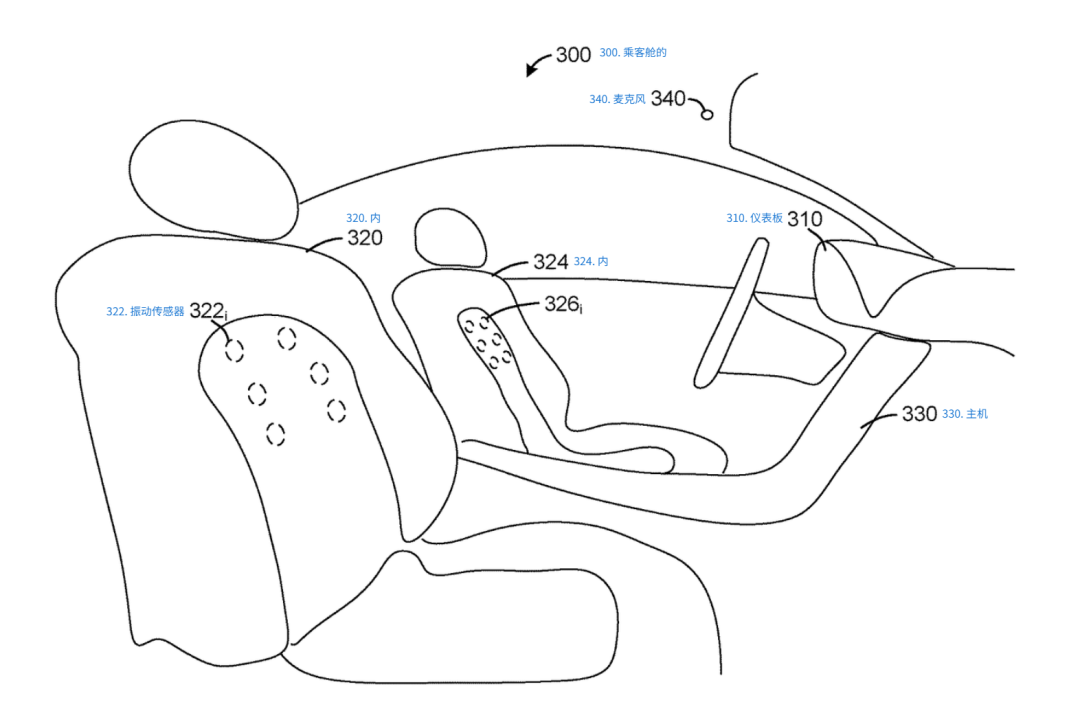
The core idea of this patent is to embed vibration sensors within the foam layer of the seat back, allowing the sensors to maintain close contact with the occupant’s back, thereby capturing the vibration signals transmitted through bones and soft tissues during voice production. Unlike sound waves transmitted through air, bone-conducted signals have higher noise resistance, with their main frequency components concentrated below 2 kHz.
The patent proposes that the vibration sensors can take the form of piezoelectric elements (such as PZT ceramics, PVDF films), MEMS accelerometers, or strain gauges. These sensors are fixed within the seat foam through a cavity embedding method, and the shape and size of the cavity can be ergonomically designed to be circular, elliptical, or rectangular, with diameters ranging from5 – 50mm, to accommodate occupants of different body types and postures. Some designs even allow the sensor surface to slightly protrude from the seat to enhance contact quality.
 |
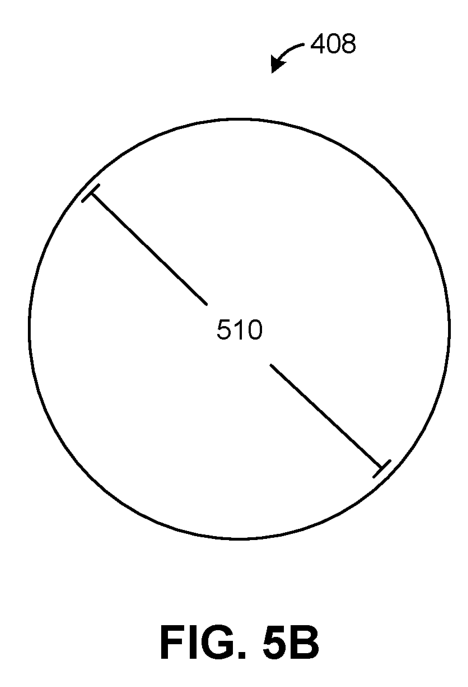 |
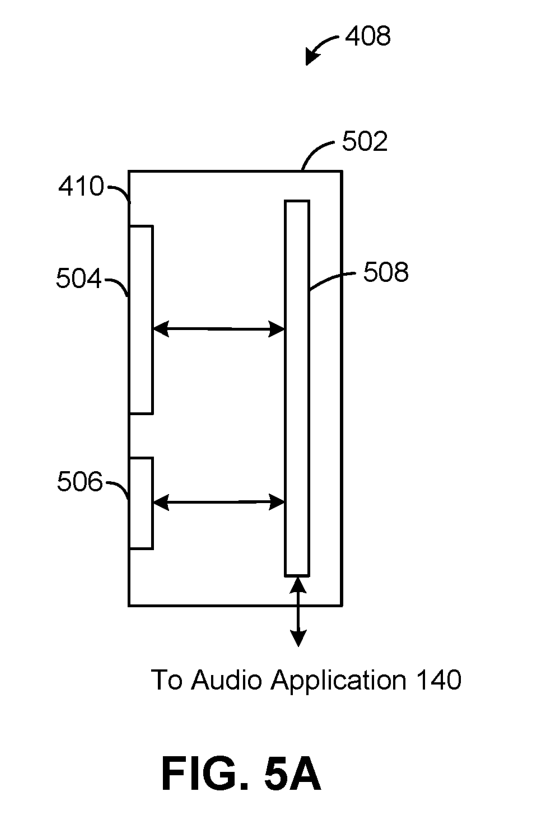
| Figure 5A shows the internal structure of the vibration sensor 408, including the housing 502, transducer element 504, contact switch 506, and printed circuit board assembly 508. | Figure 5B displays the sensor’s outer surface as circular, with a diameter 510 ranging from 5 – 50mm. It provides a detailed view of the sensor’s internal structure and external shape. |
After signal acquisition, the system enters a multi-stage processing phase. The first step isfiltering: using a high-pass filter to eliminate vehicle vibration signals below 200–300 Hz, while employing a low-pass filter to remove invalid components above 4 kHz, thus retaining the main frequency band of the voice.
Next issignal enhancement and reconstruction: due to the natural lack of high-frequency details in bone-conducted signals, the patent proposes combining voice reconstruction algorithms or machine learning-based predictive models to compensate for the signals, restoring a more natural voice quality. Additionally, the system can be equipped with amplification circuits and dedicated signal processing units (PCBA) to ensure that the acquired signals remain stable before transmission to the vehicle’s main unit.
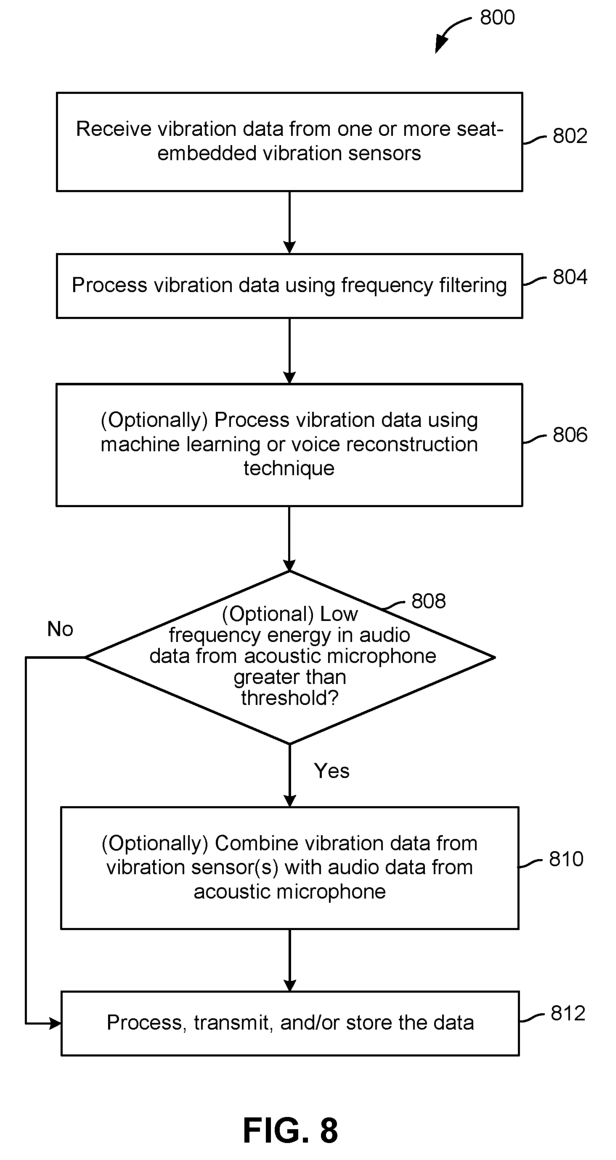
Figure 8 illustrates the flowchart for processing vibration sensor signals, including steps for receiving vibration data, frequency filtering, optional machine learning or voice reconstruction processing, assessing the relationship between low-frequency energy of acoustic microphone sound data and a threshold, optional data fusion, and finally processing, transmitting, or storing the data.
The patent also emphasizesmulti-source fusion mechanisms. Vehicles typically still have air sound microphones, such as those located in the ceiling or center console. When external noise is low, the system can combine air sound signals with seat sensor signals to achieve higher fidelity voice; however, when it detects that the low-frequency energy of the air sound signal is too strong (indicating severe wind noise), the system prioritizes using bone-conducted signals. Through this dynamic switching or weighted fusion, the solution can balance voice clarity and naturalness in different environments.
This patent systematizes the existing bone conduction pickup method for in-car applications. Its features include: first, the hardware design emphasizes “non-intrusiveness,” allowing occupants to use it without additional devices; second, it proposes a complete process for acquisition, filtering, reconstruction, and fusion, making it adaptable to complex in-car scenarios.
Compared to existing solutions, this patent offers a differentiated design path. A single air sound microphone’s performance is limited in high noise scenarios; microphone arrays and beamforming methods have been applied in some high-end models to enhance the directionality of target voices, but still fall short under high wind noise conditions; throat microphones or bone conduction headsets perform excellently in military and sports environments but require wearing devices, lacking comfort. The embedded seat solution avoids the inconvenience of wearing while possessing strong noise resistance.
However, its limitations are also quite evident: bone-conducted signal bandwidth is limited, leading to reduced voice naturalness; different users’ body types, postures, and clothing thickness may affect the sensor’s contact effectiveness, resulting in unstable signals; additionally, embedding sensors in seats must consider the balance between comfort and manufacturing costs.
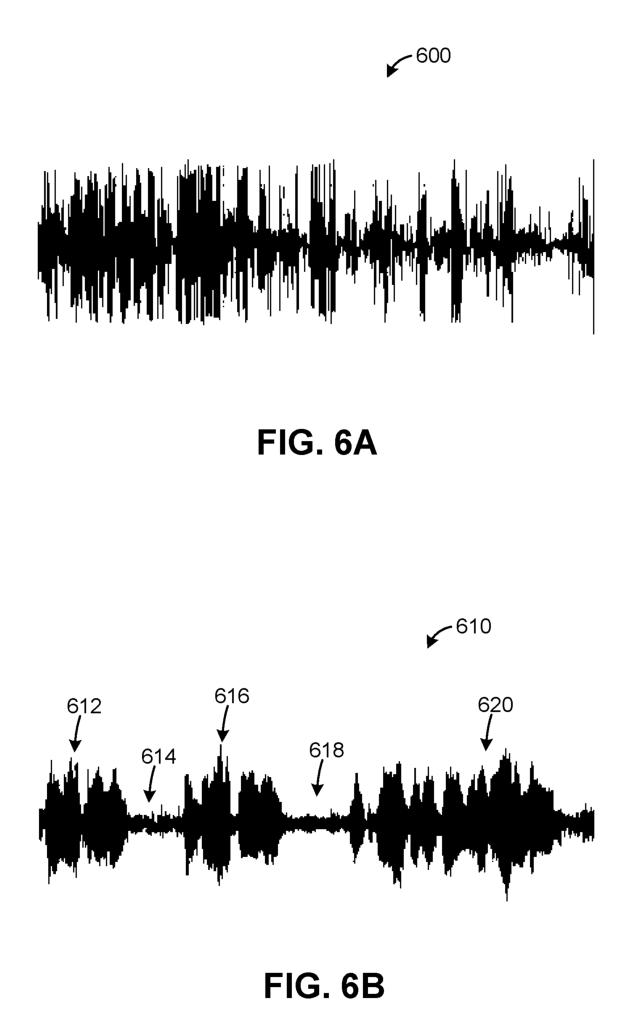
Figure 6A shows the waveform 600 of sound data collected by an acoustic microphone under specific vehicle driving conditions, where voice and wind noise are mixed, resulting in a poor signal-to-noise ratio; Figure 6B shows the waveform 610 of vibration data collected by a uniaxial accelerometer within the seat, containing regions related to both voice and only wind noise, with a better signal-to-noise ratio but fewer frequency components than the sound data.
Both the industry and academia are advancing other solutions. For example, deep learning-based voice enhancement methods have demonstrated high voice recovery quality under low signal-to-noise ratio conditions, representing the current mainstream direction in the automotive and consumer electronics fields.
Multimodal fusion technology is also gradually emerging, combining air sound, lip movement recognition, and millimeter-wave radar chest vibration signals to enhance robustness and accuracy. Additionally, research on embedded sensors in headrests or seat belts is also underway, as these positions are closer to the sound source, providing higher signal stability, but still face challenges in comfort and cost control.
In summary, the embedded voice sensor solution proposed by this patent provides a new path for in-car voice acquisition. Its innovation lies in embedding bone conduction pickup in seats, achieving “non-intrusive” signal acquisition, and enhancing the robustness of voice signals through filtering, reconstruction, and fusion mechanisms.
Despite limitations in bandwidth, adaptability differences, and comfort issues, this solution can still serve as an important complement to existing in-car voice systems. Combined with cutting-edge technologies such as deep learning voice enhancement and multimodal fusion, its application potential still holds significant room for development in the future.


About Us
21dB Acoustics is a technology media under the Suzhou Electroacoustic Industrialization Base of the Chinese Academy of Sciences, focusing on new acoustic technologies, audio testing and analysis, acoustic market research, acoustic entrepreneurship incubation, intellectual property services, etc.
Cooperation Promotion
Article submission | Entrepreneurship support | Intellectual property services | Technology transferFor inquiries, please send your requirements to the following email, and we will assign a dedicated person to contact you[email protected]
Copyright Statement
All images and text in this article are copyrighted by 21dB Acoustics
If you need to reprint or collaborate with the media, please contact us