Click the blue text above to follow our public account, where we share a LabVIEW case every day.
-
LabVIEW can call MATLAB, leveraging the former’s advantages in visual process and hardware interaction, combined with the latter’s strong numerical computation and algorithm capabilities. This allows for the reuse of mature algorithms to speed up development while also enabling flexible code modifications. However, it requires matching versions and installation of the runtime environment, and there is performance loss in data transfer, with debugging errors requiring cross-software troubleshooting.
Advantages
-
High Efficiency Collaboration: LabVIEW is responsible for visual process building and hardware interaction, while MATLAB specializes in numerical computation and algorithm implementation. The combination makes the development of tasks like fractals, which require complex calculations and process presentation, much more convenient.
-
Accelerated Development: Directly reuse mature MATLAB algorithms (such as matrix operations and fractal formulas) without having to rewrite mathematical logic in LabVIEW, saving development time.
-
Flexible Adaptation: Through script nodes, MATLAB code can be quickly embedded and modified, facilitating frequent adjustments of algorithm parameters and iterations in research scenarios.
Disadvantages
-
Strict Dependencies: It is necessary to ensure that the versions of LabVIEW and MATLAB match, and the MATLAB runtime environment must be installed, leading to many steps during deployment and potential compatibility issues.
-
Performance Loss: Data transfer between LabVIEW and MATLAB (such as matrices and variables) incurs additional overhead, and during large-scale computations, efficiency is not as high as pure MATLAB or pure LabVIEW implementations.
-
Debugging Complexity: If there is an error in the MATLAB script, it requires cross-checking issues in both software environments, making error localization more complex.
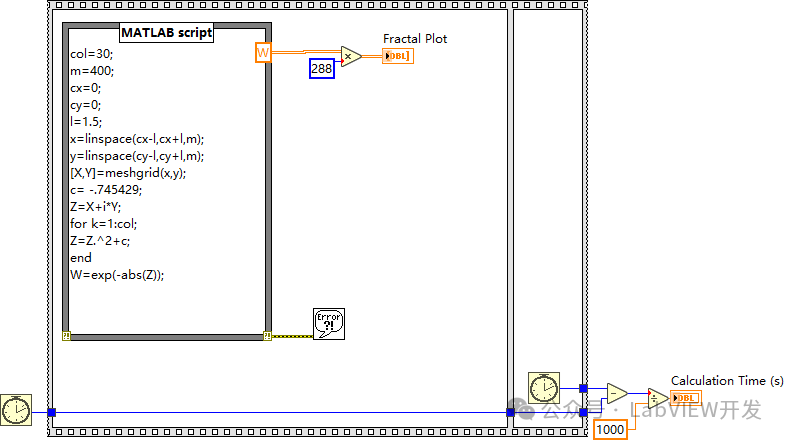
By utilizing the MATLAB script node in LabVIEW, fractal graphics can be generated using MATLAB code, with a timing module to track computation time, achieving fractal generation and performance monitoring.
Function Description
1. Fractal Calculation and Plotting
-
Function: Call MATLAB scripts in LabVIEW to define fractal calculation parameters (such as grid range, iteration formulas, etc.), generate a matrix W that describes the fractal, output it for plotting after magnification, and associate timing logic to track computation duration.
-
Usage Scenarios: This is needed to combine the visual process of LabVIEW with the numerical computation advantages of MATLAB to generate fractals (such as the Mandelbrot set) and validate complex graphical algorithms in research or teaching scenarios.
-
Features: Cross-platform tool collaboration (LabVIEW process + MATLAB computation), reusable fractal algorithms from a single development; flexible embedding of MATLAB code through script nodes to adapt complex mathematical computation logic.
-
Considerations: Ensure compatibility between LabVIEW and MATLAB versions (requires MATLAB 5.0+); variables within MATLAB scripts must be correctly passed (e.g., W must be adapted to LabVIEW data types for output); during large-scale fractal calculations, the execution efficiency of MATLAB scripts may be limited by local computational power.
-
Comparison with Similar Functions: If fractals are implemented purely in LabVIEW, manual coding of iterations and matrix operations is required, leading to a longer development cycle; pure MATLAB plotting lacks the advantage of LabVIEW’s visual process integration. This VI combines both, balancing development efficiency and process requirements.
Fractal generation is a typical scenario in the study of complex systems and chaos theory. LabVIEW excels at constructing visual testing and measurement processes, while MATLAB is efficient in numerical computation and mathematical algorithm implementation. The combination allows for rapid validation of fractal algorithms and performance monitoring, commonly used in research prototype development and teaching demonstrations (visually showing the correlation between algorithm time consumption and graphical results), and also provides development references for complex graphical generation algorithms in engineering (such as texture simulation and fault feature visualization).
About Us
This is a feature introduction of LabVIEW. For more usage methods and development cases, please visit our official website for more information. If you need LabVIEW project collaboration, please contact us. Join our public account to stay updated on the latest technology trends.13691203761Manager Wang (Mobile WeChat)