The semiconductor industry has been buzzing these past few days, as Jiang Shangyi’s statement left foreign media stunned: “Chinese chips are not rising; they are dominating the global market.” This is not just my opinion; it comes from a former high-ranking executive at TSMC, a top veteran in the industry. If I had said this, I would probably be accused of “nationalism,” but this time it comes from their own ranks.
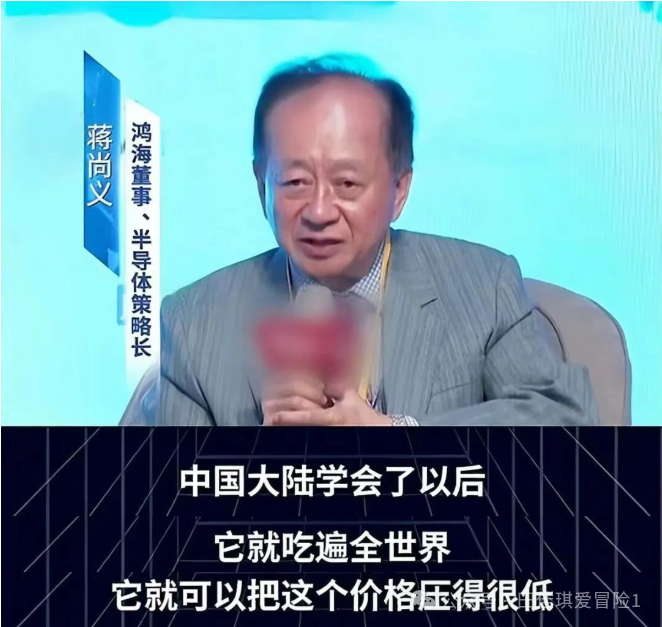
What does “dominating” mean? Many people’s first reaction is that the three-nanometer and two-nanometer processes will completely overtake others. But I want to remind you that China’s strategy has never been about direct confrontation; it has been very clever. While others are burning money on seven-nanometer and five-nanometer processes, we are directly expanding our network at twenty-eight nanometers. SMIC currently has a monthly capacity of 750,000 wafers, which is 60% more than TSMC. Even more aggressive is that the price is set at 60% of the international average. How can others compete?
Many netizens have said it well: “Let’s applaud our country’s chips; in Greater China, there is nothing we cannot achieve.” This is not just a slogan; it is a reality that cuts to the bone. Guangzhou Nansha slashed the price of silicon carbide wafers from $1,500 to $500, resulting in a 90% collapse in the stock price of the American company Wolfspeed, which ultimately had to sell its factory to survive. This is a dimensionality reduction attack; no matter how advanced your technology is, if my cost performance crushes you, you will still have to kneel.
The more critical logic is “using war to fund war.” We are crazily harvesting profits in the mature process market and then pouring all the money into the R&D of seven-nanometer and five-nanometer processes. It’s like a snowball getting bigger and bigger, with profits from mature processes providing blood transfusions to advanced processes. New energy vehicles and smart home appliances are all major consumers of chips. Chinese companies are shipping products while making profits, conveniently turning overseas consumers into users of Chinese chips. By the time you realize it, there’s no turning back.
 Some people mockingly say that China has a significant gap in high-end processes. I laugh. A significant gap forces people to innovate desperately. Huawei, in collaboration with SMIC, has mass-produced Kirin chips, and the lithium tantalate photonic chip from the Chinese Academy of Sciences has even bypassed photolithography, taking a completely new path. Can you imagine? The U.S. keeps blocking our roads, but instead, it has forced us into a new track.
TSMC is now in a difficult position. On one hand, it must invest heavily to maintain technological leadership; on the other hand, it finds that the profit margins in the mature process market are being gradually eroded by China. The most critical point is that this is not accidental; it is inevitable. The Chinese market is large enough, the demand is sufficient, and the localization of the supply chain is gradually being completed, with cost advantages being ground out.
The U.S. is even more anxious, pushing for the “CHIPS Act” to try to bring the supply chain back home. What’s the result? The costs are frighteningly high, workers are hard to find, and subsidies are swallowed up. While they are still arguing over budgets, Chinese factories are already starting production one after another. Isn’t this just getting further and further away?
I particularly like a netizen’s quip: “Chasing with heads down, looking up to find no one ahead; we can’t just stop and rest waiting for those behind to catch up, so we can only compare ourselves to ourselves.” This is a portrayal of today’s Chinese chips. In the past, we were always watching TSMC and ASML; now we have our own rhythm and our own rules.
In the next decade, the chip landscape will undergo earth-shattering changes. Jiang Shangyi’s statement may sound extreme: in the end, there will only be two types of companies left globally, one type working for the Chinese supply chain and the other forced to change industries. But think about it carefully; does it make some sense? When 90% of applications can be solved with twenty-eight nanometers, and China can push costs to the extreme, what other manufacturers will have a way out?
This is not blind confidence; it is a solid trend. Chinese chips rely not only on technological breakthroughs but also on the collective strength of the entire industry chain. If you block one link, I will supplement another. The more you block, the faster I accelerate. Today’s China is no longer the “processing factory” that can be manipulated; it is a giant that can set the rules.
So, stop laughing about the so-called “years of gap.” Gaps are meant to be chased, not to kneel before. We have already caught up and will continue to run. As for those who are still singing the blues, I advise you to read more news and not be trapped by the illusions you create.
I just want to say one thing: “This time, we are not just rising; we are truly going to dominate the global market.”
The end of the article. If you liked it, please give a “like” or follow me. ↓↓↓