Exploring the Path of Rust Programming: Learning Notes from Design Philosophy to Memory Safety
In the programming world, Rust has rapidly risen to prominence as a new favorite for system-level programming due to its features of memory safety, zero-cost abstractions, and high performance. “The Rust Programming Path” is not just a technical book but a journey exploring the design philosophy and practice of Rust. This article will take you into the world of Rust, outlining its language features and memory management, clarifying core concepts to help you quickly get started with this new era programming language!

This article is based on learning notes organized from “The Rust Programming Path,” deeply analyzing the main features of the Rust language, including design philosophies such as memory safety, zero-cost abstractions, and thread safety. The article starts with the language background and design concepts of Rust, systematically organizing the core knowledge points through the type system, ownership mechanism, and concurrency model. By summarizing the chapters of “The Rust Programming Path” and distilling the content of the first chapter, it helps readers understand why Rust has become the preferred language for modern system programming and provides a clear path for further learning.
Main Content
Main Features of the Rust Language
Rust is a modern system-level programming language with the following core features:
- System-level language: Suitable for low-level development, directly manipulating hardware resources.
- No garbage collection (GC): Avoids performance overhead, ensuring efficient operation.
- Based on LLVM: Utilizes the LLVM compilation framework for cross-platform optimization.
- Memory safety: Eliminates memory errors through ownership and borrowing mechanisms.
- Strongly typed + statically typed: Checks type safety at compile time, reducing runtime errors.
- Mixed programming paradigms: Integrates imperative, functional, and object-oriented programming styles.
- Zero-cost abstractions: Provides high-level abstractions without runtime performance costs.
- Thread safety: Built-in concurrency model to avoid data races.
These features make Rust widely used in fields such as blockchain, gaming, WebAssembly, and machine learning.
The Joy of Programmers
What is joy? True joy is not just the “sourness” of writing code but the “stability” after the code is deployed to production.
The Three Laws of Programming
- The program must be correct.
- The program must be maintainable, but it cannot violate the first law.
- The program must be efficient, but it cannot violate the first two laws.
Correctness of Programs
- The program meets the actual problem requirements.
- It satisfies its own program specifications.
How to Ensure Program Correctness
- By conducting various tests, assertions, and error handling mechanisms to ensure it meets actual problem requirements.
- By utilizing mature type theory to ensure the correctness of the program’s specifications.
The Rust language perfectly supports the three laws of programming. Rust ensures that programs are “correct, maintainable, and efficient” through its type system, ownership mechanism, and compile-time checks.
Currently, Rust is being applied in blockchain, gaming, WebAssembly technology, machine learning, distributed databases, network service infrastructure, web frameworks, operating systems, and embedded systems.
Features and Chapter Overview of “The Rust Programming Path”
The steep learning curve of Rust is fundamentally due to its integration of various language features and programming paradigms.
Starting from Rust’s design philosophy and firmly grasping its design consistency allows one to string together all its features, thus achieving mastery.
Features of “The Rust Programming Path”
- Explores the inherent consistency of the Rust language from the perspective of design philosophy.
- The design philosophy is key to the consistency of an excellent programming language.
- The design philosophy serves as the motivation and guideline for the design of language features and syntax elements.
- Starts with source code analysis to explore Rust’s authentic programming style.
- Approaches from an engineering perspective to explore Rust’s support for robustness.
- Begins with underlying principles to explore the essence of Rust’s memory safety.
Chapter Overview
Chapter 1: A Language for the New Era
Chapter 2: Essentials of the Language
Chapter 3: Type System
Chapter 4: Memory Management
Chapter 5: Ownership System
Chapter 6: Functions, Closures, and Iterators
Chapter 7: Structured Programming
Chapter 8: String and Collection Types
Chapter 9: Building Robust Programs
Chapter 10: Modular Programming
Chapter 11: Safe Concurrency
Chapter 12: Metaprogramming
Chapter 13: Beyond the Boundaries of Safety
Chapter 1: A Language for the New Era
Those who do not plan for the whole cannot plan for a part.
A good language is one that has an inherent philosophy, is consistent inside and out, and has intentions and actions.
Two Difficulties
- It is difficult to write memory-safe code.
- It is difficult to write thread-safe code.
Ada Language
In 2006, Graydon Hoare, who called himself a “professional programming language engineer” (abbreviated as GH), began developing a programming language called Rust.
What is a “professional programming language engineer”? In GH’s own words, a professional programming language engineer’s daily work is to develop compilers and toolsets for other languages, but they do not participate in the design of those languages themselves.
GH’s Expectations for the Rust Language
- It must be safer and less prone to crashes, especially when handling memory, which is particularly important.
- It should not require a system with garbage collection, and it should not introduce performance burdens for memory safety.
- It should not be a language with just one main feature but should have a range of broad features that are consistent with each other. These features should work well together, making the language easier to write, maintain, and debug, allowing programmers to write safer and more efficient code.
Rust is a modern system-level programming language that simultaneously pursues safety, concurrency, and performance.
Design Philosophy
- Memory safety
- Zero-cost abstractions
- Practicality
Some things, if not done now, will never have another chance. — Etude [2006]
“Programs are proofs of types”
Benefits of the Type System
- Allows the compiler to detect meaningless or even invalid code, exposing hidden errors in the program.
- Can provide meaningful type information to the compiler, helping to optimize code.
- Enhances code readability, more clearly expressing the developer’s intentions.
- Provides a certain level of high-level abstraction, improving development efficiency.
In simple terms, type safety means that the type system can ensure that the program’s behavior is meaningful and error-free.
Undefined Behavior: Behavior that occurs outside the specifications defined by the language.
If Rust wants to ensure memory safety, the first thing it must do is ensure type safety.
Type-safe languages: OCaml, Haskell
The role of the type system is to define the types of values and expressions in the programming language, classify them, assign them different behaviors, and guide how they interact.
Memory Safety
What is memory safety? In simple terms, it means that memory access errors do not occur.
Memory errors occur only when a program accesses undefined memory.
Generally, memory errors can occur in the following situations:
- Dereferencing a null pointer
- Using uninitialized memory
- Using after free, which is dereferencing a dangling pointer
- Buffer overflow, such as array out of bounds
- Illegally freeing a pointer that has already been freed or a pointer that was not allocated, which is double freeing
Rust Language’s Safe Memory Management Model
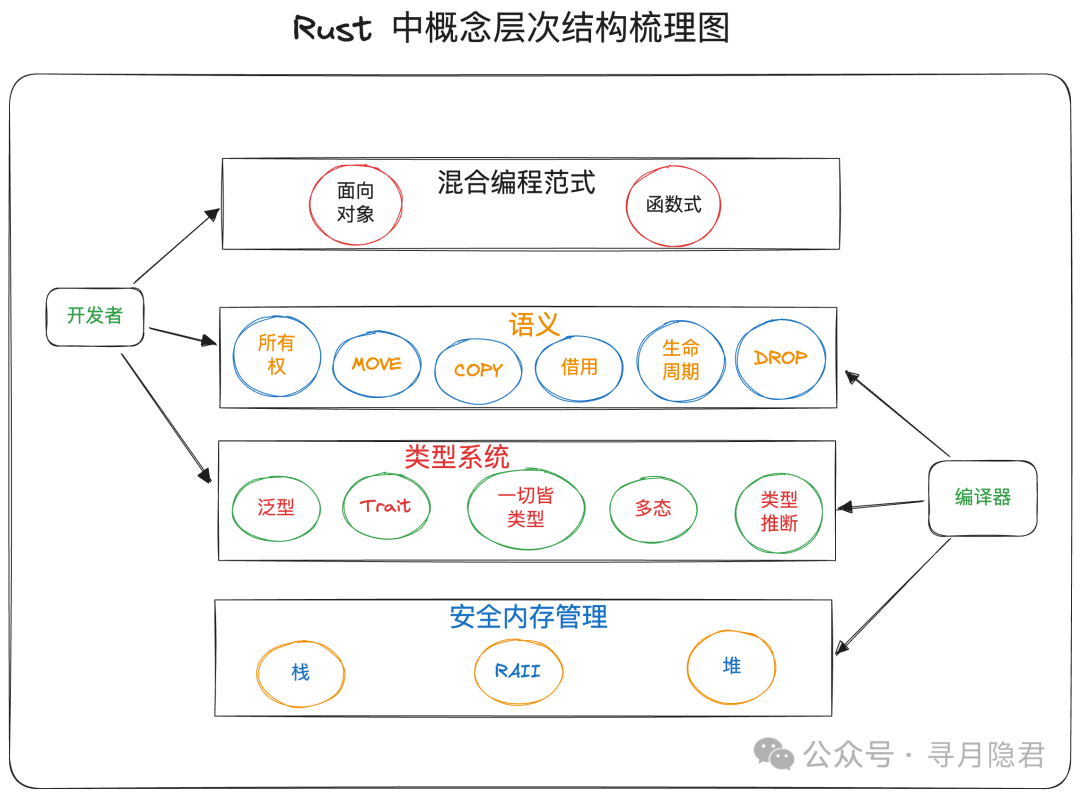
- Ownership System
- Each allocated memory has a pointer that exclusively owns it.
- Memory can only be released when that pointer is destroyed.
- RAII mechanism
- Borrowing and Lifetimes
- Each variable has its lifetime, and once it exceeds its lifetime, the variable is automatically released.
- If it is a borrow, it can prevent dangling pointers by marking lifetime parameters for the compiler to check.
Rust Draws the Following Features from Haskell’s Type System:
- No null pointers
- Default immutability
- Expressions
- Higher-order functions
- Algebraic data types
- Pattern matching
- Generics
- Traits and associated types
- Local type inference
Unique Features of Rust
- Affine Type, which expresses the Move semantics in Rust ownership.
- Borrowing, Lifetimes
The Rust compiler can check types at compile time to see if they meet the safe memory model, effectively preventing undefined behavior.
The Rust compiler will analyze through static checks to identify all data race issues in multithreaded concurrent code at compile time.
Zero-Cost Abstractions
Rust’s abstractions do not incur runtime performance overhead; everything is completed at compile time.
The cornerstone of zero-cost abstractions in Rust is generics and Traits.
Practicality
How to evaluate the practicality of a programming language?
- Practicality
- Usefulness
- Stability
In daily development, there are generally three types of abnormal situations: failures, errors, and exceptions.
Rust provides specialized handling methods for these three types of abnormal situations, allowing developers to choose based on the situation.
- For failures, assertion tools can be used.
- For errors, Rust provides a layered error handling method based on return values, such as Option, which can handle cases where there may be null values, while Result is specifically used for errors that can be reasonably resolved and need to be propagated.
- For exceptions, Rust treats them as problems that cannot be reasonably resolved and provides a thread panic mechanism, allowing the thread to exit safely when an exception occurs.
Safe Rust means that developers trust the compiler to ensure safety at compile time, while Unsafe Rust means that developers trust themselves to ensure safety.
Rust code is compiled and distributed in packages (crates).
Learning Rust
- Maintain a beginner’s mindset
- Learn concepts before hands-on practice
- Consider the compiler as a friend
In 2015, Rust released version 1.0.
In 2018, the Rust team launched a new major version (edition) plan.
Rust 2015 version
Rust 2018 version
Rust 2021 version
Rust 2024 version
The Rust compiler can conveniently manage version compatibility.
The Rust team maintains three release branches: Stable, Beta, and Nightly.
The stable and beta versions are released every six weeks.
Language features or standard library features marked as unstable and feature-gated can only be used in the nightly version.
The Rust compiler is a front-end compiler that performs lexical analysis, syntax analysis, type checking, generates intermediate code, and performs target machine-independent optimizations.
Using LLVM as the back-end code generation framework allows for cross-platform compilation and optimization by leveraging LLVM’s compatibility with multiple target machines.
When users use Rust, they generally do not need to consider the specific properties of each target machine platform, allowing for a write once, run anywhere experience.
Rust source code is tokenized and parsed to generate an AST (Abstract Syntax Tree).
The AST is then further simplified into HIR (High-level IR) to facilitate type checking by the compiler.
HIR is further compiled into MIR (Middle IR), which is an intermediate representation.
Finally, MIR is translated into LLVM IR, which is then processed by LLVM to compile into target machine code that can run on various platforms.
Conclusion
As a modern system-level programming language that pursues safety, concurrency, and performance, Rust’s design philosophy and memory management model provide developers with powerful tools and guarantees. Through these learning notes, we not only understand Rust’s language features and design concepts but also grasp the core ideas of its type system, ownership mechanism, and concurrency model. We hope this content provides a solid foundation for your Rust learning journey, helping you advance further on your programming path!
