
The JD.com merchant intelligent assistant aims to solve various problems faced by e-commerce merchants during operations, including responding to various information transmitted by the platform and assisting merchants in understanding their store’s operational status. Merchants only need to communicate with the intelligent assistant on the Jingmai platform using the natural language they are most familiar with to receive 24/7 operational agency services, with responses in as fast as 1 second. Whether querying operational rules or executing quick functional operations, it can be achieved through simple dialogue, making it easier and more convenient for merchants to operate.The algorithm foundation of the merchant assistant is built on a Multi-agent system based on large language models (LLM), simulating the collaborative operational methods of e-commerce merchant teams in reality. Through multi-agent dynamic planning and collaborative technology, combined with LLM and reverse planning, it achieves intelligent dynamic planning capabilities to solve complex decision-making problems in e-commerce operations, covering the entire process from product release, order management, customer service communication to data analysis, and providing merchants with operational functions such as sales forecasting, marketing investment, pricing, and business keyword recommendations.Currently, the multi-agent collaborative technology adopted by the merchant intelligent assistant has achieved a decision accuracy rate of over 90%, with individual system operation efficiency reaching seconds, helping merchants create a store experience of “faster operations, better services, and lower costs.”This article is part of the 2024 annual summary series, introducing the technical exploration of JD.com’s merchant intelligent assistant in the e-commerce domain.Merchants are welcome to download the Jingmai workstation for experience.00 Introduction First, let’s introduce the evolution process of the multi-agent architecture of the merchant intelligent assistant:Phase 1: B Mall work order automatic reply, LLM combined with RAG to respond to the knowledge base, unable to solve tool calls.Phase 2: JD.com recruitment site, single Agent handling knowledge base Q&A and tool calls, low accuracy & LLM model hallucinations, poor scene differentiation.Phase 3: Jingmai intelligent assistant, introducing a multi-agent architecture, master + subagents collaborative working mode, dividing and conquering problems, significantly improving accuracy.The algorithm foundation of the merchant assistant is built on a Multi-agent system based on large language models (LLM), simulating the collaborative operational methods of e-commerce merchant teams in reality. Merchants only need to use their most familiar natural language to communicate with this assistant on the Jingmai platform to receive 24/7 operational agency services. This document will map the simulated real merchant operating space to the Multi-agent algorithm space, gradually analyzing the business motivation, algorithmic architecture, and key technologies of the merchant assistant in the e-commerce platform business scenario.The merchant assistant Multi-agent is a general & open host for various capabilities of merchant operations (such as sales forecasting, marketing investment, pricing, business keyword recommendations, etc.), which can friendly face other capability providers’ Tools, including Agent, API, etc., as construction progresses.01 Merchant Operations: From Multi-role Real Space to Multi-Agent Algorithm Space The design motivation of the Multi-Agent system architecture comes from the essence that “Agents simulate the problem-solving process of people in the real world”.First, through a video, we introduce how real-world merchants and their teams operate, and how they map roles with the AI world.02 Key Technologies of Multi-Agent Planning
2.1 Agent Construction Technology: Multi-model Integration of the ReAct Paradigm
2.1.1 Agent Construction Integrates Four Types of Models, Achieving Intelligent Reverse Planning Capabilities of the Agent Brain•LLM: Analyzes the problem and refines the ultimate goal, directing reverse planning while verifying the rationality of the calling chain.•Embedding: Rapidly matches ultimate node tools, avoiding lengthy prompts and selection hallucination issues from LLM.•Tools DAG: Performs multi-path reverse reasoning, combining LLM to extract parameter tools and accurately obtain scheduling strategies.•Operational optimization: Theoretically accelerates problem-solving and improves reverse planning efficiency, pending actual testing verification.2.1.2 Dynamic Updates of ReAct PlanningDynamic planning updates: In the forward execution of planning, the ReAct paradigm achieves dynamic planning updates at each step based on execution results.
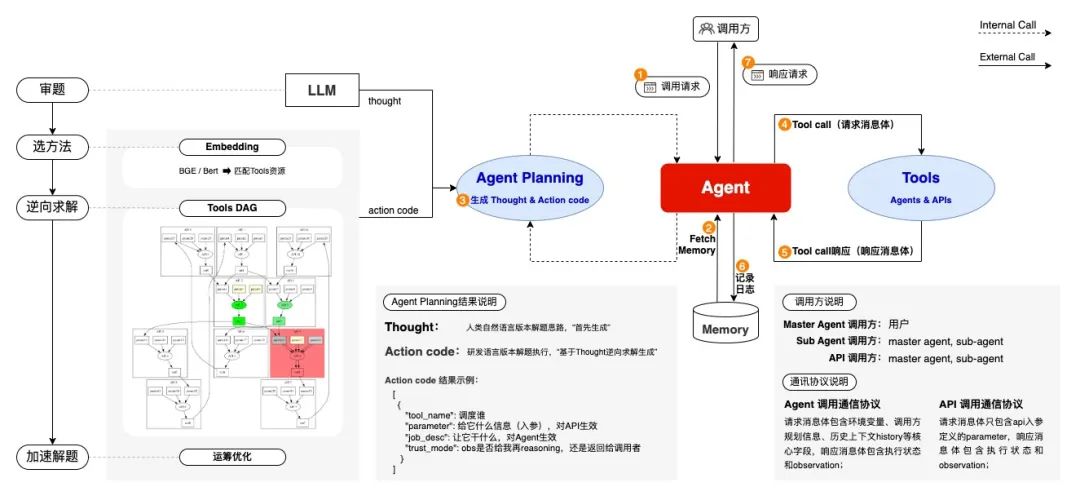
2.1.3 Technical Challenges and Benefits•Enhancing planning efficiency, reducing reasoning costs: Multiple model orchestration replaces ultra-large models, significantly improving reasoning speed and planning efficiency while saving reasoning costs.•Enhancing architectural stability, controllable effects and risks: After task splitting, small models handle simple and clear tasks, while large models focus on single complex tasks, reasonable division of labor makes effects and risks controllable, reducing the impact of model iteration on the whole.•Governance of LLM hallucinations improves planning quality: Embedding solves the uncertainty and hallucinations brought by LLM, Tools DAG ensures planning logic and accuracy, and the accuracy of tool calls in Jingmai scenarios has increased by 10%.•Reduces the sample engineering volume of LLM: LLM only processes text understanding, does not directly select tools, avoiding the problem of needing a large number of samples for training new tools, improving system scalability and maintenance efficiency by over 60%.•Real-time and accuracy: Through ReAct dynamic planning updates, strategies are adjusted in real time, optimizing execution links.
2.2 Multi-Agent Online Inference
2.2.1 Technical Features1. Task Layered Dynamic Planning and Distributed CollaborationBased on the ReAct paradigm, dynamic planning and scheduling of tasks are performed at different levels through Master Agent and Sub Agents, supporting distributed collaboration.•Master Agent: Plans tasks at the domain level, breaking complex scenarios into multiple independent sub-tasks for scheduling sub-agents to collaborate.•Sub Agents: Execute task planning within the domain, responsible for executing specific sub-tasks, supporting distributed scheduling and collaborative work.2. Agent Collaboration Based on Standard Communication ProtocolsEnsures efficient collaboration of Muti-agents through standard communication protocols, supporting multi-step linkage and global thinking chain planning.•Agent standard communication protocol: Ensures efficient collaboration of agents in the Muti-agent system, supporting layered planning and execution of tasks.•Multi-step linkage: Supports multiple interdependent tasks, completing complex tasks through ReAct single-step execution and callback mechanisms.2.2.2 Demonstration of Multi-Agent Online InferenceTo demonstrate the collaborative online reasoning process of multi-agents, a video has been recorded. Combining the assistant product form of Jingmai’s front end, it synchronously showcases the background algorithm reasoning service of multi-agents, using a video for easier understanding.2.2.3 Architectural SummaryThe architectural features are:Low reasoning difficulty, transforming the generation task of the entire link multi-step plan of ultra-large models into next task prediction;Low cost, the collaboration of multiple small models is easier to implement, with low training and deployment costs;Fast iteration, rapid problem location, and quick model iteration.However, there are still issues to be resolved:Long response time, facing complex problems, users experience longer wait times, requiring product guidance; risk accumulation, chain reasoning of multiple agents has the risk of error accumulation. Research on solutions is ongoing, such as multi-agent joint learning.Compared with single-agent and LLM-MoE architectures, the multi-agent architecture has stronger stability under the same large model capability, better supporting collaboration and expansion of complex business scenarios and tasks, but requires more engineering development and more complex reasoning links.
2.3 Full-link ReAct Evaluation Technology for Agents
2.3.1 Comprehensive Evaluation of Full-link ReAct Effectiveness of Agents•Full-link evaluation: From a global perspective, through task decomposition and link scheduling, each Agent in the system is scored to calculate the overall effectiveness of the Multi-Agent system.•Local evaluation: Using Reward Model to evaluate the thought/action/observation present in each Agent’s ReAct cycle, identifying performance bottlenecks and inefficient model segments, providing targeted optimization suggestions.2.3.2 Diversified Reward Model•Business customization: Supports business-customized rule functions/reward models for flexible adaptation to different business evaluation needs.•Existing large models: Utilizes existing high-order Sota large models for evaluation, ensuring the generality and accuracy of the evaluation.•Training Reward models: Enhances adaptability to specific tasks and scenarios through training dedicated models for evaluation.
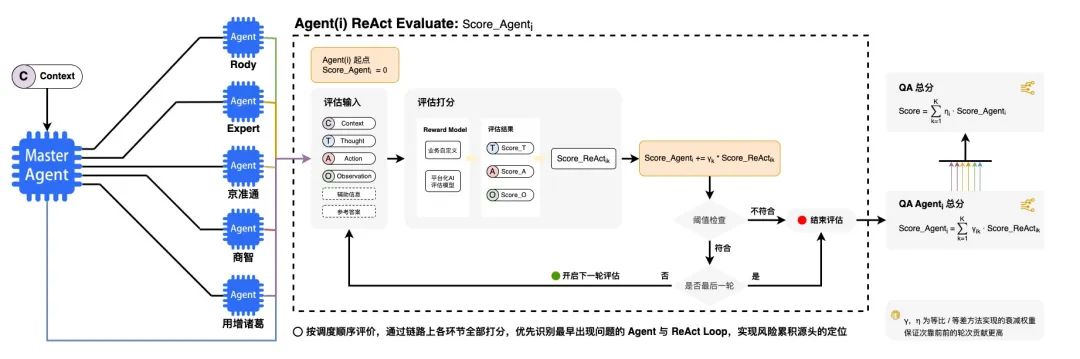
Reward Model – Platform AI Evaluation Model Case Description:
Input summary model's goal is to analyze the specific intent of the user's historical conversation records and the current round of questions, as the core link of Master Agent's thinking, requiring evaluation of its intent summary effect. 1. Automated evaluation scheme: 1. Evaluation method: Using a high-order model (e.g., GPT-4o) as the referee model, combined with the user's current round of questions and historical conversation records, evaluate the accuracy of online reasoning. 2. Automated scoring instructions (simplified): You are an expert in understanding question intentions. Now you need to evaluate the quality of an e-commerce platform AI assistant's understanding of merchant users' questions, and you are required to evaluate the answers from the following dimensions, scoring from 0-10, scores must be integers: 1. Correctness: Does the intention accurately express the user's current question? 2. Relevance: The intention of the current question may be strongly related to historical dialogue or unrelated, judge whether the assistant's understanding of the intention is correctly related to historical dialogue. We will provide you with the user's current question, historical dialogue with the AI assistant, and the AI assistant's answer to evaluate. A reference answer may be provided; when given a reference answer, you need to judge the similarity between the assistant's summarized intention and the reference intention, this dimension is named "Degree of Similarity to Human Understanding". Return all your scoring results in the following dictionary format (including brackets): {{'Dimension One': Score, 'Dimension Two': Score, ..., 'Comprehensive Score': Score}}. For example: {{'Correctness': 6, 'Relevance': 9, ..., 'Comprehensive Score': 7}}. Input data format is as follows: User's current question: {question}
[Historical dialogue starts]
{history_conv}
[Historical dialogue ends][Reference intention starts]
{reference}
[Reference intention ends]
[Assistant intention understanding starts]
{intention}
[Assistant understanding intention ends]
Tool scheduling models need to accurately evaluate the action code parsed by the model based on user questions and specific descriptions of available APIs, so as to ensure the correctness of API selection and parameter parsing. 1. Automated evaluation scheme: 1. Evaluation method: Using a high-order model (e.g., GPT-4o) as the referee model, combined with user questions and API database, evaluate the accuracy of online reasoning. 2. Automated scoring instructions (simplified): You are an assistant proficient in evaluating the rationality of API usage. Now you need to evaluate whether an e-commerce platform AI assistant has correctly called the API to address merchant user questions; if the API is correctly selected, further determine whether the parameter parsing for that API is correct. Please note: you only need to evaluate the correctness of API selection and parameter parsing, not generate the correct calling method. We will provide you with the user's question, API, and the AI assistant's evaluation results. A reference answer may be provided; when a reference answer exists, the accuracy evaluation must be compared with the reference answer; when no reference answer exists, only evaluate based on the assistant's answer itself. Return all your evaluation results in the following dictionary format (including brackets): {{'API Selection': Correct or Wrong, 'Parameter Parsing': When API selection is wrong, the result is "None"; when API selection is correct, the result is Correct or Wrong}}. For example: {{'API Selection': 'Wrong', 'Parameter Parsing': 'None'}}; {{'API Selection': 'Correct', 'Parameter Parsing': 'Correct'}}. Input data format is as follows: User's current question: {question}
[API information starts]
{retrivals}
[API information ends]
[Reference parsing result starts]
{reference}
[Reference parsing result ends]
[Assistant parsing result starts]
{answer}
[Assistant parsing result ends]
The output summary model needs to evaluate the final summary effect of the model based on user questions and recalled corpus, hence the model's final summary effect needs to be evaluated. 1. Automated evaluation scheme: 1. Evaluation method: Using a high-order model (e.g., GPT-4o) as the referee model, combined with user questions and core corpus to score the responses of the AI assistant. A universal scoring instruction set is constructed to accommodate both scenarios with and without manual labeling. 2. Automated scoring instructions (simplified): You are an assistant proficient in evaluating text quality. Now you need to evaluate the quality of an e-commerce platform AI assistant's response to merchant users' questions, and you are required to evaluate the answers from the following dimensions, scoring from 0-10, scores must be integers: 1. Meeting user needs: Does the response content solve the user's question? 2. Factual correctness: Is the response derived from the reference corpus, without excessive inference? 3. Completeness of the response: For the question being answered, has all the information from the corpus been completely extracted? We will provide you with the user's question, the core corpus to be referenced, and the AI assistant's answer you need to evaluate. A reference answer may be provided; when a reference answer exists, scoring needs to be compared against the reference answer; when no reference answer exists, only evaluate based on the assistant's answer itself. Return all your scoring results in the following dictionary format (including brackets): {{'Dimension One': Score, 'Dimension Two': Score, ..., 'Comprehensive Score': Score}}. For example: {{'Meeting user needs': 6, 'Factual correctness': 9, ..., 'Comprehensive Score': 7}}. Input data format is as follows: User's current question: {question}
[Core corpus starts]
{retrivals}
[Core corpus ends]
[Reference summary result starts]
{reference}
[Reference summary result ends]
[Assistant summary result starts]
{answer}
[Assistant summary result ends]
2.4 LLM Offline Sample Enhancement Technology
2.4.1 Automated Offline Sample Generation and ExpansionStandardized corpus accessed offline: By accessing standardized business data, it can automatically generate and expand samples for LLM training, quickly adapting to different scene training needs, and batch generating high-quality training samples.2.4.2 Automated Online Reasoning Labeling and Sample AccumulationAgent online reasoning data: Through various Reward Model strategies, the system can continuously automate labeling and accumulate samples generated during online reasoning. This allows the sample library to continuously expand and optimize, improving the model’s online reasoning capability.03Outlook Through the application exploration of the merchant intelligent assistant in complex distributed interactive systems, it provides valuable practical experience and replicable models for solving the global dynamic intelligentization issues in the industry:Universalityand Replicability:The technical route of multi-agent collaboration provides a reference for other industries to solve the “capability short board” of general large models in rigorous industrial applications—relative lack of domain knowledge, inability to handle complex decision-making, and the fact that dialogue interaction does not equal effective collaboration.Industry Benchmark:Through practical verification, JD.com’s merchant intelligent assistant has become a benchmark case of multi-agent systems and large model integration applications in the e-commerce field, which is of great significance for promoting the landing of large model product applications in the e-commerce industry.The merchant intelligent assistant demonstrates the tremendous potential of multi-agent collaboration and large model technology in the e-commerce field. The future intelligent user experience will not rely solely on one large model but will require deep collaboration across the entire industry, with many specialized intelligent agents participating, each performing their roles. This provides a new direction for the future intelligent user experience and deep industry collaboration.(The case of JD.com’s merchant intelligent assistant was selected in InfoQ Research Center’s “China AI Agent Application Research Report 2024”, 2024 Top 100 Global Software Cases, and Jiazi Guangnian – 2024 Best Practices in China’s Science and Technology Industry.)Join Us:
The JD Retail Data Algorithm Team is responsible for building large model intelligent agents, with key technologies including SFT/RLHF/RAG/KAG/Multi-Agent/Self-reflection/Distillation, etc. Our team members come from top universities at home and abroad, dedicated to building a first-class team of large model intelligent agents, driving business development with cutting-edge technology. We sincerely invite innovative and passionate individuals about technology to join us and look forward to meeting you at JD.com! Resume submission email: [email protected].
2024 JD Retail Technology Annual Summary Series
2024 JD Retail Technology Annual Summary
Frontier Exploration of AI in JD Retail Technology – Collection of 10 Top Conference Papers
JD Supply Chain Innovation and Practice: Using Data-Driven Inventory Selection and Allocation Algorithms to Improve Fulfillment Efficiency
Event Recommendations

Previous Recommendations
Efficiently Integrating Structured and Unstructured Data—Large Model Intelligent Analysis Agent Driving Innovative Breakthroughs in Business Analysis and Insights
Content Volunteer Recruitment | January Update Topic: Data and AI Solutions (Including 2025 Annual Conference Schedule)
Alibaba’s Li Feifei | Data + AI: The Double-Engine of the Intelligent Era
In-depth Reveal of AI Agent + GraphRAG in Real-World Applications
DeWu – NorthStar Large Model Training Framework
Data Mesh and Automated Governance Platform Applications in the Gaming Industry
Data + AI: The Triple Evolution of Data Engines in the Era of Large Models
B Station Big Data Tasks Based on Volcano’s Cloud Native Scheduling Practice
Exploration of Large Model Applications in McLaren
New Practices in Black and Gray Production Risk Control for Cross-Channel Device Identification
Click to see your best look
SPRING HAS ARRIVED
