Click the blue text to follow us
Industry Background
With the trend of refined energy management, the high-precision collection and real-time analysis of electricity meter data have become core demands in the power industry. DLT645, as a national standardized communication protocol for electricity meters, has become the cornerstone of domestic power data collection due to its reliability based on the RS-485 hardware interface and master-slave half-duplex communication architecture, which is crucial for enhancing the scientific nature of energy decision-making.
Demand Analysis
01
Data Fragmentation
The energy consumption data from scattered electricity meters is difficult to collect and summarize uniformly;
02
Response Delay
Manual meter reading or traditional communication methods lead to insufficient data timeliness;
03
Weak Analysis
Lack of deep mining capabilities for key indicators such as voltage, current, and power.
There is a need to build an automated and intelligent full-link management system for electricity meter data.
Solution
Deploy an industrial intelligent gateway as the core data collection system:
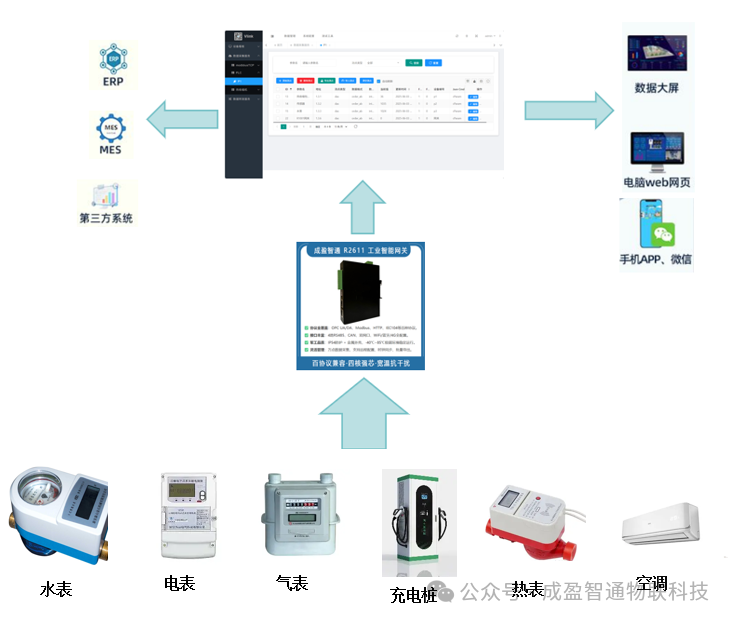
01
Terminal Layer
Scale deployment of smart electricity meters in factories, buildings, and other scenarios to monitor power parameters in real-time;
02
Collection Layer
The gateway connects to the electricity meter via the RS-485 interface, parses DLT645 protocol data, and transmits it to the cloud platform or local server via 5G/4G/WiFi/Ethernet;
03
Analysis Layer
The platform achieves data visualization, anomaly warning, and multi-system integration (such as interfacing with data management platforms like Vlink). It forms a “terminal-edge-cloud” integrated digital energy closed loop.
System Functions

System Benefits
Management Efficiency Improvement: Replaces manual meter reading, achieving full-process automation of energy consumption supervision;
Cost Optimization: Accurately identifies high energy consumption nodes, driving the formulation of energy-saving strategies;
Risk Control: Real-time fault warnings reduce equipment downtime losses;
Decision Empowerment: Multi-dimensional data analysis supports grid load scheduling and energy planning;
Ecological Compatibility: The openness of the protocol aids in the upgrade of smart grids and multi-scenario implementation (industrial/commercial/residential electricity).
This solution provides core support for building a highly reliable and low-cost modern energy management system through deep adaptation of the DLT645 protocol + industrial gateway edge computing + cloud-based intelligent analysis, connecting the entire chain from data collection to decision-making.


www.cyzt-iot.com
Customer Service Hotline:
18317773889


1
END
1
Please like

Please share

Please like