In the context of growing global concerns about the environmental, ethical, and health issues associated with traditional meat production, an innovative technology is attempting to revolutionize consumer choices at the dining table. Lab-grown meat has garnered significant attention in recent years as a sustainable alternative. However, making these “artificial meats” genuinely appealing to consumers, akin to traditional meat, remains a major challenge in the technical field.
Recently, a team of scientists led by Dongwei Wu proposed a novel solution: embedded bioprinting technology. This technology combines casting techniques with 3D printing to successfully create lab-grown meat with complex structures for the first time. These meats not only visually resemble traditional meat but also replicate the natural distribution of muscle and fat, providing consumers with a more authentic choice.
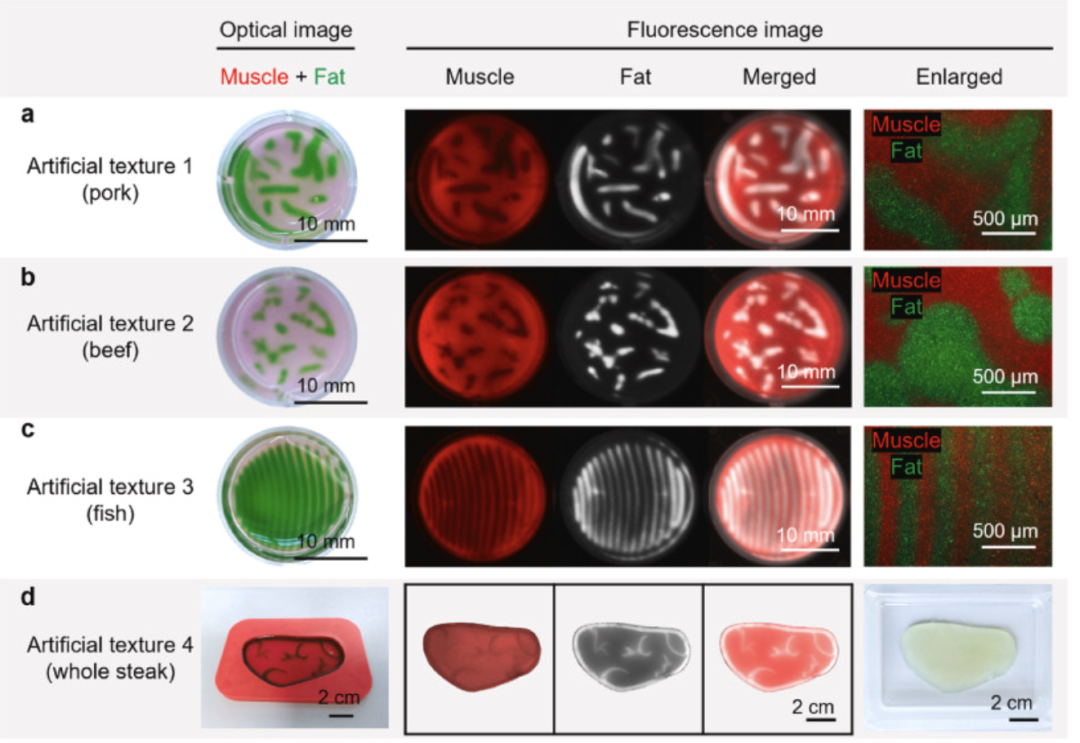
One of the biggest challenges in lab-grown meat is replicating the complex texture of traditional meat. The structure of traditional meat is composed of muscle fibers, fat cells, and connective tissues, all of which are key factors determining taste and flavor. Currently, most cultivated meat products on the market appear as ground meat, failing to meet consumer expectations for natural meat.
Embedded bioprinting technology successfully prints various meat models, including pork, beef, and fish, using an optimized alginate hydrogel as bio-ink. The research team utilized micro-computed tomography (μCT) technology to capture the structure of real meat and generated 3D models through algorithms, precisely embedding fat tissue within the muscle matrix. This technology not only enhances printing accuracy but also ensures structural integrity, making the printed cultivated meat visually and texturally closer to traditional meat.
Additionally, the team used oil-emulsified food dyes to simulate the natural color of meat, making the printed cultivated meat visually more appealing to consumers. These details not only represent a technical breakthrough but also cater to consumers’ aesthetic and sensory demands for meat.
Despite the significant progress made with embedded bioprinting technology, there are still many challenges to overcome in scaling from laboratory to commercial production. Balancing printing speed and resolution is key to achieving large-scale production; at the same time, ensuring the effective transfer of nutrients and oxygen within deep tissues remains an urgent issue to address. The research team suggests introducing vascular-like networks or perfusion systems to optimize the cell culture environment.
Furthermore, consumer demands for the taste, flavor, and texture of cultivated meat require further research. Future work should include comprehensive texture analysis and consumer testing to ensure that cultivated meat meets market expectations.