🌠This work includes the program, Chinese comments, references, and a video on how to operate the program.🚀Software versions: Matlab 2024b/Matlab 2022a 🌠How to obtain the program
Click the bottom left corner of WeChat to read the original text

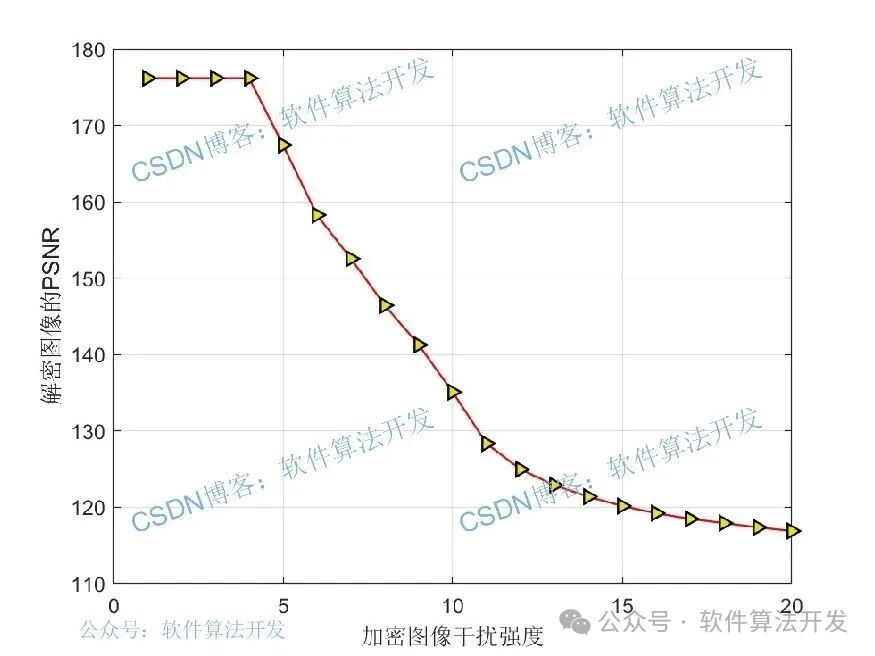
 💥Program test results displayThe simulation test results are as follows: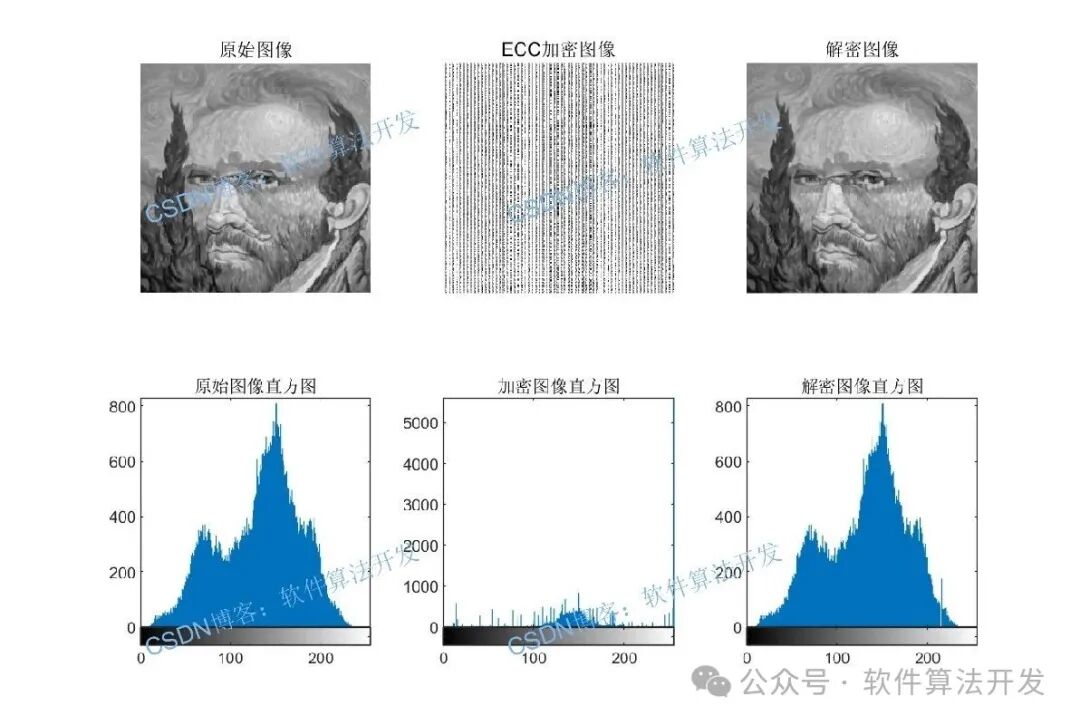
 ✨Algorithm Overview
Elliptic Curve Cryptography (ECC) is an important branch of modern public key cryptography. It offers shorter keys and higher computational efficiency at the same security level, making it an ideal choice for data encryption in resource-constrained environments (such as mobile devices and the Internet of Things). Applying ECC in the field of image encryption and decryption not only protects the confidentiality of image content but also fully utilizes the two-dimensional characteristics of image data and the mathematical properties of ECC to design efficient and secure encryption schemes.
Traditional image encryption methods (such as AES and DES) typically treat images as one-dimensional data streams, ignoring the two-dimensional structure of images and the correlation between pixels. The ECC-based image encryption algorithm combines the mathematical properties of ECC with the spatial characteristics of images, mainly achieving this through the following methods:
Pixel value transformation: Using ECC point operations to perform nonlinear transformations on pixel values;
Pixel position scrambling: Rearranging pixel positions based on ECC-generated chaotic sequences;
Key generation and management: Using ECC to generate public/private key pairs for secure key exchange and management.
The ECC-based image encryption algorithm typically includes the following core modules:
Key generation: Generating public/private key pairs based on ECC;
Chaotic sequence generation: Using ECC point operations to generate pseudo-random sequences for pixel scrambling and value transformation;
Pixel scrambling: Changing the spatial positions of pixels to disrupt the visual features of the image;
Pixel value encryption: Transforming the scrambled pixel values to make their statistical properties resemble noise;
Decryption process: Executing the encryption steps in reverse order to restore the original image.
The ECC-based image encryption and decryption algorithm fully utilizes the mathematical properties of elliptic curve cryptography and the two-dimensional structure of image data, achieving efficient and secure image encryption through pixel scrambling and value transformation.
 🪐Partof the program
...................................................................% Generate the base point and parameters required for encryptionaphn = func_primroot(p); % Get the primitive rootXm1 = func_mult([d(1),d(2)],aphn,a,b,p); % Calculate the scalar multiplication of the base pointXm2 = func_mult([d(1),d(2)],k,a,b,p); % Calculate the scalar multiplication of the base point% Image encryption processfor i=1:m for j=1:n m1 = x(i,j); % Get the current pixel value c = func_Elliptic(m1,a,b,p,K); % Map the pixel value to the elliptic curve % Perform encryption operations on the elliptic curve Xm3= func_add([c(1),c(2)],func_mult([Xm1(1),Xm1(2)],k,a,b,p),a,b,p); % Store the encryption result (each pixel is converted to two points on the elliptic curve) jm(l) = Xm2(1); jm(l+1)= Xm2(2); jm(l+2)= Xm3(1); jm(l+3)= Xm3(2); l=l+4; endend106