
Beijing, September 2, 2025
Against the backdrop of the rise of STEM education and the development of the AI industry, the educational robot market is presenting a vibrant development vitality with a myriad of innovations and attempts in hardware.
According to the latest data from the International Data Corporation (IDC), the hardware sales of the educational robot market in China reached 1.07 billion yuan in the first half of 2025, a year-on-year increase of 12.5%. IDC predicts that by 2029, the hardware sales of the educational robot market in China will reach 3.93 billion yuan, with a five-year compound annual growth rate of 12.9%.
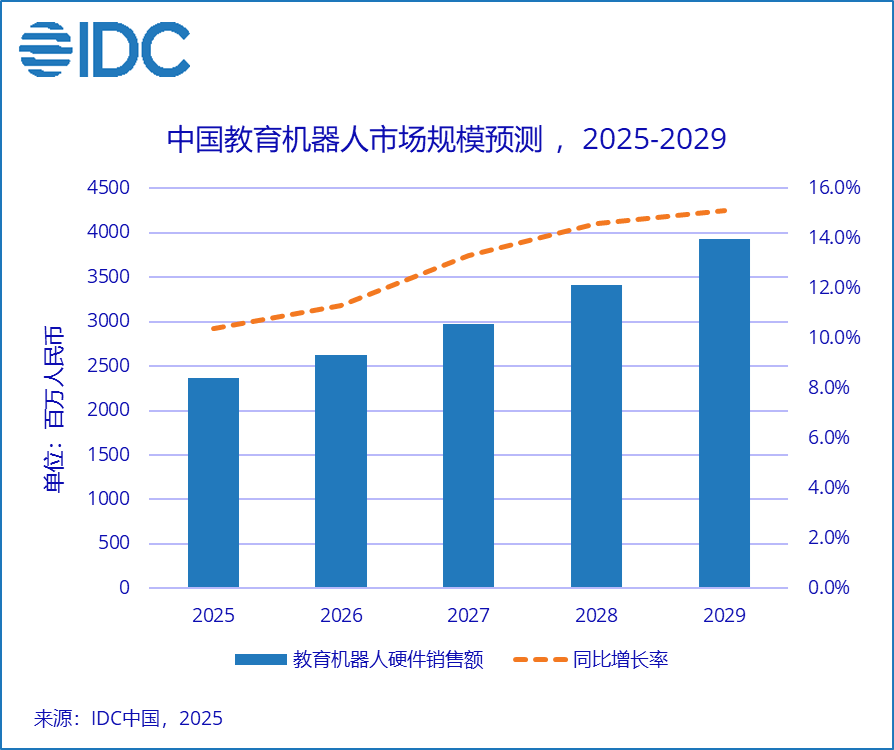
IDC defines educational robots as intelligent products that are automatically controlled by computers, capable of connecting to the internet, with one or more degrees of freedom or the ability to express human-like emotions, and contain educational content. Educational robots can be specifically divided into three categories: programming robots, bionic robots, and interactive robots.
Educational Programming Robots
• Core Features: Designed for programming education, consisting of standardized building blocks, mechanical parts (gears, motors, connectors), and electronic modules (sensors, controllers), which need to be manually assembled into different forms (such as cars, robotic arms, humanoid structures), or have relatively fixed hardware structures (such as cars, tanks), focusing on controlling movement through programming (obstacle avoidance, line following, task execution).
• Representative Manufacturers:UBTECH, Alpha Egg, DJI, LEGO SPIKE Prime, Makeblock, etc.
Educational Bionic Robots
• Core Features: Mimicking human or animal forms (such as humanoid or quadruped robots), possessing multi-joint movement capabilities, capable of combining voice and visual interaction, supporting complex action programming and scene simulation in educational contexts.
• Representative Manufacturers:UBTECH, Loona, etc.
Educational Interactive Robots
• Core Features: Centered on voice interaction and image recognition, capable of Q&A, course explanations, and personalized learning guidance, supporting AI scenario-based teaching (such as early education Q&A, simulated English conversations, chess teaching, scientific experiment demonstrations, etc.).
• Representative Manufacturers:Alpha Egg, Yuanluobo, etc.
IDC’s research found that the development of the educational robot market has the following characteristics and directions:
1. A Flourishing Landscape—The Market Structure is Still in a Stage of Intense Change
Educational robotics has a long history, and in recent years, with the development of the AI industry and the emphasis on basic computer skills training in education, the programming robot market has developed steadily and formed a complete educational system based on courses and competitions. Although international brands like LEGO have a high-end competitive advantage, Chinese manufacturers such as UBTECH and Makeblock have also achieved stable development through years of building offline course systems and content services. In the field of bionic robots, domestic manufacturers like UBTECH and Kexin Technology have miniaturized bipedal and quadrupedal robots for educational scenarios, adding more fun and intelligent programming education products.
2. Specialization—The Deepening of Sub-Scenes and Professional Division of Labor in Educational Contexts is Becoming More Defined
The demand for differentiated education and personalized education has become more apparent, such as early education, K12 programming enlightenment, language learning, and chess learning. These different learning scenarios have different requirements for product definitions and functions, prompting more detailed classification of products in educational contexts, thus providing more matching technical solutions in AI interaction, sensing, and software content.
3. Integration—Building a Value Ecosystem Model of Hardware + Content + Services
In terms of long-term development, educational robot manufacturers will be more inclined to provide comprehensive solutions of “robot + courses/content + competitions/services”. For example, UBTECH and Alpha Egg are building related resource systems to enhance product value and create a closed-loop ecosystem. From industry practice and user demand, this integrated service model essentially solves the landing gap in educational scenarios through resource collaboration. This full-chain coverage allows robots to upgrade from a single teaching tool to a comprehensive educational carrier of “teaching implementation + capability assessment + interest stimulation”.
PAN Xuefei
Research Director, IDC China

PAN Xuefei, Research Director of IDC China, stated that the educational robot sector is transitioning from “hardware innovation” to “ecological competition”. The current market structure is still uncertain, and local manufacturers are forming differentiated competition with international brands through content and service accumulation. In the future, simple competition based on technical parameters will gradually give way to a deep understanding of educational scenarios and resource integration capabilities. The ability to build an integrated solution of “hardware + content + services” around layered and personalized needs will be key for companies to break through. This new track is not only about the implementation of technology but also a long-term test of the deep integration of the essence of education. IDC predicts that manufacturers who complete the ecological closed-loop layout first will occupy a core position in growth over the next five years.
Disclaimer
All content and data in this article are sourced from reports published by IDC, and all content and data are owned by our company. Without IDC’s written permission, no organization or individual may reproduce, copy, publish, or quote in any form.

End of Article
IDC CONTENT HUB



Contact Us
Scan the QR code on the left
Stay in touch with us
For related inquiries, please contact:
Wang Yong, Vice President, IDC China
Phone: (+86-10) 5603 4087
Email: [email protected]
Liu Xiaoting, Customer Support Representative, IDC China
Phone: (+86-10) 5082 5797
Email: [email protected]
Xie Jing, Marketing Department, IDC China
Email: [email protected]
