Ford launched its next-generation infotainment system SYNC4 in 2020. The first vehicle equipped with SYNC4 is the all-electric Ford Mustang MACH-E.
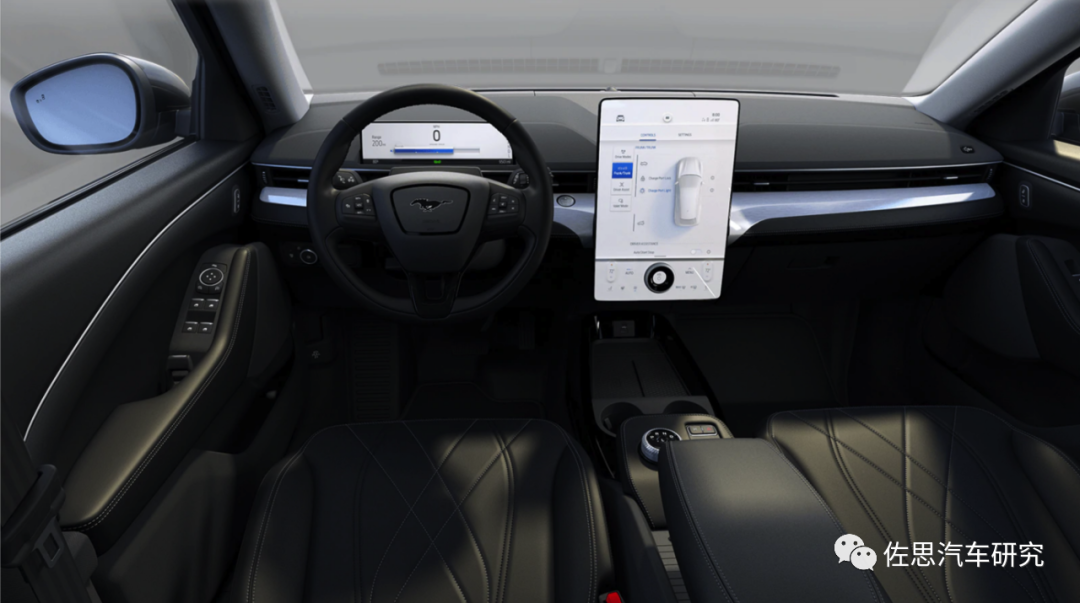
The all-electric Ford Mustang features a 10.2-inch instrument cluster and a 15.5-inch vertical screen. Similar to the Tesla Model 3, the large screen is also divided into two parts, with a resolution likely at 1920*1200. In the future, the vast majority of Ford models will be equipped with the SYNC4 system, with very few low-end vehicles using the Samsung Suzhou Harman CTR system. SYNC4 comes in three sizes: 8, 12, and 15.5 inches, with the 12 and 15.5-inch versions adopting a vertical layout.
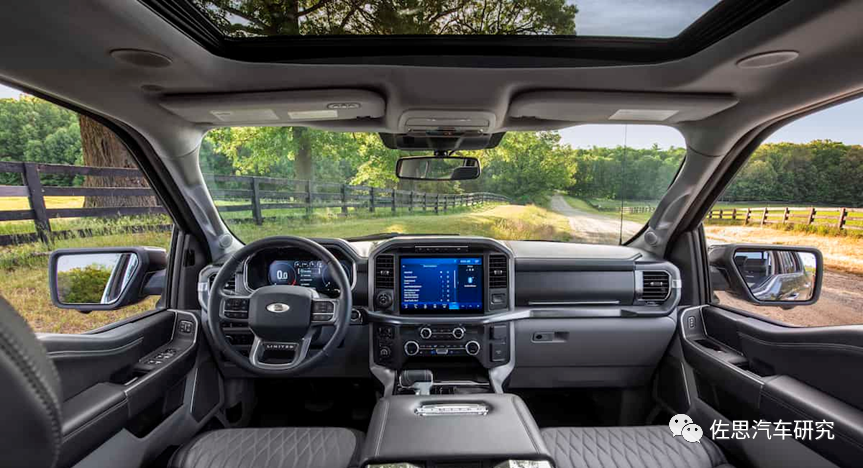
The 2021 Ford best-selling model F-150 comes standard with an 8-inch horizontal screen equipped with SYNC4, with an optional 12-inch vertical screen, and a 12.4-inch full LCD instrument cluster provided by Visteon. SYNC4 system achieves wireless connectivity between the vehicle and smartphones for the first time, supporting Apple CarPlay and Android Auto. Through the SYNC AppLink feature, applications like Waze and Ford + Alexa can also connect wirelessly to the infotainment system, allowing direct control of various vehicle functions (such as lights, air conditioning, radio, etc.) from the smartphone. Coupled with the wireless charging pad inside the vehicle, it allows you to completely eliminate messy data connection cables. SYNC4 will come standard with cloud platform connectivity, combining cloud big data with SYNC4’s computing power. By connecting to cloud data, navigation functions can be updated in real-time with current traffic conditions; at the same time, the cloud-based voice processing feature will enable SYNC4 to understand voice semantics more intelligently, providing reasonable suggestions to drivers based on big data. Additionally, SYNC4 retains local data processing capabilities, ensuring a smooth and intelligent user experience even in remote areas with poor signal. Furthermore, SYNC4 can continuously learn the driver’s preferences and provide suggestions based on usage habits. SYNC4 introduces a new digital owner’s manual that supports direct database searches, allowing consumers to easily find detailed information about vehicle functions without flipping through dozens of pages. It also includes videos to help users learn about relevant features more quickly and effectively. The in-car audio entertainment platform SiriusXM with 360L equipped in SYNC4 will provide drivers with a wealth of entertainment resources. SYNC4 also supports OTA updates. To reduce costs and better optimize software, SYNC4 was designed internally by Ford and manufactured by the contract manufacturer Flex, similar to how Geely operates domestically, completing design in-house. SYNC4 is available in two versions: G and GL, with the GL version being slightly lower. Designed in 2018, it was basically completed by September 2019. The previous generation SYNC3 was primarily produced by Panasonic and Harman (now acquired by Faurecia). Additionally, Ford’s T-Box, or TCU, has also begun internal design, with production outsourced to Visteon.
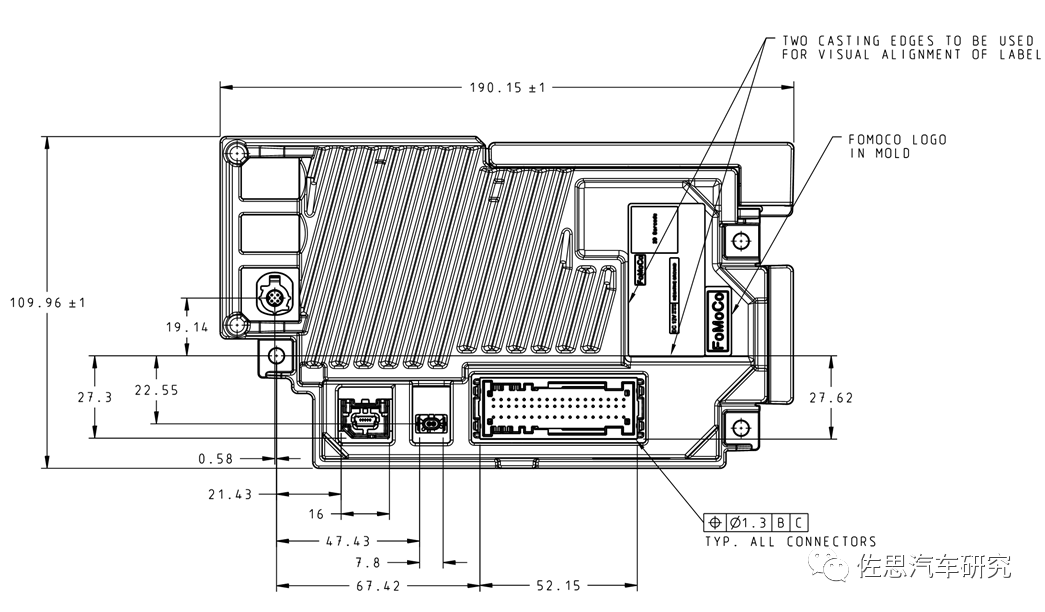
SYNC4 is significantly smaller in size compared to other infotainment systems.
The maximum thickness of the infotainment system is 33.95 mm, while the minimum thickness is only 23.1 mm. Some systems, such as the next-generation Lexus (Renesas H3 system) and Honda (Qualcomm 820A system), have thicknesses close to 100 mm.
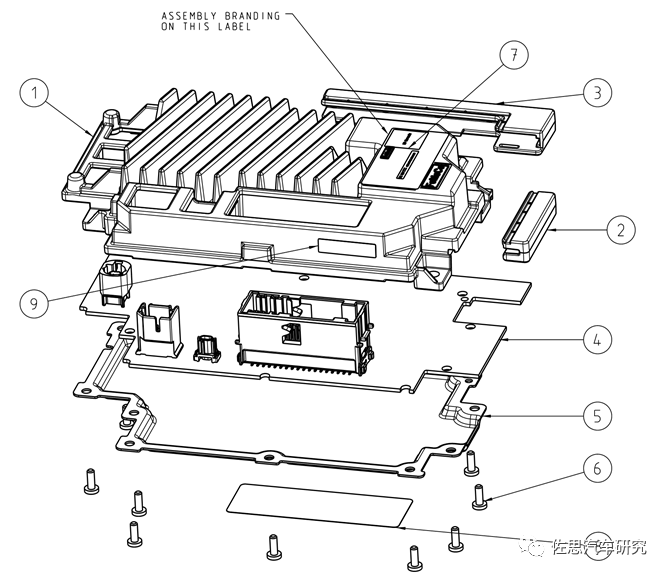
SYNC4’s exploded view
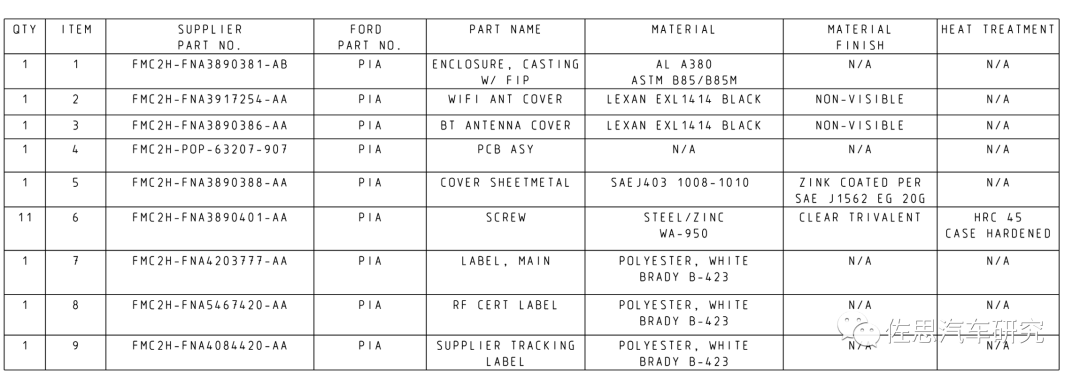
1 is the aluminum alloy shell, using the most common A380 cast aluminum alloy. 2 is the WIFI antenna cover, 3 is the Bluetooth antenna cover, both made from LEXAN provided by Saudi SABIC, which is actually polycarbonate. 4 is the PCB board, 5 is the rear shell, made from SAE J403 low carbon steel. 6 is 11 steel-zinc alloy screws. 7/8/9 are certification labels.
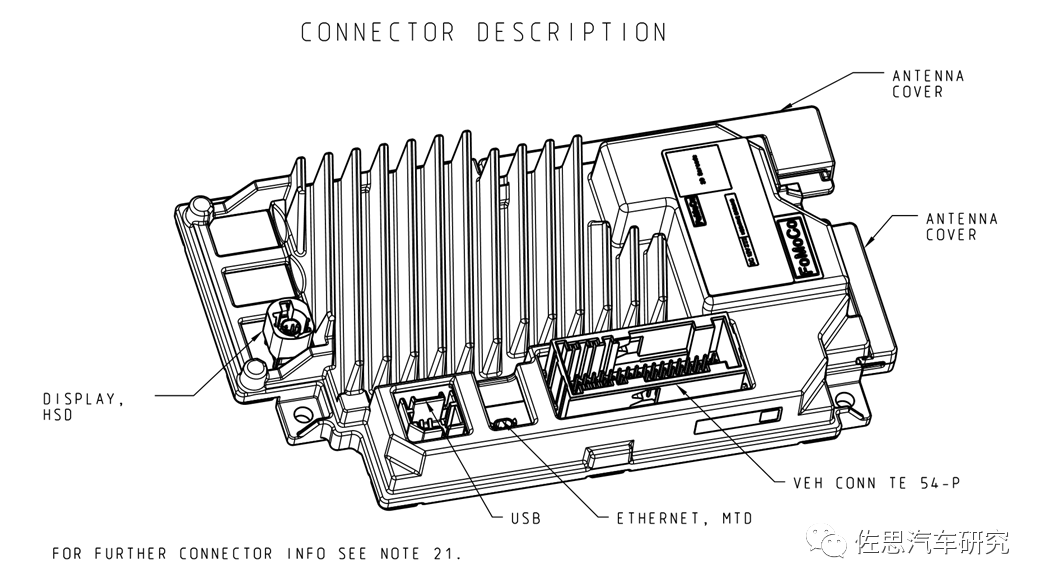
SYNC4’s connections are quite simple, featuring one HSD display, one Ethernet, one USB, one CAN power main interface, and a video input that is not marked in the diagram. There is also a reserved position for a video output interface.
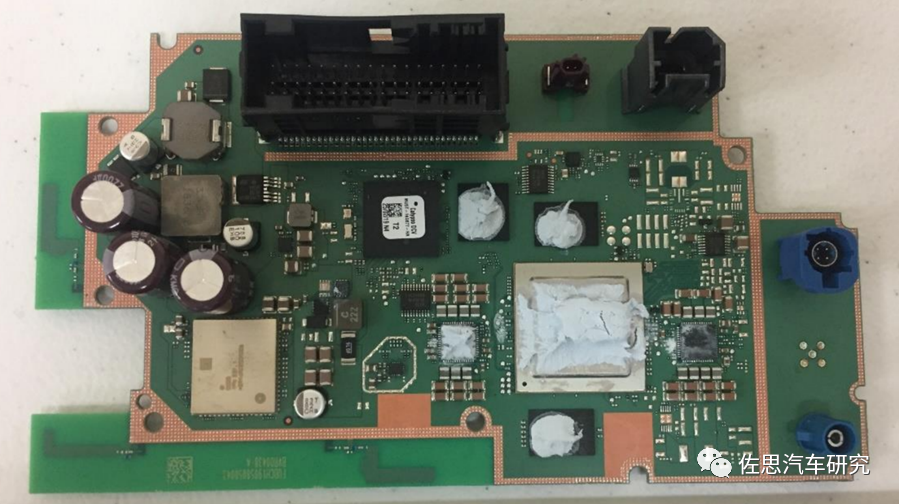
The front of the circuit board is shown in the image above, with some space reserved for video I/O.
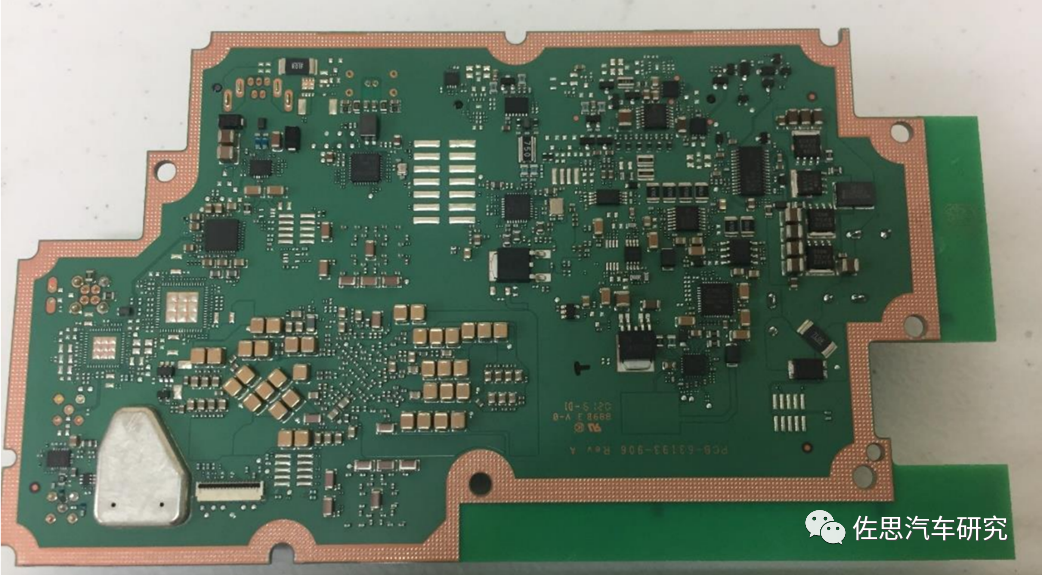
The back of the circuit board is shown in the image above
SYNC4 is jointly designed by Ford and NXP, utilizing the complete set of NXP chips, with the main chip being the i.MX8QM, power management handled by the PF8100, and the Ethernet switch being the SJA1105, which is a 5-port AVB/TSN Ethernet switch. The Ethernet physical layer is the TJA1102S. The MCU is NXP’s MPC5748G, which has ASIL-D level safety. In terms of storage, it likely uses Micron’s 4GB DRAM and Samsung’s 32GB EMMC. The audio part is independent, completed by Visteon, referred to as AHB, and is not located within the infotainment system but in the trunk, responsible for AM/FM/DAB reception, while also receiving SiriusXM’s network audio, and can simulate engine sound for electric vehicles. AHB connects to the infotainment system via Ethernet, and the audio power amplifier is also within AHB.
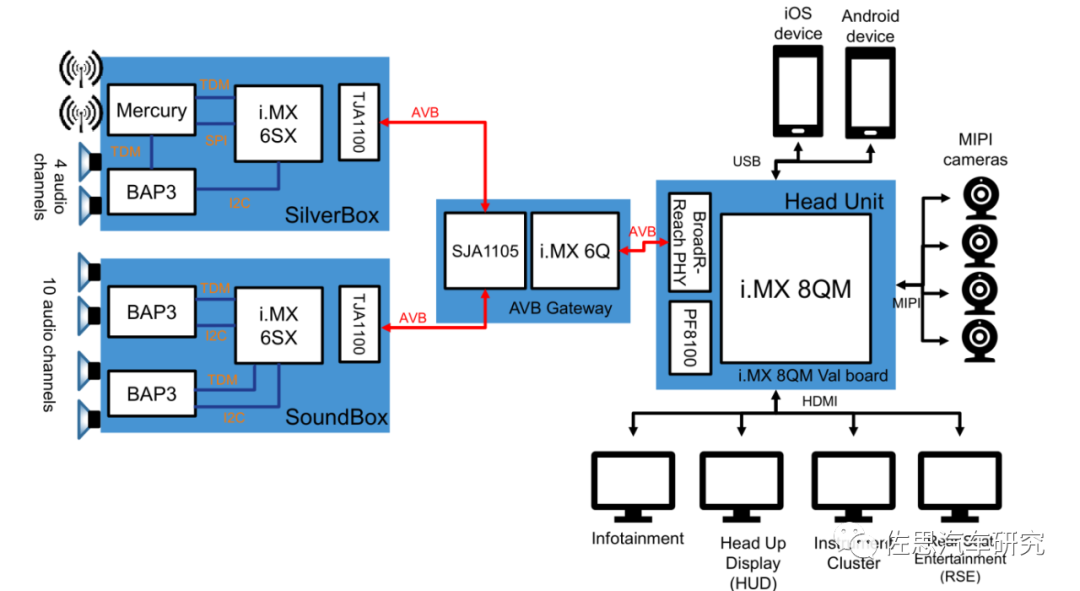
The SilverBox and AVB gateway in the image represent AHB. The standard configuration is 4-channel audio, with Mercury being NXP’s reception and audio processing part, including FM/DAB/HD, featuring multi-standard software-defined radio and tuning. BAP3 is NXP’s Class D audio power amplifier, expandable to 10 audio channels.
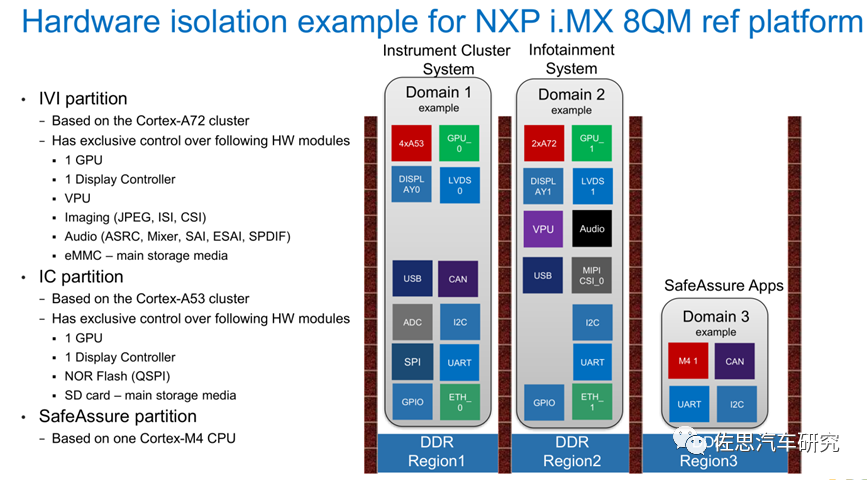
The i.MX8QM adopts a hardware partition design, allowing for dual-screen operation without using expensive and complex software virtual machine technology, while driving both the central control and instrument cluster.
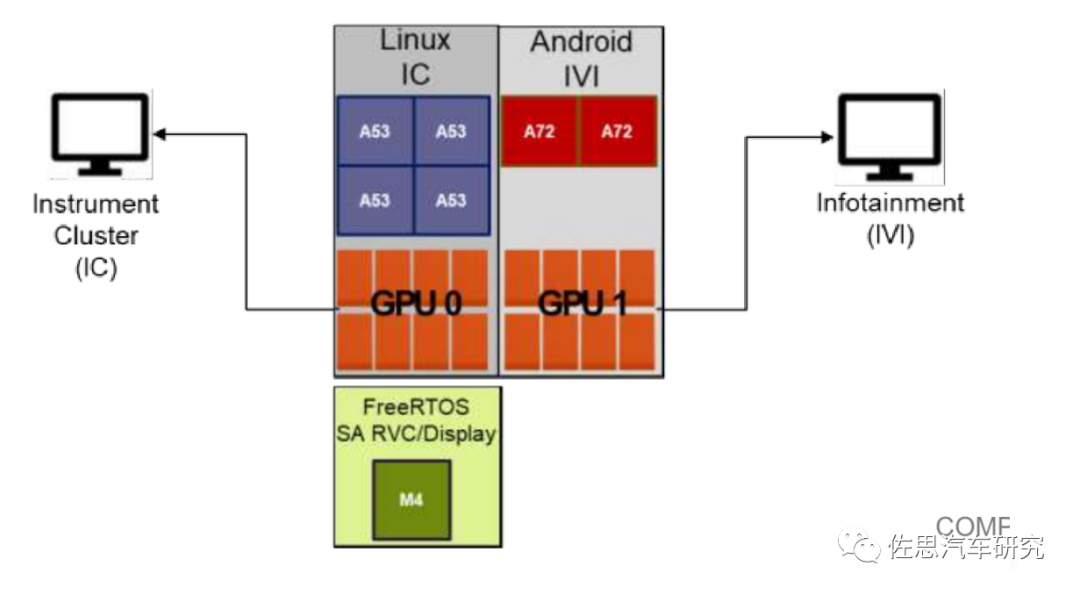
Hardware Partition refers to the division or isolation of hardware resources. Based on the NXP i.MX8QM’s Hardware Partition feature, resources such as Resource, Memory, and Pad are managed through hardware partitioning. The partition that owns the hardware resource has access and management rights to that resource, while other partitions cannot operate on it. This Hardware Partition feature enhances the i.MX8QM’s management of hardware resources, simplifying resource ownership and management issues, and facilitating software development. The Hardware feature based on NXP i.MX8QM can be used for dual-system development. The i.MX8QM is a multi-core chip, including 4x A53, 2x A72, and 2x M4 cores. By creating hardware partitions for two systems, different hardware resources can be allocated to these two partitions, with A53 and A72 cores assigned to each system partition, ultimately allowing the CPUs on both partitions to independently run a set of operating systems. The NXP i.MX8QM chip is widely used in the automotive industry, and the dual-system (A53 running Linux, A72 running Android) enabled by its Hardware Partition feature can be used for instrument and central control entertainment systems.
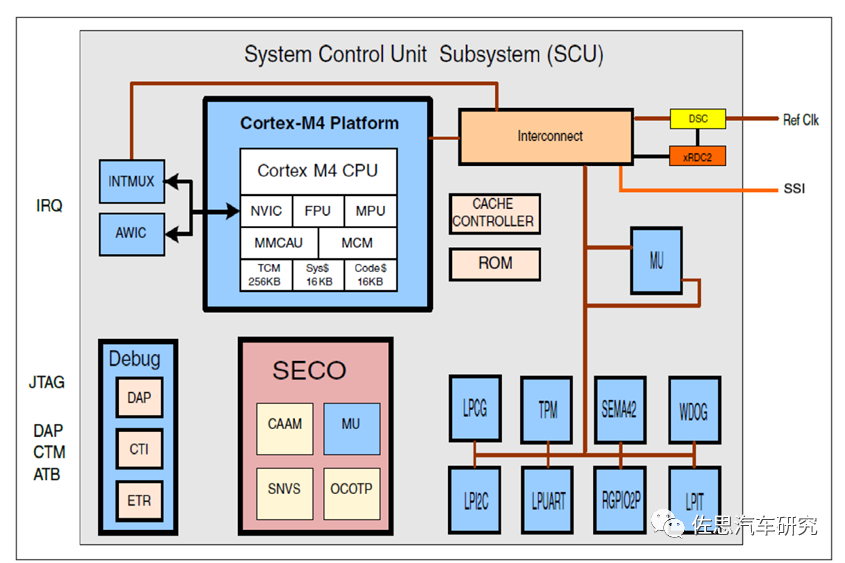
The SCU subsystem in the i.MX8 and i.MX8X series plays a central control role, primarily consisting of a Cortex-M4 with 256 KB TCM, along with some dedicated peripherals and external communication devices. This M4 is not open for general user access and is only provided for internal system control, so various resources within the subsystem cannot be accessed by other cores.Hardware partitions have the following characteristics, all partitions:
-
Can be created and destroyed at startup, and dynamically created during runtime
-
Have a hierarchical relationship, with each partition having a parent (SCFW has no parent, partition number 0)
-
Resources contained within a partition: Resource (master and peripheral), Pad, and Memory
-
By default, only access to owned resources is permitted
-
Can boot, reset, and power off
-
Have power states; can transition to other power states
-
Have watchdog timers, RTC alarms, and system counter alarms
Resources represent IP blocks within the SOC. They can be hosts, peripherals, or both. Resources always belong to one (and only one) partition. Access control for resources includes two main mechanisms:
-
API access rights – SCFW API functions use information such as calling partition and resource parameters to determine whether operations can be performed on resources. The ownership of resources and the hierarchical relationship between the owning partition and calling partition are used to determine whether operations are authorized.
-
Hardware protection – SCFW programs the underlying protection hardware (in i.MX8, this is XRDC2) to control which hosts can access which peripherals. It maintains access rights for each resource, and owners can set access rights for each access partition.
By default, only hosts within the same partition can access peripherals within that partition. Resources can be allocated or moved to another partition (the allocating partition will no longer own that resource). The main resource can set security, privileges, SMMU bypass, and streamID (SID). Peripheral resources can set access rights. The security state of the main resource can only be set when the partition owning the main resource is secure. Currently, SYNC4 has not yet adopted this hardware partitioning method, but based on the reserved spaces on the circuit board and the reserved terminals, it is possible that SYNC4 may adopt this method in the future. Hardware partitioning can significantly reduce costs, and the difficulty of software development is much lower than that of virtual machines, although the downside is that resource utilization efficiency may be somewhat low, and two A72 cores may not be sufficient.
Research report writing plan for Zosi 2021
Panorama of the Intelligent Connected Vehicle Industry Chain (December 2020 Edition)

「Zosi Research Annual and Quarterly Reports」
| OEM Autonomous Driving Strategy | Low-Speed Autonomous Driving Research |
| Automotive Vision Market (Part 1) | Automotive Vision Market (Part 2) |
| Commercial Vehicle Autonomous Driving Research | Emerging Intelligent Vehicle Manufacturing |
| Automotive MLCC Research Report | Automotive Car-Sharing Research |
| Automotive Simulation Research (Part 1) | Automotive Simulation Research (Part 2) |
| High-Precision Map Industry Research | Automotive and Domain Controller Research |
| APA and AVP Industry Research | Vehicle Laser Radar Research |
| Vehicle Millimeter-Wave Radar Research | Processors and Computing Chips |
| DMS Driver Monitoring Report | Automotive Power Semiconductor Research |
| HUD Industry Research Report | ADAS and Autonomous Driving Tier 1 |
| Passenger Vehicle Camera Quarterly Report | Passenger Vehicle Camera Quarterly Report Q2 |
| OEM Vehicle Networking Product Analysis | T-Box Market Research Report |
| Automotive Gateway Industry Research | In-Vehicle Voice Industry Research |
| Automotive Wiring Harness and Cable Research | Automotive Intelligent Cockpit Research |
| Human-Machine Interaction Industry Research | V2X and Vehicle-Road Collaboration Research |
| Automotive Operating System Research | L4 Autonomous Driving Industry Research |
| Dedicated Vehicle Autonomous Driving Research | Computing Platforms and System Architecture |
| Millimeter-Wave Radar Disassembly Research | Shared Mobility and Autonomous Driving |
| Automotive High-Precision Positioning Research | In-Vehicle Infrared Night Vision System |
| Automotive OTA Industry Research | Automotive IGBT Industry Research |
| Automotive Cockpit Multi-Screen and Linked Screens | Tesla New Four Modernizations Research |
| Daimler New Four Modernizations Research | BYD New Four Modernizations Research |
| Intelligent Rearview Mirror Research | AUTOSAR Software Research |
| Roadside Intelligent Perception Research | Fuel Cell Market and Trends |
| Volkswagen New Four Modernizations Research | Cabin SOC Research |
| Steer-by-Wire Chassis Research | Huawei New Four Modernizations Research |
| ADAS/AD Main Control Chip | Independent Brand Vehicle Networking |
| Automotive Digital Key Research | Automotive Cloud Service Platform |
| Wireless Communication Module Research | In-Vehicle Display Industry Research |
| Tier 1 Intelligent Cockpit (Part 1) | Tier 1 Intelligent Cockpit (Part 2) |
| Commercial Vehicle Vehicle Networking | Joint Venture Brand Vehicle Networking |
| Intelligent Connected and Autonomous Driving Base | OEM Information Security |
| Commercial Vehicle ADAS | Autonomous Driving Regulations Research |
「Zosi Research Monthly Reports」
ADAS/Intelligent Vehicle Monthly Report | Automotive Cockpit Electronics Monthly Report | Automotive Vision and Radar Monthly Report | Battery, Motor, and Control Monthly Report | V2X and Vehicle-Road Collaboration Monthly Report/In-Vehicle Information System Monthly Report / Passenger Vehicle ACC Data Monthly Report / Front View Data Monthly Report / HUD Monthly Report / AEB Monthly Report
Report Order Contact: Zhao Zhifeng18702148304(Same WeChat) Zhang Yafei 13716037793(Same WeChat)