1 Content Introduction
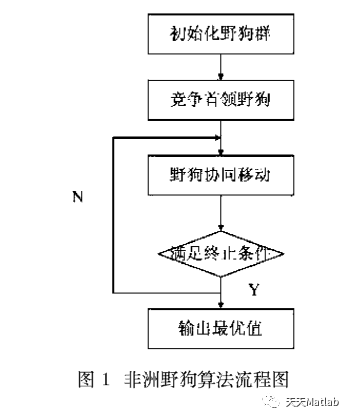
The African wild dog primarily lives in the dry grasslands and semi-arid regions of Africa. They are often found in grasslands, savannas, and open dry shrublands. They usually live in packs with a territory ranging from 200 to 2000 square kilometers, using vocalizations for positioning. They hunt cooperatively, targeting medium-sized ungulates, reaching speeds of up to 45 km/h during the chase. Each pack typically consists of about 40 members, with adult members usually numbering between 7 to 15, led by a dominant pair. They excel in cooperation, with the male leader guiding the hunt within their territory. The African wild dog relies on sight rather than smell for hunting; they will closely chase their prey until it is exhausted. They communicate using various methods to establish connections among themselves, utilizing scents (olfaction), sounds, and body language. Their strong sense of smell allows them to easily detect other pack members from a distance. During hunts, the African wild dogs use vocalizations for positioning, with sounds resembling bird calls, which can be an unusual low growl or chirping until the hunt is successful. The Dingo Optimization Algorithm (DOA) is inspired by the hunting behavior of these dogs, simulating their group hunting strategies to find optimal values. The algorithm initializes the positions of the hunting dogs, competes for leadership, and coordinates movements in several steps to solve optimization problems. The flowchart of the algorithm is shown in Figure 1.
2 Simulation Code
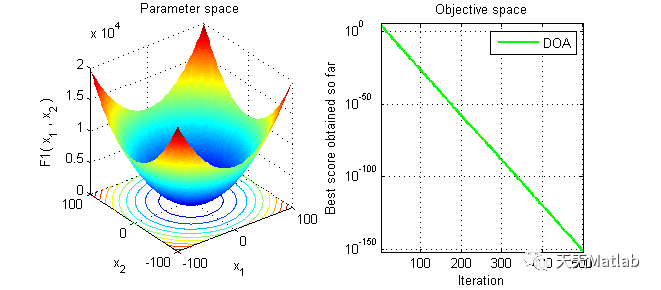
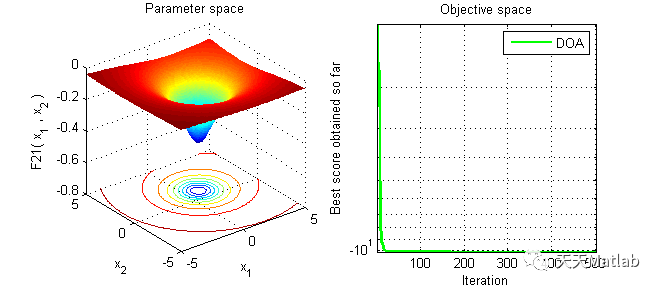
%_________________________________________________________________________%% Dingo Optimization Algorithm (DOA) source code %% %% A Bio-Inspired Method for Engineering Design Optimization Inspired by %% Dingoes Hunting Strategies. %% Mathematical Problems in Engineering. (2021). Hindawi. % %% DOI: doi.org/10.1155/2021/9107547 %%_________________________________________________________________________%clearclcclose allSearchAgents_no=100; % number of dingoesFunction_name='F21'; % Name of the test function. From F1 to F23 (Table 2,3,4 in the paper)Max_iteration=500; % Maximum number of iterations% Load details of the selected benchmark function[lb,ub,dim,fobj]=Get_Functions_details(Function_name);[vMin,theBestVct,Convergence_curve]=DOA(SearchAgents_no,Max_iteration,lb,ub,dim,fobj);figure('Position',[269 240 660 290])%Draw search spacesubplot(1,2,1);func_plot(Function_name);title('Parameter space')xlabel('x_1');ylabel('x_2');zlabel([Function_name,'( x_1 , x_2 )'])%Draw objective spacesubplot(1,2,2);semilogy(Convergence_curve,'Color','g','linewidth',2)title('Objective space')xlabel('Iteration');ylabel('Best score obtained so far');legend('DOA');axis tightgrid onbox ondisplay(['The best solution obtained by DOA is : ', num2str(theBestVct)]);display(['The best optimal value of the objective function found by DOA is : ', num2str(vMin)]);%__________________________________________________________________________3 Running Results
4 References
[1] Zhao Jianqiang, Miao Zhangxiao, Guo Jialiang, et al. Research on TSP Problem Based on Binary-Coded African Wild Dog Algorithm [J]. Mathematics Practice and Understanding, 2018, 048(022):304-312.