

Application Background
01
In the wave of intelligent high-end equipment, from unmanned aerial vehicles to industrial automation systems, their core performance increasingly relies on the reliability, safety, and resilience of complex embedded control architectures. The fault tolerance of these systems under real operating conditions directly determines the success or failure of missions, asset safety, and even public safety.
Taking long-endurance unmanned aerial vehicle systems as an example, their flight control systems must continuously process data streams from multiple sensors (such as IMU, GPS, and airspeed tubes) and interconnect information through multiple buses. If transient data frame loss, abnormal bus levels, or common-mode failures occur in critical navigation links under complex electromagnetic environments or extreme weather conditions, can the flight control algorithms perform fault diagnosis and isolation within milliseconds? Can they switch seamlessly to backup channels based on preset redundancy management strategies to ensure continuous stability of flight posture?

The essence of this issue is a severe test of the system fault mode coverage and dynamic response mechanisms. Traditional testing methods struggle to accurately and repeatably simulate specific fault scenarios in embedded links within laboratory environments, thus failing to effectively verify the robustness of the system under boundary conditions.
To address this, fault injection technology has evolved from an auxiliary verification method to an indispensable part of the high-reliability system development process. It primarily simulates faults in various signal links, accurately reproducing hundreds or thousands of fault scenarios such as sensor contradictions, bus disconnections, and signal short circuits, thereby comprehensively assessing the system’s fault detection, isolation, and recovery capabilities, providing a crucial verification foundation for the R&D of unmanned systems, aviation, aerospace, and other safety-critical fields.

Solution
02
To meet a certain unit’s demand for extreme fault scenario testing of flight control systems, we provided a fault injection system that integrates hardware injection, software management, and multi-protocol support, aiming to offer users a comprehensive, precise, and repeatable fault testing solution for critical systems.
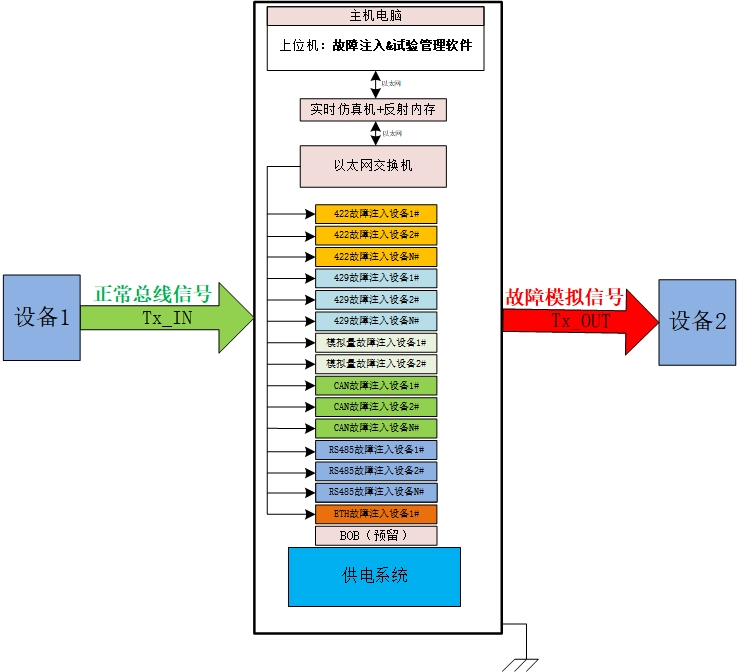
The system mainly consists of management control computer, real-time simulator, fault injection devices, and related software. The management control computer has functions such as permission management, fault mode configuration, communication management, and self-checking, and controls the fault injection devices via Ethernet. The fault injection software runs on the management control computer and can simulate faults for various system interfaces, injecting faults into the device under test in a series manner.
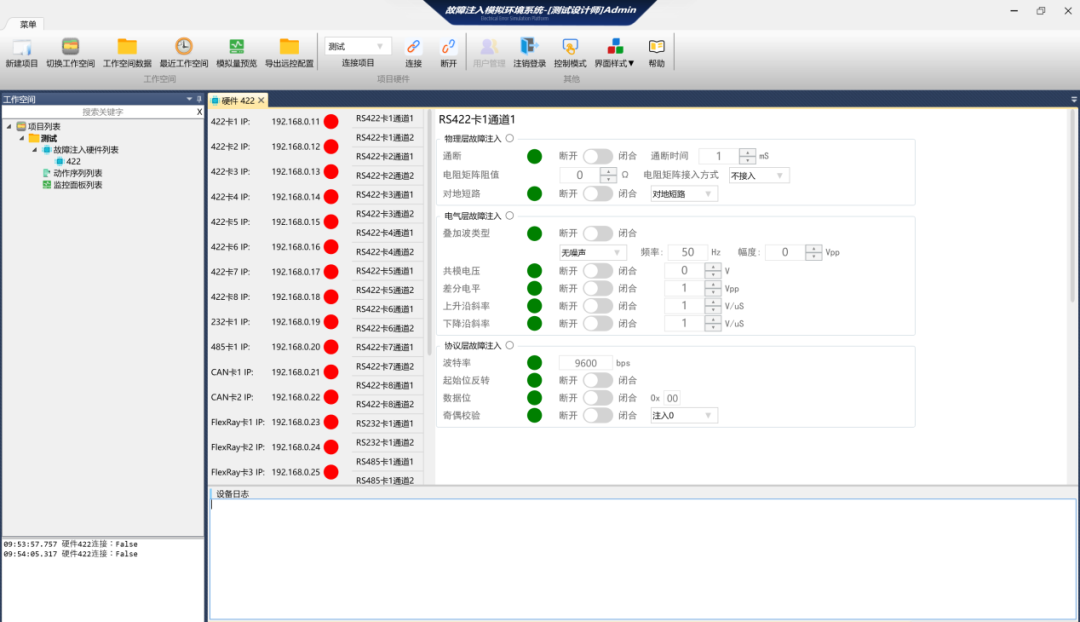
Each device in the fault injection system is independent of the tested system and connects to the transmission path of the tested system in a serial manner, allowing signals to pass normally without a fault environment; under fault conditions, it can achieve fault injection at the physical layer, electrical layer, and protocol layer.

Platform Features
03
-
Support for Multiple Protocols: Supports fault simulation and injection functions for ARINC 429, RS422, RS485, CAN, analog signals, ETH bus, etc.
-
Full-Level Fault Injection Capability: Supports fault injection at the physical layer (disconnection/short circuit/impedance/capacitance), electrical layer (common-mode adjustment/slopes control/noise superposition), and protocol layer (start bits/data bits/parity bits tampering), covering full-link anomaly simulation from signal integrity to communication protocols.
-
Intelligent State Machine Management and Seamless Switching: Based on FPGA multi-layer state machine design, ensuring smooth switching of various state levels during fault injection, avoiding intermediate state interference, and ensuring controllability and repeatability of the testing process.
-
Strong Real-Time Performance: Integrates a high-performance real-time simulator as the ‘dynamic decision center’, with microsecond-level hard real-time capabilities, ensuring high synchronization of fault injection timing and system response, achieving closed-loop testing of fault injection and system response, greatly enhancing the accuracy and reliability of testing.
-
Injection and Response Interaction: Supports real-time fault triggering based on model states, simulating sudden abnormal conditions during system operation, achieving full-process automation of “fault-response-record”.

Application Value
04
-
Breakthrough in Verification Capability: Accurately reproducing extreme fault scenarios that were previously untestable, achieving full coverage of reliability verification;
-
Testing Efficiency Multiplication: Supports automated batch testing, shortening lengthy fault verification cycles by several times;
-
Preemptive R&D Risks: Exposing potential system defects early in the laboratory, significantly reducing later rectification costs and risks;
-
System Confidence Assurance: Provides critical data support for the stable operation of flight control systems in real complex environments.

Conclusion
05
The fault simulation environment system is not just a testing device but a strategic tool for the reliability engineering of future complex systems. We are committed to providing more users with fault testing solutions that are reliable and precise, supporting China’s intelligent manufacturing in achieving a higher reliability era through continuous technological iteration and deep industry engagement.

About Us
Beijing Lingsi Chuangqi Technology Co., Ltd. provides an integrated platform for intelligent equipment simulation testing, LINKS-XIL, and lightweight digital twin solutions based on the forward design methodology MBSE. It is the first domestic manufacturer to propose a miniaturized, prototyped, scenario-based, and standardized industrial digital twin platform. Implemented in unmanned systems, robotics, motor servo control, and other vertical industry scenarios, it serves industries such as national defense, military industry, commercial aerospace, automotive, energy, and factory automation, assisting in the R&D design, virtual testing, and verification of equipment, shortening R&D cycles, reducing R&D costs, and improving R&D efficiency. In addition to serving industrial scenarios, our products are widely used in higher education and research fields, such as aerospace, robotics engineering, automation, electrical engineering, vehicle engineering, and artificial intelligence, enhancing the engineering and innovation capabilities of students and teachers. Based on advanced research products, customers have published over 70 high-level SCI/EI papers. Lingsi Chuangqi is one of the first batch of specialized and innovative enterprises in Beijing in 2021, with both software and hardware products having independent intellectual property rights, achieving import substitution in multiple industrial fields.