 ZigBee is one of the most important wireless protocols in wireless communication, widely used in various IoT communication fields. The success of ZigBee technology in IoT applications is inseparable from its powerful networking capabilities. In this article, we will explore the network types of ZigBee.
 ZigBee Network Device TypesZigBee defines two types of devices to make full use of hardware resources and avoid waste, while considering low power consumption and low-cost hardware. These are the Full-Function Device and Reduced-Function Device.
- Full-Function Device: Capable of data sending, receiving, and forwarding. It can establish new networks and perform routing discovery and maintenance, providing all IEEE 802.15.04 MAC services.
- Reduced-Function Device: Occupies fewer resources, has a smaller storage capacity, and is low-cost. It only has the capability to send and receive data, providing partial IEEE 802.15.04 MAC services.
 ZigBee Network Device RolesAfter defining device types, the next step is to assign different roles to devices within a network. In a ZigBee network, there are three device roles: Coordinator, Router, and End Device. These roles have the following characteristics:
- Coordinator: The ZigBee Coordinator is the information aggregation point and core node of the entire network. It is responsible for building, maintaining, and managing the network. The Coordinator usually serves as the gateway for ZigBee, responsible for protocol conversion with Wi-Fi and possesses all the functionalities of a Router.
- Router: The Router can send and receive data and is responsible for data path searching and maintenance, allowing Router or End Devices to join the network, typically used as a relay node between the Coordinator and End Devices.
- End Device: The End Device can send and receive data but cannot perform routing. End Devices can only connect to Coordinator or Router nodes. They are usually low-power devices, such as various sensors, relays, switches, etc.
Star NetworkThe star network is the most common network structure. It generally includes two types of devices: Coordinator and End Devices, with the Coordinator as the central node. All End Device information is sent directly to the central node, forming a star structure. The greatest feature of this networking structure is its simplicity and ease of use; since all nodes must connect to the central node, the number of supported nodes is relatively small, resulting in a smaller network scale.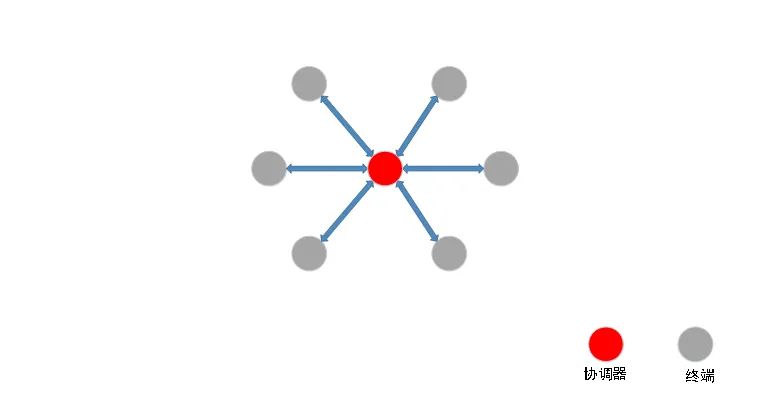
Figure 1 Star Network
ZLG Zhiyuan Electronics has launched the FastZigBee protocol which uses a star network structure. Unlike traditional star networks, FastZigBee does not have a Coordinator (the central node is assumed by a certain End Device), and all devices are End Devices, utilizing a point-to-point communication method where nodes can communicate with each other.
Mesh Network
The Mesh network typically consists of Coordinators, Routers, and End Devices. The Coordinator is essential for network construction and maintenance. Routers can forward data and plan information paths, making communication paths more flexible while increasing network scale. In a Mesh network, End Device information can traverse multiple routing hops to ultimately reach the target node. The information transmission paths are not unique, as each Router selects the most suitable transmission path based on network conditions, resulting in higher network reliability and flexibility. Compared to star networks, Mesh networks have a larger scale, supporting more network nodes, and due to the use of multi-level routing, the networking distance is significantly increased.

Figure 2 Mesh Network
ZLG Zhiyuan Electronics has launched the ZLG Mesh protocol using a Mesh networking structure, which has the following functional characteristics:
- Rapid routing addition, intelligent routing algorithms, quick communication recovery;
- Automatic path maintenance without manual router configuration;
- Supports multi-level hops, with a maximum of 15 routing levels.
It is important to note that FastZigBee and ZLG Mesh are two different communication protocols and cannot communicate with each other. Technical Exchange GroupLong press to recognize the QR code below to join the “Wireless Communication Technology Exchange Group” to interact with like-minded friends, and have professional technicians available to answer your questions. For inquiries, you can contact Xiaozhi WeChat: zlgmcu-888.

For more past articles, please click “ Read Original ”.