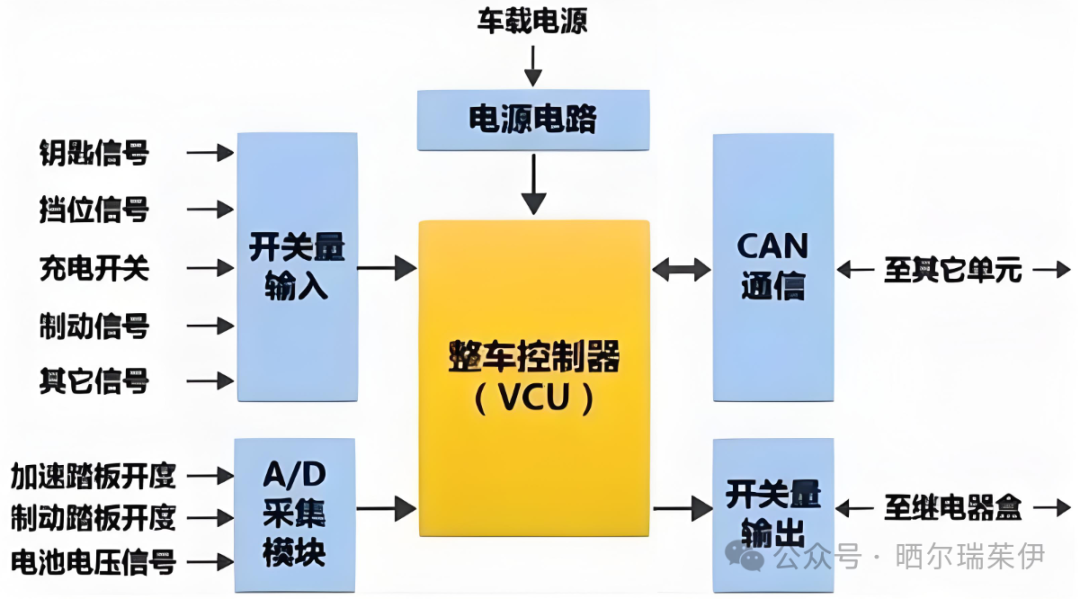
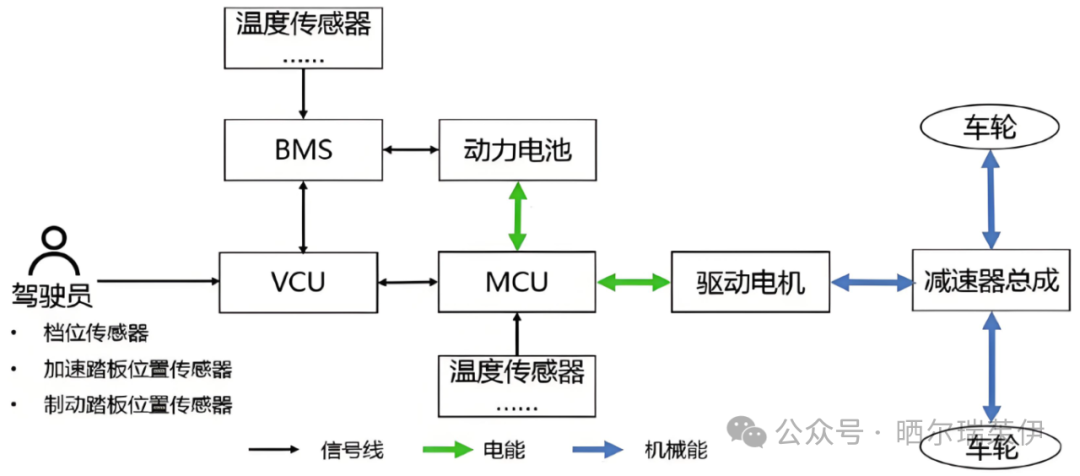
The control system of new energy vehicles operates through the collaboration of core modules such as VCU, MCU, and BMS, achieving efficient power output, battery safety assurance, vehicle status monitoring, and intelligent driving assistance. Its working principles encompass key technologies such as inverter control, state estimation, and thermal management, ensuring the vehicle operates in an efficient, safe, and comfortable manner.Image source: Internet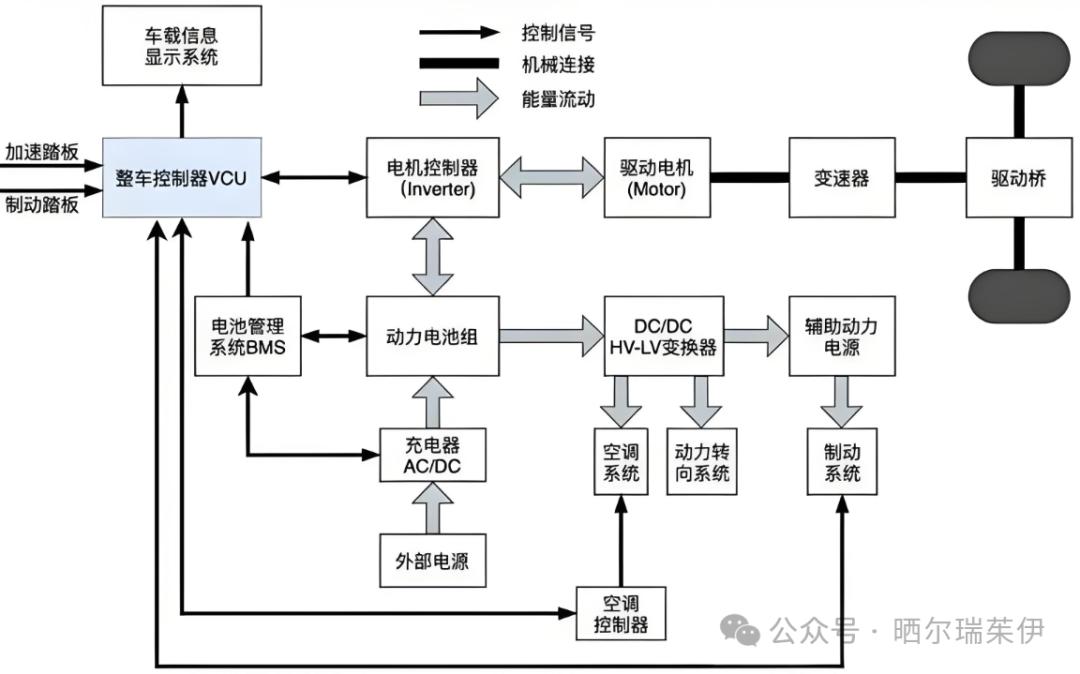 01 VCU (Vehicle Control Unit)Vehicle ControllerThe VCU serves as the “brain” of the vehicle, coordinating the operation of the battery, motor, and electric drive system, interpreting driver intentions (such as acceleration and braking), optimizing power output and energy distribution, and managing the high-voltage system’s power-up and power-down logic as well as range optimization. The core functions of the VCU include drive control, energy management (such as regenerative braking), thermal management coordination, fault diagnosis, and OTA upgrades.The control process of the VCU is mainly divided into three parts. First, it receives input signals, including driver operations (accelerator pedal, brake pedal, gear selection), the status of various subsystems (battery SOC, motor speed, fault information), and environmental information (vehicle speed, external temperature). Then, it makes decisions and generates commands based on the input signals, combined with preset strategies (such as energy management strategies, power distribution strategies), calculating target torque, power demand, regenerative braking intensity, etc. Finally, it issues commands and coordinates, sending control commands to the motor controller, battery management system, braking system, etc., while monitoring the execution status of each subsystem. If a fault occurs, it triggers protective mechanisms (such as limiting power output or alarms).Image source: Internet
 02 MCU (Motor Control Unit)Motor ControllerThe MCU is the core of the vehicle’s power execution, converting the DC power from the battery into three-phase AC power to drive the motor, precisely controlling speed and torque to achieve vehicle start, acceleration, braking, and energy recovery. The core functions of the MCU include inverter control (DC to AC), PWM modulation, and motor status monitoring (such as temperature and current).The control process of the MCU includes receiving commands, power conversion and driving, and status feedback. Receiving commands means obtaining target torque/speed commands issued by the VCU and the allowable output power feedback from the BMS. Power conversion and driving involve converting the battery’s DC power into three-phase AC power through the inverter, controlling the motor’s voltage, current, and frequency to achieve forward, reverse, or regenerative braking. Status feedback involves real-time monitoring of motor speed, temperature, current, etc., and reporting the operating status back to the VCU. In case of overcurrent or overheating, it triggers torque limiting or shutdown protection.03 BMS (Battery Management System)Battery Management SystemThe BMS serves as the core of energy control, monitoring the battery status (voltage, current, temperature) in real-time, preventing overcharging/over-discharging, extending battery life, and ensuring range and safety. The core functions of the BMS include SOC/SOH estimation, balancing management (passive/active balancing), thermal management (liquid cooling/air cooling), fault diagnosis, and communication.The control process of the BMS includes state monitoring, safety control, and energy coordination. State monitoring refers to the real-time collection of the battery pack’s voltage, current, and temperature through sensors, estimating SOC, SOH, and SOF. Safety control involves detecting anomalies such as overvoltage, undervoltage, overcurrent, and high temperature, triggering balancing control, cooling/heating control, and in severe cases, cutting off battery output. Energy coordination means receiving power demand commands from the VCU, combining the current state of the battery, and providing feedback to the motor controller on the maximum power that can be output/recovered, facilitating energy distribution and recovery. For more information on the BMS, refer to the previous article BMS: The Core of New Energy Vehicle Power Battery Systems.04 BCM (Body Control Module)Body Control ModuleThe BCM centrally manages the vehicle’s electrical devices (such as lights, windows, wipers), reducing wiring harness requirements and enhancing reliability. The core functions of the BCM include signal relay, power management, and fault storage and processing.The BCM controls actuators such as the air conditioning compressor, fan, and light relays by obtaining driver operations (such as air conditioning switch, light adjustment) or commands from other modules (such as battery heating requirements in low temperatures), adjusting the interior temperature, light modes, etc., while also detecting actuator faults (such as air conditioning compressor anomalies), reporting to the VCU, and triggering alarms.05 CDC (Chassis Domain Controller)Chassis Domain ControllerThe CDC acts as the “motion coach” of the chassis, with core functions including vehicle dynamic control (stability, maneuverability), coordination of regenerative braking (in collaboration with the VCU and braking system), adaptive cruise control, lane keeping, and other ADAS functions, enhancing driving comfort and safety through multi-system collaboration.The CDC calculates the required braking force, steering assistance, and suspension damping in real-time by integrating wheel speed, yaw rate, steering angle, and radar/camera targets, and issues commands to actuators via CAN FD or Ethernet.06 ADC (Automated Driving Controller)Automated Driving Domain ControllerThe ADC serves as the “commander” of high-level automated driving, with core functions including multi-sensor fusion (LiDAR, millimeter-wave radar, cameras, high-precision maps), path planning and decision-making, generating lateral/longitudinal control commands, redundant monitoring, and degrading or prompting takeover in case of faults.The ADC performs parallel computing through GPU/NPU, and then interacts with the chassis/power domain in milliseconds through perception, prediction, planning, and control, enabling functions such as lane keeping, automatic lane changing, and valet parking.Image source: Internet
 References:1.https://zhuanlan.zhihu.com/p/6633956452.https://blog.csdn.net/m0_56208280/article/details/1304158973.https://news.qq.com/rain/a/20250408A05O0800