Name: (Diacetoxyiodo)benzene, (二乙酰氧基碘)苯
Formula: C10H11IO4
Molecular Weight: 322.10
CAS Registration Number: [3240-34-4]
Abbreviations and Aliases: DIB, Iodobenzene Diacetate
Physical Properties: mp 163~165 °C, soluble in most organic solvents. Commonly used in MeOH, MeCN, and AcOH solvents.
Preparation and Commercial Availability: The commercial reagent is a white solid, available from foreign reagent companies. It can be prepared in the laboratory by oxidizing iodobenzene in acetic acid with peracetic acid [1].
Precautions: This reagent is relatively stable to air and moisture and should be stored in a cool, dry place.
——————————————————–
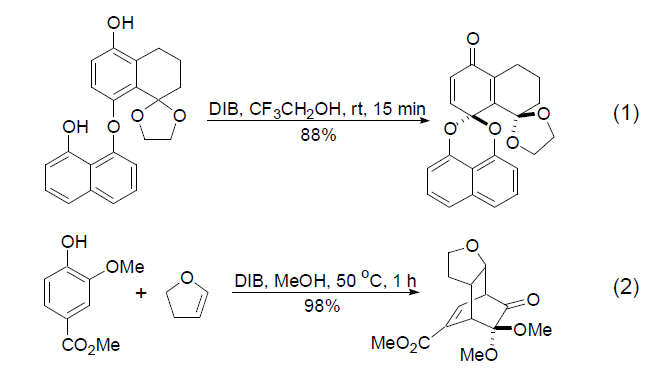
(二乙酰氧基碘)苯 (DIB) is a widely used mild selective oxidizing reagent in organic synthesis. It has many functions very similar to lead reagents and thallium reagents, but with lower toxicity and better reaction outcomes. Literature has provided a relatively detailed review of its properties and applications [2], and here we will exemplify a few well-established and widely used properties. DIB can oxidize phenols to generate radicals, disrupting the aromatic structure of phenols to produce quinones while also undergoing substitution reactions at the ortho or para positions [3]. The intramolecular substitution reactions have significant synthetic value and can be used in the synthesis of natural products (Scheme 1) [4,5]. If a diene is present, the generated quinone can also undergo a Diels-Alder reaction (Scheme 2) [6].
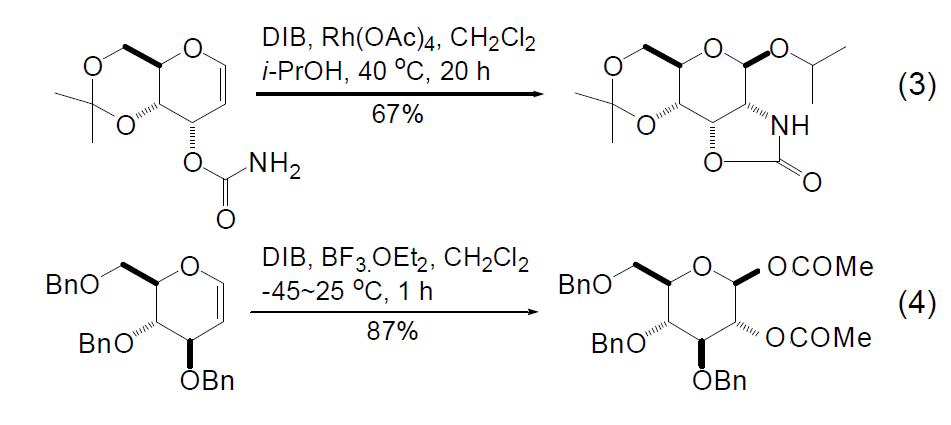
In the presence of DIB, alkenes can undergo addition reactions, where the functional groups added to the alkene can come entirely from DIB [7], or partially [8] or entirely from DIB [9]. This reaction has greater synthetic value in the addition reactions of enol ethers in sugars (Scheme 3, Scheme 4).
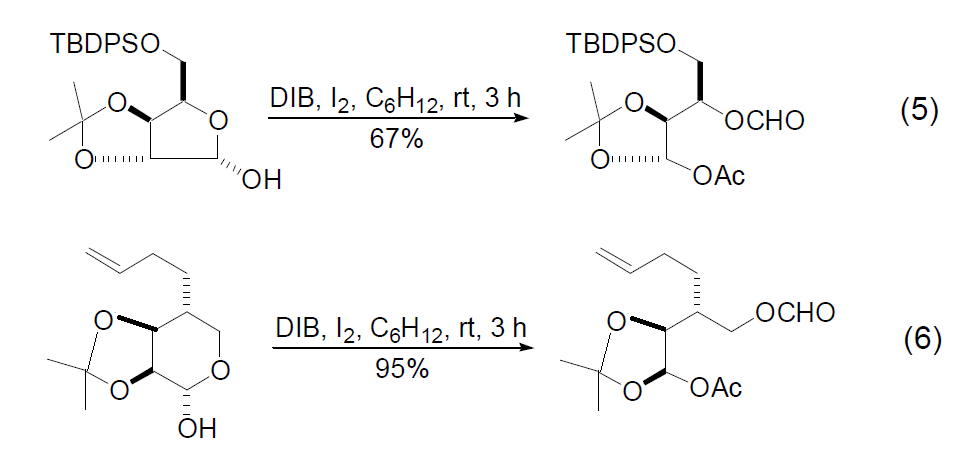
DIB’s reaction with hemiacetals results in the cleavage of C-C bonds, which is a traditional yet continually updated important reaction of this reagent. Choosing polycyclic hemiacetal substrates can yield highly valuable ring expansion products, often used in the synthesis of nine-membered or ten-membered target products [10]. There are numerous hemiacetal substrates in carbohydrate chemistry, and their reactions with DIB can yield sugar derivatives that are generally difficult to obtain using standard methods (Scheme 5, Scheme 6) [11,12].
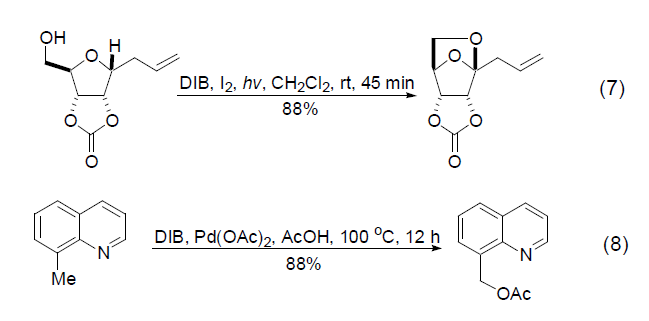
Recent literature has reported that DIB can activate C-H bonds on carbon atoms connected to oxygen atoms in substrates (Scheme 7) [13]. More significantly, metal Pd can catalyze the activation of C-H bonds on the γ-carbon atom of nitrogen atoms, with this selectivity primarily due to the formation of a five-membered ring complex between metal Pd and the nitrogen and γ-carbon atoms (Scheme 8) [14,15].
As an oxidant used in the Hofmann rearrangement reaction.
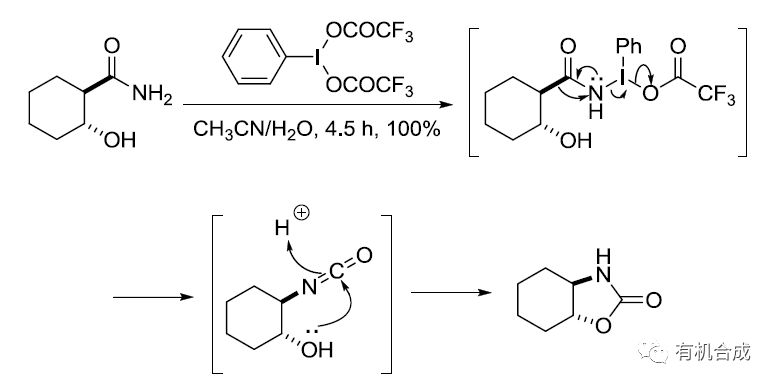
Tetrahedron Lett. 2001, 42, 1449–1452
Hunsdiecker-Borodin reaction, Suárez improved method【J. Org. Chem. 1986, 51, 402-404】, carboxylic acids and high-valent iodine reagents (iodobenzene acetate) react in CCl4, decarboxylation halogenation, significantly improving functional group tolerance compared to the classical Hunsdiecker-Borodin reaction.

J. Am. Chem. Soc. 2007, 129,10211–10219
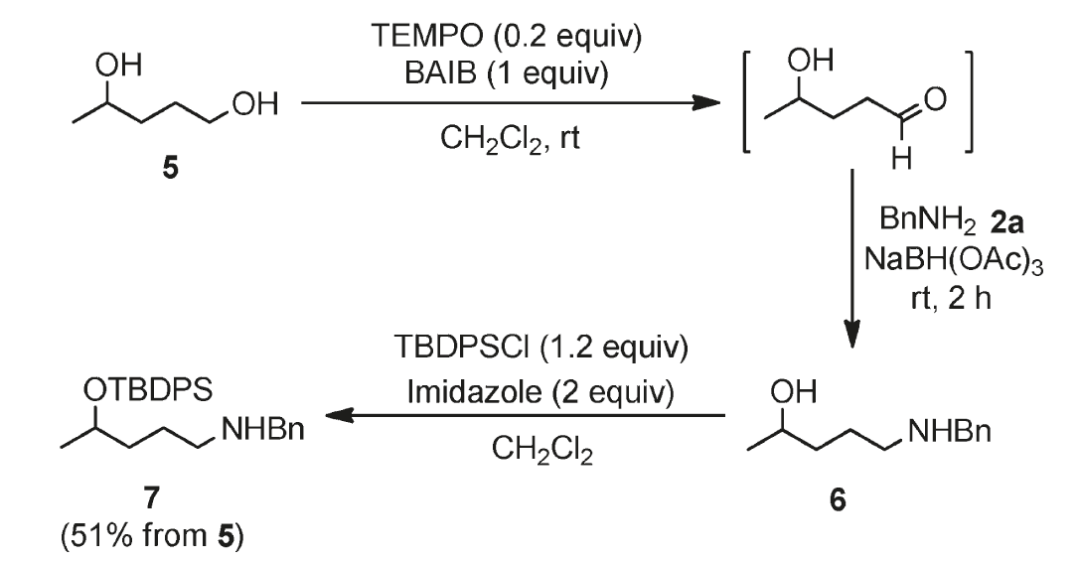
(二乙酰氧基碘)苯 and TMPO selectively oxidize primary alcohols, followed by one-pot reduction and amination.
Org. Lett. 2011, 13, 3534–3537
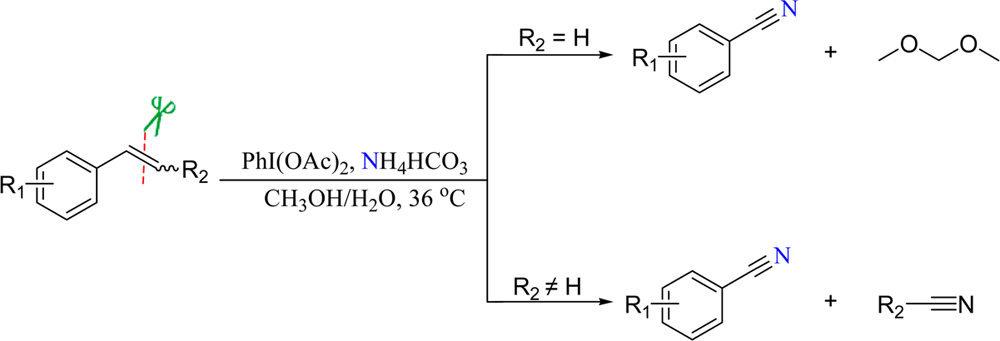
(二乙酰氧基碘)苯 directly oxidizes styrene in the presence of ammonium bicarbonate to prepare benzyl cyanide.
J. Org. Chem. 2013, 78, 11881–11886
References
1. Sharefkin, J. G.; Saltzman, H. Org. Synth., 1973, Coll. Vol. V,660.
2. Review literature: (a) Kitamura, T.; Fujiwara, Y. Org. Prep.Proced. Int., 1997, 29, 409. (b) Wirth, T. Angew. Chem. Int.Ed., 2005, 44, 3656.
3. Churcher, I.; Hallett, D.; Magnus, P. J. Am. Chem. Soc., 1998,120, 3518.
4. Wipf, P.; Jung, J.-K. J. Org. Chem., 2000, 65, 6319.
5. Canesi, S.; Bouchu, D.; Ciufolini, M. A. Org. Lett., 2005, 7,175.
6. Gao, S.-Y.; Ko, S.; Lin, Y.-L.; Peddinti, R. K.; Liao, C.-C.Tetrahedron, 2001, 57, 297.
7. Kirschning, A.; Hashem, Md. A.; Monenschein, H.; Rose, L.;Schoning, K.-U. J. Org. Chem., 1999, 64, 6522.
8. Levites-Agababa, E.; Menhaji, E.; Perlson, L. N.; Rojas, C. M. Org. Lett., 2002, 4, 863.
9. Shi, L.; Kim, Y.-J.; Gin, D. Y. J. Am. Chem. Soc., 2001, 123,6939.
10. Kaino, M.; Naruse, Y.; Ishihara, K.; Yamamoto, H. J. Org.Chem., 1990, 55, 5814.
11. Khan, N.; Cheng, X.; Mootoo, D. R. J. Am. Chem. Soc., 1999,121, 4918.
12. Cheng, X.; Khan, N.; Kumaran, G.; Mootoo, D. R. Org. Lett.,2001, 3, 1323.
13. Francisco, C. G.; Herrera, A. J.; Suarez, E. J. Org. Chem.,2002, 67, 7439.
14. Dick, A. R.; Hull, K. L.; Sanford, M. S. J. Am. Chem. Soc.,2004, 126, 2300.
15. Desai, L. V.; Hull, K. L.; Sanford, M. S. J. Am. Chem. Soc.,2004, 126, 9542.
This article is adapted from: “Modern Organic Synthesis Reagents – Properties, Preparation, and Reactions”, edited by Hu Yuefei et al.