13.2.1
Clock Sources
13.2.1.1
External Oscillator Clock Area
The external oscillator includes an external high-speed oscillator (main clock oscillator) and an external low-speed oscillator (sub-clock oscillator).
Main Clock Oscillator (MOSC):
Main clock oscillator
-
RA6M5/RA4M2 connects to an external 8~24MHz high-speed crystal oscillator (connected to pins EXTAL, XTAL);
-
RA2L1 connects to an external 1~20MHz high-speed crystal oscillator (connected to pins EXTAL, XTAL).
Sub-Clock Oscillator (SOSC):
Sub-clock oscillator
- Connects to an external 32.768kHz low-speed crystal oscillator (connected to pins XCIN, XCOUT).
- The external clock frequency of 32.768 kHz is generally used for RTC to provide time and calendar functions for the user system.
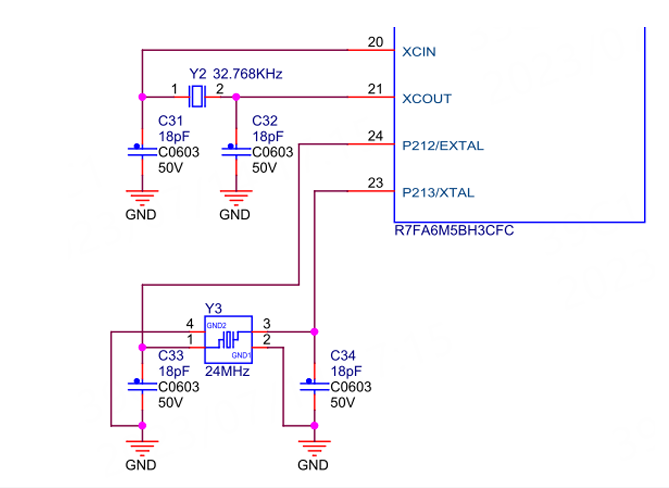
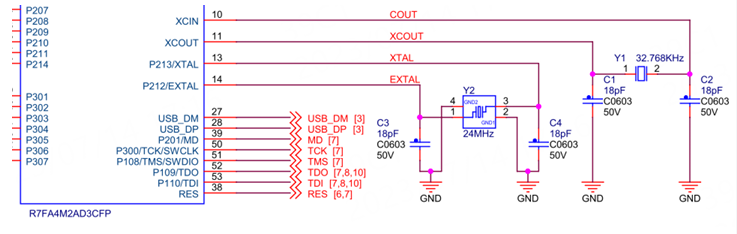
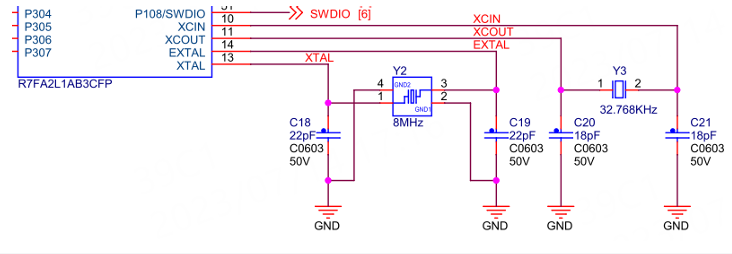
By examining the schematics of the Qiming 6M5 and Qiming 4M2 development boards, it can be seen that both boards use a 24MHz external high-speed crystal oscillator, so in the clock configuration page, XTAL should be set to 24MHz; the Qiming 2L1 development board uses an 8MHz crystal oscillator, and in the clock configuration page, XTAL should be set to 8MHz.
The schematic of the external crystal oscillator section for the Qiming 6M5 development board is shown below:
Click to view the full image
The schematic of the external crystal oscillator section for the Qiming 4M2 development board is shown below:
Click to view the full image
The schematic of the external crystal oscillator section for the Qiming 2L1 development board is shown below:
Click to view the full image
13.2.1.2
Internal Oscillator Clock Area
The internal oscillator, also known as the on-chip oscillator, is equivalent to a built-in crystal oscillator in the chip. In some application scenarios, to meet design requirements and save hardware costs, the external crystal oscillator can be omitted, and the internal oscillator can be used to provide the main clock signal for the chip.
High-speed on-chip oscillator (HOCO):
High-speed on-chip oscillator
-
Oscillation frequency: RA6M5/RA4M2 is 16/18/20MHz;
-
Oscillation frequency: RA2L1 is 24/32/48/64MHz.
Middle-speed on-chip oscillator (MOCO):
Middle-speed on-chip oscillator, oscillation frequency: 8MHz
Low-speed on-chip oscillator (LOCO):
Low-speed on-chip oscillator, oscillation frequency: 32.768kHz
The internal oscillator of the RAMCU mainly includes HOCO, MOCO, and LOCO, distinguishing high-speed, middle-speed, and low-speed, providing complete functionality, allowing users to flexibly choose when enabling the internal oscillator.
The FSP clock configuration page and the internal oscillator section on the clock tree:
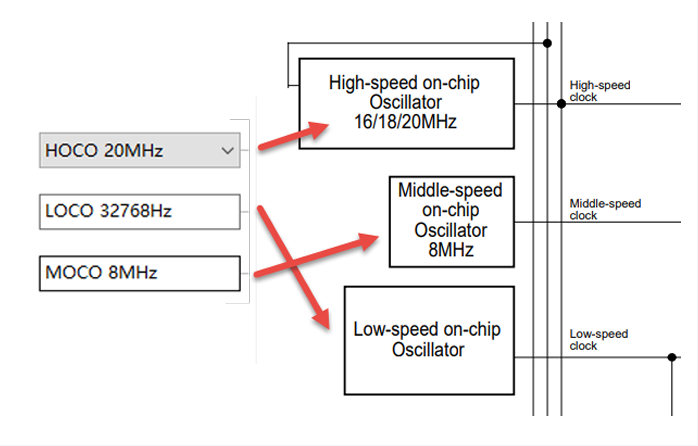
Click to view the full image
14.2.2
Phase Locked Loop
Phase Locked Loop (PLL, PLL2):
PLL stands for Phase Locked Loop. The PLL circuit has the function of multiplying the oscillator frequency, allowing selection of the clock signal input to the PLL, and performing division and multiplication on it. The input clock sources are MOSC and HOCO, with input frequencies ranging from 8MHz to 24MHz, and the multiplication ratio can be selected between 10 and 30 (0.5 step).
-
PLL output frequency: 120MHz~200MHz.
-
PLL2 output frequency: 120MHz~240MHz.
Note
RA2L1 does not have a PLL, so its main frequency (48MHz) is relatively low, which is also beneficial for low power consumption.
14.2.2.1
PLL Phase Locked Loop
The PLL output clock signal is generally used for system clock (ICLK), internal Flash clock (FCLK), and peripheral module clocks (PCLKA/B/C/D), etc. The default setting in the clock configuration diagram for RA6M5/RA4M2 is PLLCLK=MOSC(24MHz)/3* 25 = 200MHz.
The clock view and corresponding clock tree PLL section of the FSP configurator:
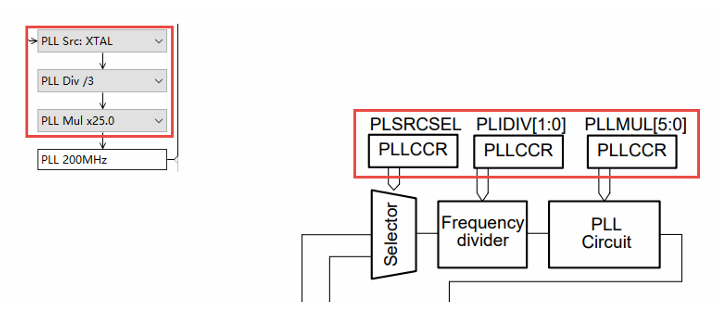
Click to view the full image

Need Technical Support?
If you have any questions while using Renesas MCU/MPU products, you can scan the QR code below or copy the URL into your browser to access the Renesas Technical Forum for answers or to get online technical support.

https://community-ja.renesas.com/zh/forums-groups/mcu-mpu/
To be continued
Recommended Reading
SystemInit()——Renesas RA Series FSP Library Development Practical Guide (28)
CGC Clock Control——Renesas RA Series FSP Library Development Practical Guide (29)
CGC Clock Configuration Block Diagram Analysis——Renesas RA Series FSP Library Development Practical Guide (30)