In the programming world of Python 3.12, class inheritance has long transcended the superficial understanding of “subclass reusing parent class code” and evolved into a deep architecture that embodies software design principles, type system constraints, and code evolution capabilities. This article will reveal five core dimensions of class inheritance in the context of Python 3.12, combined with financial data analysis scenarios.—— Deconstructing the deep logic of class inheritance and modern Python practices
The Essence of Inheritance: Not “Copying Code”, but “Contract Inheritance”
In traditional understanding, inheritance is simplified to “subclasses acquiring attributes and methods from parent classes”, but Python 3.12’s <span>typing</span> module and type system give inheritance a stricter contractual meaning.
Example: Abstract Base Class (ABC) for Financial Data Interfaces
from abc import ABC, abstractmethod
from typing import Protocol

class DataFeed(ABC):
    """Abstract Base Class: Defines the contract for data sources"""
    @abstractmethod
    def fetch(self, symbol: str) -> dict:
        """Method that must be implemented"""
        pass

class RealTimeFeed(DataFeed):
    """Concrete implementation: Real-time data source"""
    def fetch(self, symbol: str) -> dict:
        return {"symbol": symbol, "price": 150.0, "timestamp": "2023-01-01"}

class MockFeed(DataFeed):
    """Concrete implementation: Mock data source"""
    def fetch(self, symbol: str) -> dict:
        return {"symbol": symbol, "price": 145.0, "is_mock": True}

# Using polymorphism
def display_price(feed: DataFeed, symbol: str):
    data = feed.fetch(symbol)
    print(f"{symbol} price: {data['price']}")

# Dynamically switch implementations
display_price(RealTimeFeed(), "AAPL")
# Output: AAPL price: 150.0
display_price(MockFeed(), "MSFT")
# Output: MSFT price: 145.0
Key Points:
<span>DataFeed</span>as an abstract base class defines the contract for the<span>fetch</span>method that subclasses must implement- Subclasses
<span>RealTimeFeed</span>and<span>MockFeed</span>gain polymorphic capabilities by implementing the contract - The caller does not need to care about the specific implementation, only relying on the abstract interface
The Pitfalls of Inheritance: Tight Coupling and the “Fragile Base Class” Problem
The “white-box reuse” characteristic of inheritance can lead to strong binding between subclasses and parent classes, where changes in the parent class may inadvertently break the subclass.
Counterexample: Fragile Base Class
class BaseAnalyzer:
    def __init__(self):
        self.metrics = ["return", "volatility"]  # Hidden assumptions in the parent class

    def calculate(self, data):
        results = {m: 0 for m in self.metrics}
        # ... calculation logic
        return results

class RiskAnalyzer(BaseAnalyzer):
    def __init__(self):
        super().__init__()
        self.metrics.append("max_drawdown")  # Depends on the parent class's metrics attribute

# Parent class modification leads to subclass failure
BaseAnalyzer.metrics = ["return"]  # Parent class modified unexpectedly
risk = RiskAnalyzer()
print(risk.metrics)
# Output: ['return'] (missing max_drawdown!)
Root of the Problem:
- The subclass directly depends on the parent class’s implementation details (
<span>metrics</span>attribute) - Changes in the parent class may disrupt the logic of the subclass
Solutions:
- Encapsulate Parent Class State: Expose data through methods rather than attributes
- Use Composition Instead of Inheritance: Inject dependencies into subclasses
Composition Over Inheritance: Python’s Duck Typing Practice
The dynamic features of Python make composition more flexible than inheritance, aligning with the philosophy of “Duck Typing”.
Example: Financial Metric Calculator (Composition Pattern)
from typing import List, Callable

class MetricCalculator:
    """Calculates metrics through composition strategy"""
    def __init__(self, metrics: List[Callable]):
        self.metrics = metrics

    def compute(self, data):
        return {name: func(data) for name, func in self.metrics.items()}

# Define independent metric functions
def calculate_return(data):
    return (data["close"] - data["open"]) / data["open"]

def calculate_volatility(data):
    return data["high"] - data["low"]

# Compose metrics
calculator = MetricCalculator({
    "return": calculate_return,
    "volatility": calculate_volatility
})

data = {"open": 100, "close": 105, "high": 110, "low": 95}
print(calculator.compute(data))
# Output: {'return': 0.05, 'volatility': 15}
Advantages Comparison:
| Dimension | Inheritance Scheme | Composition Scheme |
|---|---|---|
| Flexibility | Changes in the parent class may break the subclass | New metrics can be added without modifying existing code |
| Testability | Subclass testing requires mocking the parent class | Each metric function can be tested independently |
| Extensibility | Requires subclassing to extend | New functions can be injected directly |
Inheritance Enhancements in Python 3.12: Type Annotations and <span>__init_subclass__</span>
Python 3.12 further strengthens inheritance control through the type system and metaclasses.
Example: Inheritance Control with Type Checking
from typing import TypeVar, Generic, Type

T = TypeVar("T")

class ValidatedFeed(Generic[T]):
    """Requires subclasses to implement type-safe fetch method"""
    @classmethod
    def __init_subclass__(cls, **kwargs):
        super().__init_subclass__(**kwargs)
        if not hasattr(cls, "fetch"):
            raise TypeError("Subclasses must implement fetch method")
        # Optional: Check return type annotations of fetch

class StockFeed(ValidatedFeed[float]):
    def fetch(self, symbol: str) -> float:
        return 150.0  # Must return float

# Error example: fetch not implemented
class InvalidFeed(ValidatedFeed[str]):
    pass  # Triggers TypeError
Key Features:
<span>__init_subclass__</span><code><span>: Executes validation logic when subclasses are created</span>- Type variable
<span>TypeVar</span>: Supports generic inheritance - Combined with
<span>mypy</span>allows for compile-time type checking
Inheritance Decision Tree in Financial Scenarios
In the development of quantitative trading systems, how to choose between inheritance or composition? Here is a decision framework:
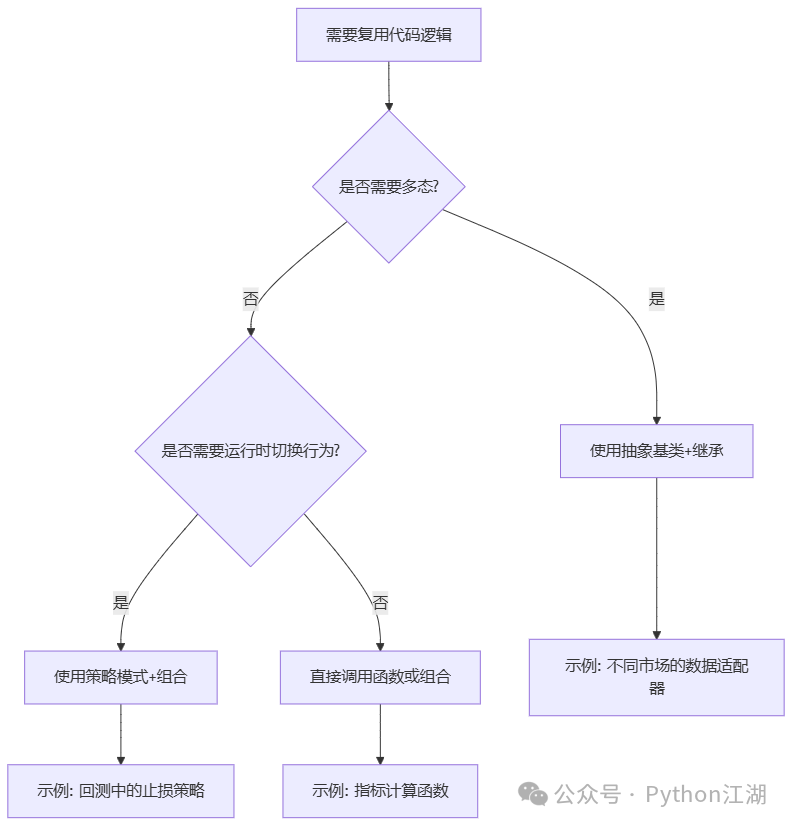
Real Case Examples:
-
Inheritance Applicable Scenarios:
<span>BaseStrategy</span>→<span>MeanReversionStrategy</span>/<span>TrendFollowingStrategy</span>(requires a unified risk management interface) -
Composition Applicable Scenarios:
<span>OrderExecutor</span>composes<span>LimitOrderStrategy</span>and<span>MarketOrderStrategy</span>(needs to dynamically switch order types)
Future Trends: Integration of Inheritance and Protocol Classes
Python 3.12’s <span>Protocol</span> class (PEP 544) separates “interface inheritance” from “implementation inheritance”, achieving a more flexible architecture:
from typing import Protocol

class RiskProtocol(Protocol):
    def calculate_var(self, confidence: float) -> float:
        """Calculate Value at Risk"""
        ...

class HistoricalVaR(RiskProtocol):
    def calculate_var(self, confidence: float) -> float:
        return 1.0  # Implementation based on historical simulation

class ParametricVaR(RiskProtocol):
    def calculate_var(self, confidence: float) -> float:
        return 1.5  # Implementation based on parametric method

# Caller only relies on the protocol
def report_risk(risk_model: RiskProtocol):
    var = risk_model.calculate_var(0.95)
    print(f"95% confidence VaR: {var}")
Advantages:
- No need for inheritance; any class implementing
<span>RiskProtocol</span>can be called - Supports structural subtyping
- Deep integration with static type checking tools (like mypy)
Conclusion: Inheritance is a Tool, Not a Goal
In the programming practices of Python 3.12, class inheritance should serve the following goals:
- Express Domain Models: Such as the hierarchy of
<span>Asset</span>→<span>Stock</span>→<span>ETF</span>in financial products - Achieve Polymorphism: Define a unified interface through abstract base classes
- Constrain Extension Points: Control subclass behavior with
<span>__init_subclass__</span>
When inheritance leads to code that is difficult to test, modify, or understand, one should decisively switch to composition patterns. Remember: Good software design is the art of removing code, not adding layers..
“Inheritance is the most abused and misunderstood feature in object-oriented programming.” —— Design Patterns: Elements of Reusable Object-Oriented Software