“Ubuntu, supported by commercial companies, addresses the pain point of the open-source community’s “free but unguaranteed” model, and now occupies a major share of the global web service market. From Debian to Ubuntu, it has become the successor to the mainline tasks of Unix-like systems.”
Review of Unix-like OS
1. Mainline tasks of Unix-like OS: from GNU/Linux to Debian
-
In 1991, Finnish student Linus released the Linux kernel, which naturally combined with Stallman’s GNU operating system project (launched in 1983) to form the release of the GNU/Linux operating system (simplistically speaking, or without particularly emphasizing Stallman’s leadership of the “free software movement” and the creation of the GNU/Linux ecosystem and the GNU/GCC toolchain, it can be referred to simply as “Linux”). Note: GNU/Linux is based on a command-line interpreter Unix shell interactive interface.
-
In 1996, as the annual Debian project leader (Debian introduced a GUI graphical interface), Perens created the term “open source” (initiative/action/advocacy OSI). This was not merely a marketing strategy to replace “free software” with “open source”; more importantly, through community collaboration and open-source initiatives, it barely solved the survival dilemma of free software (as an “open source project”, Debian GNU/Linux OS could accept donations and opened up a new way to obtain “donation” revenue through commercial naming).
-
Note 1: In comparison, Stallman’s FSF (Free Software Foundation) does not agree with this (the advocacy of “free software” emphasizes a combination of technology, humanities, and ethics, often stressing pure dedication in the name of “freedom”).
-
Note 2: As mentioned in the previous study series, the flip side of “freedom” is the mandatory disclosure of modified code and redistribution. This is the most important connotation of the Linux project or all “open source”/”free software” projects (based on Copyleft licenses or GPL licenses).
Debian can be understood as inheriting the “mainline tasks” of Unix-like OS development (its “Debian developer” community is large, with about a thousand members. It has a vast number of packages, approximately 50,000+).
2. From Debian to Ubuntu
-
Users in other regions may not be aware, but Chinese consumers, who have experienced sufficient market competition, may have some understanding of the saying “free is the most expensive.” An impulsive participation in a free event or facing a long-term membership package brought about by successful marketing.
-
However, the community-organized Debian is, in principle, superior to this. Imagine that commercial users (who are not short of money, or are choosing Debian for cost reduction, security, or to counter competitors’ monopolies) are in a critical situation where their servers and data are threatened by security vulnerabilities, and every second counts to recover commercial losses, yet they cannot find a paid service channel.
-
Therefore, Ubuntu has replaced Debian as the current most popular Linux distribution. This may be one of the main reasons (and Ubuntu’s code source is Debian), as it is supported by the commercial company Canonical for long-term services. Note: This is typically different from non-profit organizations, such as Perens’ “Open Source Initiative OSI” and Stallman’s “Free Software Foundation FSF”.
Detailed discussion:
-
It seems easy to understand that, as an “open source/free software project”, the freedom to modify and redistribute the code of the provided Debian/Ubuntu systems is too extravagant for ordinary consumers (even commercial companies). Most users actually do not need or have the ability to recompile the OS from source code, let alone talk about modifying and redistributing it to contribute to new Debian/Ubuntu versions. They may only hope for a long-term secure and reliable OS version.
-
Since Ubuntu’s code is derived from Debian, it can be inferred that its source code cannot be claimed as proprietary. That is, the Debian “open source project” characteristics must be retained by Ubuntu (Ubuntu OS must also be an open source project).
-
Thus, (at least individual or small collective) users are still free to use Ubuntu (and freely download the source code). In a commercial atmosphere, Ubuntu provides long-term services, and its market and service exploration steps will definitely go further (compared to Debian).
-
Ubuntu meets the above needs, becoming a new inheritor and developer of the mainline tasks of Unix-like OS.

01
—
Ubuntu OS
1.1 Code Source from Debian
-
Ubuntu is based on the Debian architecture and foundation of Linux distribution, and is composed mostly of free and open-source software, including Linux server and desktop systems.
-
Specifically, Ubuntu’s packages are based on Debian’s unstable branch.
1.2 Ubuntu Version Release
-
Since Ubuntu does not emphasize binary compatibility, it needs to recompile Debian’s source code.
-
Most developers maintain the (original) versions of Ubuntu’s key features within Debian packages.
-
Modified or upgraded Ubuntu packages are encouraged to return to Debian for release. It is often criticized that such “homecoming” releases are too few and infrequent.
-
Ubuntu’s milestone releases occur every 6 months (i.e., synchronizing with Debian every 6 months).
-
Long-term support versions (LTS) are released every 2 years.
1.3 Main Modules of Ubuntu
-
Kernel: Linux kernel
-
Desktop Environment: GNOME
-
Office Tools: LibreOffice, Firefox, Thunderbird, Transmission
-
Package Management Tool: APT
-
Security: Low privilege user permissions, sudo tool, and built-in firewall, etc.
1.4 Package Classification
As mentioned in the previous lecture, Stallman’s GNU/Linux OS is entirely composed of free software, while Debian GNU/Linux OS divides its software repositories into free software and non-free software.
As for Ubuntu, as the most widely used Linux OS, it (expands) defines different package classifications and support:
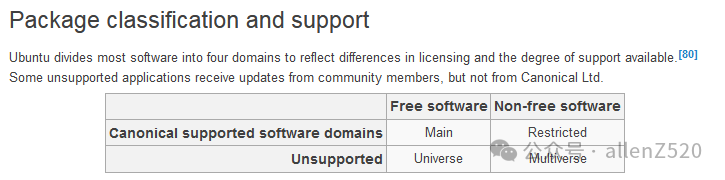
These classifications include:
-
Free software supported by Canonical (i.e., the “main” area), which can also include unmodifiable firmware (in addition to source code).
-
Canonical also supports non-free software (i.e., the “Restricted” area), such as graphics drivers that do not include source code, only binary products (binary-only).
-
The aforementioned free and non-free software supported by Canonical can support a comprehensive desktop system. Other specific purpose software/tools are located in the “Universe” area (free software) and the “Multiverse” area (non-free software), each supported accordingly.
-
Non-free software that is not supported by Canonical, located in the Multiverse third-party software, can be purchased through Ubuntu.

02
—
Canonical Company Behind Ubuntu
2.1 Mark Shuttleworth and Canonical
-
In the 1990s, Shuttleworth was one of the developers of Debian OS and participated in the system.
-
On October 20, 2004, his company Canonical (currently headquartered in London) released Ubuntu OS based on Debian (his Ubuntu Foundation was established the following year with an initial investment of $10 million).
-
This explains the origin of the African-sounding name Ubuntu (he has dual citizenship in South Africa and the UK), and the reason each version is named after adjacent animals (reflecting the harmonious cultural heritage of South African tribes).
Extended introduction:
-
In 2002, Shuttleworth became the first South African tourist to pay $20 million to complete a space trip aboard a Russian Soyuz spacecraft.
-
He was involved in a lawsuit after transferring a large sum of money from South Africa to the Isle of Man, and in 2015, the court ultimately ruled in his favor.
2.2 Ubuntu’s Relationship with Debian (from Canonical’s official website)
-
Ubuntu is built on the Debian architecture and foundation and collaborates extensively with Debian developers.
-
Ubuntu has a different user interface.
-
Ubuntu has a different community (although many developers participate in both projects).
-
Ubuntu has a different version release process.
2.3 Goals of Ubuntu (from Canonical’s official website)
-
Ubuntu is developed and maintained as a cross-platform, open-source operating system based on Debian.
-
It is primarily committed to quality releases, enterprise security upgrades, and leading capabilities in integration, security, and performance.
2.4 Company Development
(1) Basic Information
Considering the idea that “those who gather firewood for the people should not freeze to death in the wind and snow,” I briefly checked the company information to study its survival methods in the open-source and free software world.
-
In 2008, during an interview with The Guardian, Shuttleworth stated that Ubuntu’s business model was “providing services” and was not yet close to profitability (still needed 3-5 years).
-
In 2009, in an article in The New York Times, he stated that Ubuntu’s break-even point was $30 million in revenue, and it had made a small profit ($280,000).
-
Until 2017, the company was reportedly still struggling financially.
-
As of now (September 2025), checking its official website, Canonical has developed into a group with over 1,200 employees across 80 countries.
(2) Cloud Services and IoT, AI Services
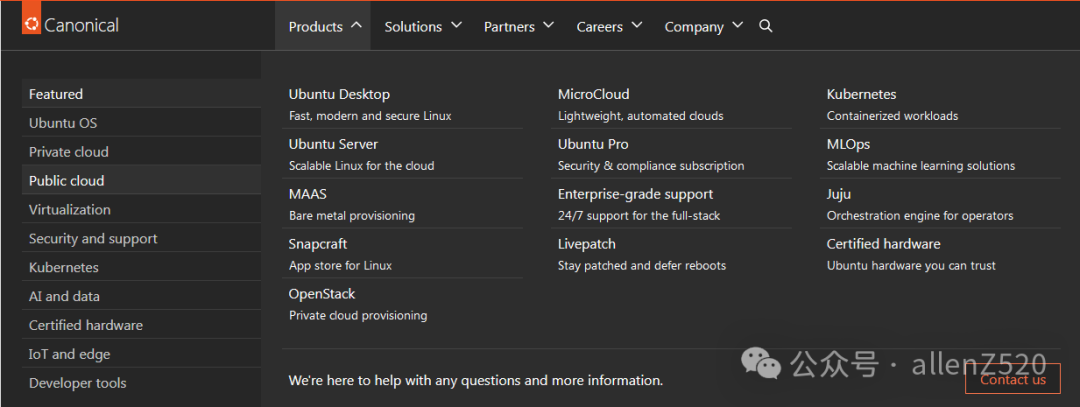
Checking the company’s product line, it seems that in addition to utilizing Ubuntu’s long-term enterprise services, its product line has developed more like a “cloud service company” (the free OS for personal download is just the “hook” of its business model).
(3) Discussion on Open Source Related Industries
-
In the domestic industry capital (especially traditional industries), it seems that a new path for the development of the electronic information industry can be observed. Originally investing in unproductive “open source/free software” projects can also have many innovative ways, just like Canonical.
-
With the rise of the fourth industrial revolution (AI), even low-cost investments in open-source software/hardware companies can be promising. Do not be intimidated by the obvious “raising the threshold” type of investments and promotions from Ma Yun, Ma Huateng, Li Yanhong, and Huawei. Consider Shuttleworth’s initial stage of revenue balance, which may just be the annual revenue of an ordinary small electronic company in Shenzhen (considering its product is a large and complex desktop/server OS). Of course, this data is over a decade old, but it should also be considered in light of China’s labor and operational costs.
-
Canonical utilizes the unpaid contributions of the thousand developers in the Debian open-source community, addressing the pain points of users needing long-term services, and leveraging the rapid global expansion of OS deployment to extend its business into high-end enterprise security customization, cloud space services, IoT integration, and AI products and services displayed on pages, all demonstrating the authenticity of this business model.
-
This model aligns with the current trend of China’s social transformation from a labor-intensive structure to an intellectual-intensive structure. Every year, millions of college graduates provide a huge “engineer dividend” to society. High-tech talents are not redundant; the phenomenon of 985 graduates farming or raising pigs in short videos is also a normal part of employment diversion. The talents needed for the dual-innovation type and social transformation are hidden among these millions of students. Liang Wenfeng and Wang Tao are both successful examples (they have rapidly promoted the current social transformation. Their companies in the initial stages were not huge entities).
-
During the campus phase, it is possible to initially complete language foundation learning and achieve the accumulation of BSD-like projects and open-source software/hardware projects to actual product transfer (note that the continuous explanations here indicate that BSD-like and open-source/free software/GPL-like have different nature certificates), which is not difficult. It is believed that the talent reserve fully meets the needs of China’s social transformation. Traditional industry capital should take a look (this is much easier than investing in semiconductor equipment).
(4) Fedora
-
In comparison, another one of the most popular Linux OS releases, Fedora, is also supported by a commercial company, Red Hat (originating in 1994). In 2019, Red Hat was acquired by IBM for $34 billion.
-
Red Hat’s products split in 2003, resulting in the Fedora Project (community project) and Red Hat Enterprise Linux (RHEL). The business model of Red Hat in the open-source world is not studied here, but from the product split and the final result of IBM’s payment, it seems to have made significant achievements in serving large enterprises’ middleware business. Interested industry capital can continue to research.
2.5 Ubuntu Deployment Status
-
In 2020, an industry survey showed that Linux/Unix distributions accounted for twice as many web servers as Microsoft Windows, with Ubuntu/Debian occupying 65% of the Linux OS market (the Unix OS of the “mainline task” can be disregarded for a few companies), and Ubuntu surpassing Debian, accounting for about 30% of the total web serving.
-
Earlier, I heard some industry news that government procurement now prioritizes “non-Windows OS,” which seems to have come relatively late. The trend of Ubuntu replacing Windows in government and educational departments began 20 years ago, mainly concentrated in Europe. After the 2013 Prism incident, there seems to be an accelerating trend. It is speculated that the core contributions of Finnish students and the background of Ubuntu’s headquarters in London are accelerating the deployment of this system in Europe (Europe should feel a strong affinity for this OS).
-
In the domestic terminal system competition, it is unclear who is leading. Huawei provides EulerOS (also a Linux distribution) on the server side and Harmony OS on personal terminals. However, observing Huawei’s Harmony model, it is very similar to Apple’s, which is based on a high-quality, high-priced hardware terminal barrier for brand-fixed share dissemination. This observation is not worth mentioning, just for reference.

03
—
Official Variants of Ubuntu
Official variants of Ubuntu include:
-
Kubuntu: A desktop system using KDE GUI.
-
Lubuntu: A lightweight system using LXQt GUI.
-
Ubuntu Core: IoT and embedded systems.
-
Xubuntu: A low-power system using Xfce.
-
Ubuntu Server
-
Ubuntu Kylin: Version for the Chinese market
Discussion:
-
“Ubuntu Kylin” is different from China’s “Galaxy Kylin.” According to Baidu, “Galaxy Kylin” is based on the FreeBSD Linux kernel and developed by the National University of Defense Technology.
-
If this information is true, then “Galaxy Kylin” can indeed achieve closed-loop commercialization (belonging to the “mainline task” path of Unix-like OS), rather than heading towards the community open-source GNU/Linux (“mainline task” path).
-
Extended discussion: Unlike Europe (which has completely lost the ability in the Sino-US CPU hardware competition), current domestic CPUs seem to exhibit a full-path characteristic, with CISC instruction authorizations (x86) from different channels, ARM architecture (such as v8), and other niche self-developed instruction sets. It is unclear what kind of OS will emerge in the Chinese market after breakthroughs in EUV, such as below 5nm, using various instruction set CPUs similar to RISC5 open source (competitors also include the preemptively positioned Ubuntu Kylin). According to Western fantasy web literature, one must obtain sequence one. According to Eastern fantasy web literature, one must achieve a unique position in the Dao fruit. It is estimated that results will be seen in the 2030s.
04
—
WSL2 (Windows Subsystem)
In 2019, Windows announced WSL2, and Canonical declared its “full support for Ubuntu.”
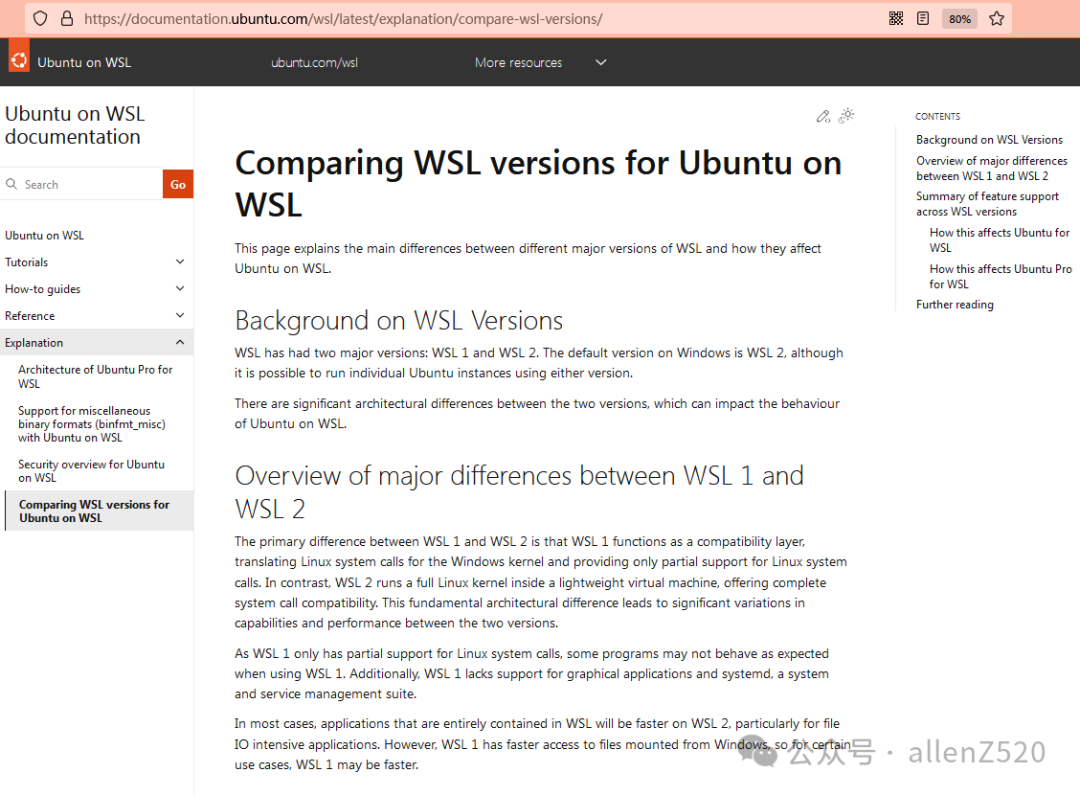
The following content is from Canonical’s Ubuntu on WSL webpage:
-
WSL2 is the default version of Windows.
-
Unlike WSL1, WSL2 runs a “full Linux kernel” on a lightweight virtual machine.
-
WSL2 adds support for graphical applications and systemd (system and service management suite). The latter (systemd) adds support for tools like Snaps (package management tool) and cloud-init (cloud service configuration tool). The former supports graphical applications.
-
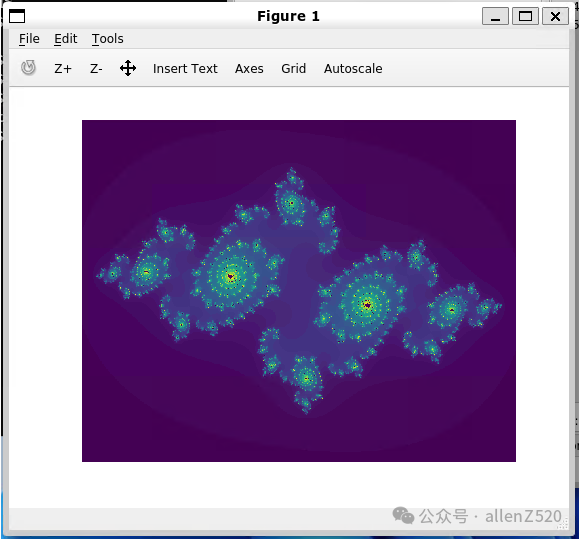
Graphical application support: (1) Common GPU acceleration (CUDA) for AI development. (2) Although WSL is a terminal environment, it can also run Linux-native graphical applications. The webpage documentation provides an example of drawing “fractals,” as shown in the image below.
Discussion: There is a lot of chaotic information online; if I have not misunderstood in this official document (see the content marked in bold).
-
WSL2 is still a command-line terminal environment, aimed at cross-platform development on Windows.
-
Support for Windows GUI (drivers?) can utilize driver APIs for CUDA development and print images on the desktop. However, it seems there is no mention of “running a Linux desktop on Windows”?
-
Additionally, support for the new package management (download) tool Snaps is also included.
05
—
Conclusion
-
Due to synchronization with Debian every 6 months, Ubuntu is like a long-term stable support system supported by the commercial company Canonical for its LTS version. Therefore, it has a basic architecture similar to Debian systems.
-
Extended discussions on the model of Ubuntu’s existence in the open-source world.
-
Introduced the content of WSL2 from Canonical’s official website.