Network topology refers to the physical and logical arrangement of nodes and connections in a network; nodes typically include switches, routers, and software with switching and routing capabilities. Network topologies can be classified into various types, including bus, star, ring, mesh, tree, and hybrid; the main categories are bus, star, and ring network topologies.
1. Bus Network Topology (Bus Network Topology) is illustrated in Figure 1. In a bus network topology, all nodes are connected to a single cable that runs from one end of the network to the other. A local area network (LAN) is an example.
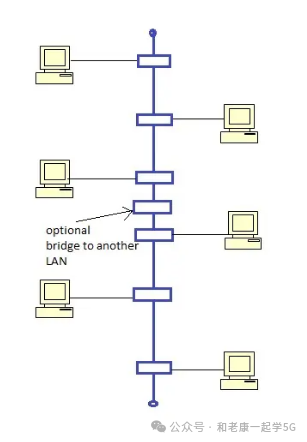
Figure 1. Bus Network Structure
1.1 Advantages of Bus Topology
-
Cost-effective: Low cost, easy to install, and simple to implement.
-
Minimal cabling: Requires less cable compared to other topologies.
-
Suitable for small networks: Best suited for small networks like LANs.
-
Direct communication: Any two stations can communicate directly without interference from other nodes.
-
Easy to expand: Additional nodes can be added without interrupting existing services.
-
Versatile cabling: Can use coaxial or twisted pair cables for bidirectional transmission.
-
Fast communication: Provides the fastest speeds due to direct communication between nodes.
1.2 Disadvantages of Bus Topology
-
Limited cable length: The length of the cable limits the number of stations the network can support.
-
Performance degradation: Too many nodes can lead to performance issues.
-
Difficult fault isolation: Identifying and isolating faults can be challenging.
-
Signal reflection issues: Susceptible to signal reflection at cable ends and joints, requiring careful planning.
-
Complex fiber implementation: Fiber-based bus networks require bidirectional optical couplers for two-way communication.
2. Star Network Topology (Star Network Topology) is shown in Figure 2, where each node is connected to a central device, such as a hub or switch. These nodes can include file servers, workstations, and peripheral devices. The hub receives signals from any node and transmits them to all other nodes on the network. In a star network, data passes through the hub/switch/concentrator before reaching its destination. The hub/switch/concentrator is responsible for managing and controlling the network’s functions.
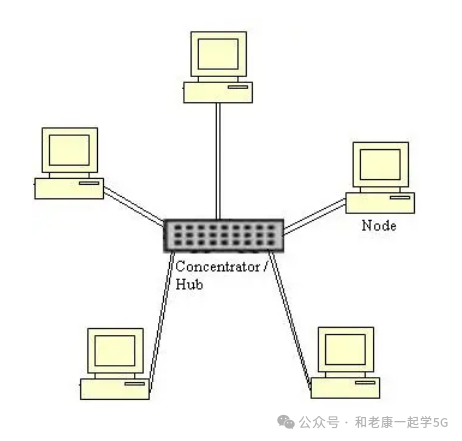
Figure 2. Star Network Structure
2.1 Advantages of Star Topology
-
Centralized control: All nodes connect to a central node, reducing the risk of total network failure. Only the faulty node needs maintenance.
-
Easy management: Simpler to manage compared to other topologies.
-
Easy installation and cabling: Nodes are easy to install and wire.
-
Easy problem localization: Easier to locate issues.
-
Easy to expand: Easier to expand compared to bus and ring topologies.
2.2 Disadvantages of Star Topology
-
Increased cabling: Requires longer cables compared to linear topologies.
-
Central point of failure: If the hub or concentrator fails, all connected nodes will be disabled. Redundant hubs are often used for emergencies.
-
Higher cost: Higher costs due to the expense of the hub.
3. Ring Network Topology (Ring Network Topology), as shown in Figure 3, connects all nodes end-to-end to form a loop. Each node is connected to two nodes on its left and right. A ring network has no central node; all nodes have some control functions, allowing them to recognize their addresses and perform retransmissions. The message format consists of the target node address and data payload. A token (a small data packet) circulates in the network. When a node needs to transmit data, it holds the token for the next transmission and attaches its data packet to the token.
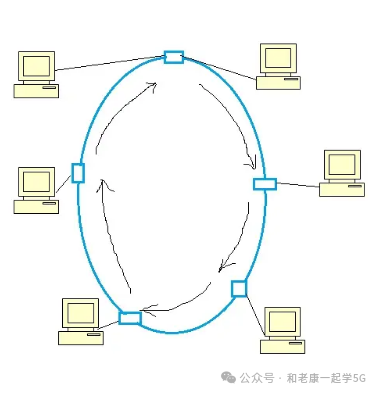
Figure 3. Ring Network Structure
3.1 Advantages of Ring Topology
-
Easy management and fault isolation: Easier to manage, with more direct fault isolation.
-
Low cost: The least expensive among all network topologies.
-
Ordered network: Each device can access the token and has the opportunity to transmit.
-
Long-distance communication: Provides good communication over longer distances.
-
High traffic handling: Efficiently handles high traffic.
3.2 Disadvantages of Ring Topology
-
Single point of failure: Any cable or node failure can disrupt the entire network, and recovery can be time-consuming.
-
Intermittent expansion: Adding a node requires shutting down the entire network, interrupting service to operational nodes.
-
Slow speed: The slowest due to sequential access to nodes.
-
Performance sensitivity: Any movement or change to a node can affect the performance of the entire network.
Each network topology (bus, star, and ring) has its own advantages and disadvantages. Bus topology is cost-effective but prone to collisions; star topology is reliable and easy to troubleshoot but heavily relies on a central hub; ring topology ensures orderly data transmission but may experience interruptions.