01Basic Understanding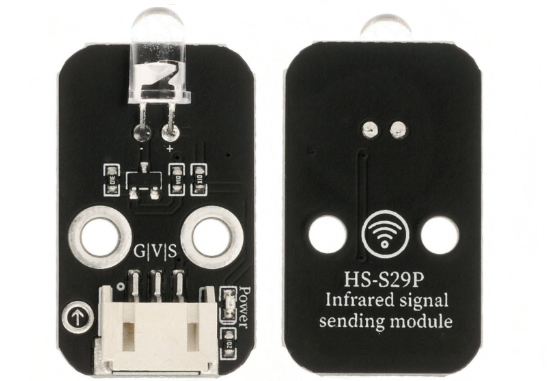 Model:HS-S29PName:Infrared Transmission ModuleSeries:Communication ModuleDescription:This module is specifically designed to transmit 38KHz carrier infrared signals, featuring a built-in infrared emitter and modulation circuit. By receiving encoded signals from a microcontroller (such as remote control button commands), it modulates them onto a 38KHz carrier and transmits them in the form of infrared light. It works in conjunction with infrared receiving modules (such as HS-S23P) to achieve “wireless command transmission” and serves as the “signal source” for infrared communication systems, making it suitable for teaching and creative practice in primary and secondary schools.Usage Scenarios:Send infrared encoded commands to control TVs and air conditioners, for example, writing code to make the module send “power on” and “temperature adjustment” commands to achieve “one-button linkage”(Smart Home);Install the transmission module on a remote-controlled car to communicate with the receiving module of another car, achieving a “chase game” (e.g., automatically turning when sending a “get closer” signal)(Toy Interaction Design);In a dust-free workshop, remotely control small devices to start and stop using the infrared transmission module, replacing wired connections(Industrial Auxiliary Control);and other scenarios; it aligns with AI Education in Primary and Secondary Schools, in accordance with the “Guidelines for General Education in Artificial Intelligence for Primary and Secondary Schools (2025 Edition),” allowing students to understand the complete communication chain of “encoding → modulation → transmission → reception → decoding” through paired practice of sending and receiving.Interdisciplinary Integration:Physics, Mathematics, Science, Information TechnologyEthical Education:Infrared signals can be easily intercepted (e.g., if someone obtains the remote control code), potentially leading to malicious control of devices, necessitating the learning of “code encryption” (e.g., dynamic passwords) for protection;Different brands of devices have non-standard infrared codes, leading to incompatibility of transmission modules, prompting consideration of the significance of “universal coding standards” for technology dissemination;Excessive infrared signals (e.g., multiple modules transmitting simultaneously) may interfere with each other, fostering awareness of “reasonable use of wireless resources”;Infrared signals are greatly affected by obstructions, which may cause control difficulties for individuals with mobility impairments, prompting exploration of “multimodal communication” (infrared + Bluetooth) adaptation solutions;If incorrect codes are sent during experiments, leading to device anomalies, it is necessary to actively troubleshoot and correct, cultivating a scientific attitude of “rigorous debugging”.
02Technical Parameters
Working Principle:
The module has a built-in 38KHz oscillation circuit. When the microcontroller inputs an encoded signal (high and low level sequence) through the signal pin (S), the circuit modulates the encoded signal onto the 38KHz carrier (i.e., controlling the “presence” of the carrier through the encoded signal), and then converts the electrical signal into an infrared light signal through the infrared emitter for transmission. The receiving module can capture this infrared light, demodulate it, and restore the original encoded signal, achieving wireless communication.
Parameter Analysis:
G(GND): Power input negative/cathode
V(VCC):Power input positive/anode
S(Signal):SignalOutput interface
Transmission Frequency: 38KHz (mainstream infrared communication carrier frequency, compatible with receiving modules)Transmission Distance: 5-10 meters (in unobstructed environments, affected by power supply voltage and emitter power)Transmission Angle: ±30° (exceeding this angle may result in reception failure)Supported Encoding: Compatible with mainstream infrared encoding protocols such as NEC, RC5 (requires programming to generate corresponding codes)Modulation Method: ASK (Amplitude Shift Keying, representing “1” and “0” through the presence or absence of the carrier)03Code Example
The connection pin is D3.
Note: Students should pay attention to signal interference at the receiving end and test whether data can be received.
04Safety Measures
1.Power must be turned off before wiring, and confirm the polarity of VCC (3.3V-5V) and GND; reversing the connection will burn out the internal oscillation circuit;
2.Keep away from strong infrared light sources (such as bathroom heaters, infrared heaters) to avoid environmental infrared interference that may “drown” the transmitted signal;
3.The emitter (the transparent/black diode on the module) should not be touched by hand to prevent fingerprints from obstructing infrared emission;4.If the transmission distance shortens, check whether the power supply voltage is stable (5V power supply is recommended to ensure power);5.Do not touch the surface of the emitter with sharp objects to prevent damage to the glass casing;6.When not in use for a long time, package it in a moisture-proof bag to avoid oxidation of the emitter pins;7.Avoid using in humid environments, as moisture can cause pin oxidation, affecting signal transmission.05Extensions
Students can try the following methods:
1. Create an “infrared remote control repeater”: receive an infrared signal and retransmit it through the sending module to solve the “obstruction control” problem;
2. Write custom encoding: design unique infrared codes (e.g., 16-bit binary codes) to achieve “exclusive remote control” (only matching receiving modules can respond);
3. Combine with button modules: use buttons to trigger different encodings, creating a “multi-functional remote control” to control lights, fans, and other devices.
 Arduino Sensor: HS-S01A Infrared SensorArduino Sensor: HS-S02P Infrared Sensor (Obstacle Avoidance)Arduino Sensor: HS-S03P Ultraviolet SensorArduino Sensor: HS-S05P Sound SensorArduino Sensor: HS-F07P Active BuzzerArduino Sensor: HS-S08P Flame SensorArduino Sensor: HS-S09LB Raindrop SensorArduino Sensor: HS-S09PC Soil Moisture Sensor
Arduino Sensor: HS-S10P Mist Sensor
Arduino Sensor: HS-S11-L Gas Sensor
Arduino Sensor: HS-S20P Ambient Light Sensor
Arduino Sensor: HS-S21P Tilt SensorArduino Sensor: HS-S22P Grayscale SensorArduino Sensor: HS-S23P Infrared Receiving ModuleArduino Sensor: HS-S24P Digital Temperature SensorArduino Sensor: HS-S26A Temperature and Humidity SensorArduino Sensor: HS-S28P Potentiometer — Previous Recommendations —