Ajinomoto’s Grip on the Global Chip Industry
There is a company in Japan called Ajinomoto, which produces monosodium glutamate. However, if this company suddenly stops production, it would not be an exaggeration to say that the global chip industry could face a major earthquake by 2030—because this monosodium glutamate company can actually “choke” the global chip industry.
“All stunning achievements are slow-cooked!” There are no sudden breakthroughs; only the accumulation of day-to-day efforts. Those seemingly sudden bursts of brilliance have actually taken root silently over time.
The Japanese are truly formidable, with a long-term vision! They simply like to perfect their products without considering whether they will be used, but it is strange how they maintain this, perhaps due to the wealth they took from us in the past to sustain their R&D.
Ajinomoto Co., Inc. is a globally renowned producer of monosodium glutamate. In 1970, while producing monosodium glutamate, Ajinomoto’s employees discovered a byproduct that could be made into a synthetic resin material with extremely high insulation properties. After research and development, this material was formed into a film, known as Ajinomoto Build-up Film (ABF), which has excellent insulation and heat resistance, meeting the insulation needs of high-density circuits in chip manufacturing, effectively solving signal interference issues, and can accommodate various complex circuit combinations with ease of installation.
As chip manufacturing processes continue to advance, the drawbacks of traditional liquid insulation materials during chip packaging have become increasingly apparent, while ABF materials perfectly meet the stringent requirements of chip manufacturing, significantly reducing chip preparation costs, improving production efficiency, and ensuring chip quality. Therefore, Ajinomoto’s ABF materials have become indispensable key materials in global chip manufacturing, with giants like Intel, Samsung, and TSMC heavily relying on ABF materials for chip packaging.
You should know this high-tech knowledge: monosodium glutamate → sodium glutamate → insulation materials → the historical story of chips. The end of technology is the existence of electronic life forms, also known as silicon-based life forms. It is common for century-old enterprises to research waste materials for eighty years, and Ajinomoto is the only one.
Ajinomoto’s ABF belongs to the functional materials business, accounting for about 2% of the company’s revenue, with a profit margin of around 45%, generating annual profits of about 10 billion yen. Although it is not large in scale within the overall structure, it is a high-profit growth point.
Many small companies in Japan master specific technologies, and when large Japanese companies produce products, they need components from these small companies, which is how they operate.
Monosodium glutamate and chips seem unrelated, and the R&D in the 1970s did not yield immediate cash income, nor did it foresee its constraints on future AI chips. However, Ajinomoto has established that “great craftsmanship is a belief”; great craftsmanship does not lie in grand narratives but in penetrating the subtle and minute details. It can be said:
“Break through the minutiae, showcase exceptional skills, fill the gaps in the universe, connect all things, and connect the energies of heaven, earth, and humanity.” Or in another phrase: “Channel the power of the universe, break through the minutiae, and create the great craftsmanship of the present moment.”
Yukun’s Notes
2025.9.1
Insightful Reading:
Three New Humans are Challenging Global Giants!
Jobs: Shocking the World with Values
Pang Donglai: Core Source Code: Trust!
Break through a skill to connect all things, live out the wisdom of one’s nature II
Break through a skill to connect all things, live out the wisdom of one’s nature I
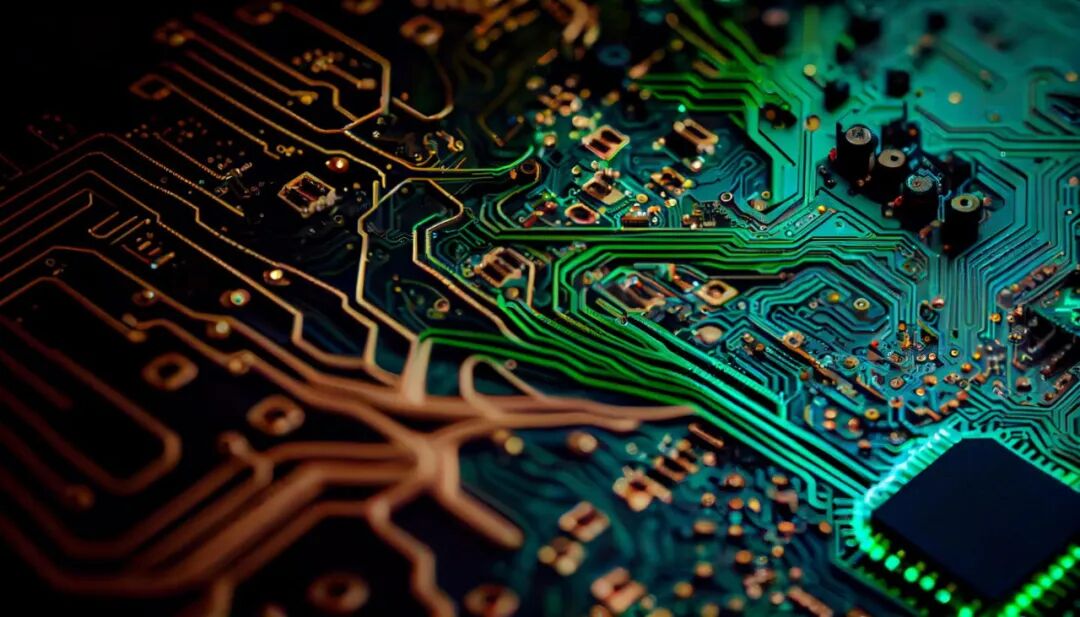
Monosodium Glutamate and Chips
Source: Youyi Si 2025
Monosodium glutamate and chips, two seemingly unrelated things, what do you think their relationship is?
There is a company in Japan called Ajinomoto, which produces monosodium glutamate. However, if this company suddenly stops production, it would not be an exaggeration to say that the global chip industry could face a major earthquake by 2030—because this monosodium glutamate company can actually “choke” the global chip industry.
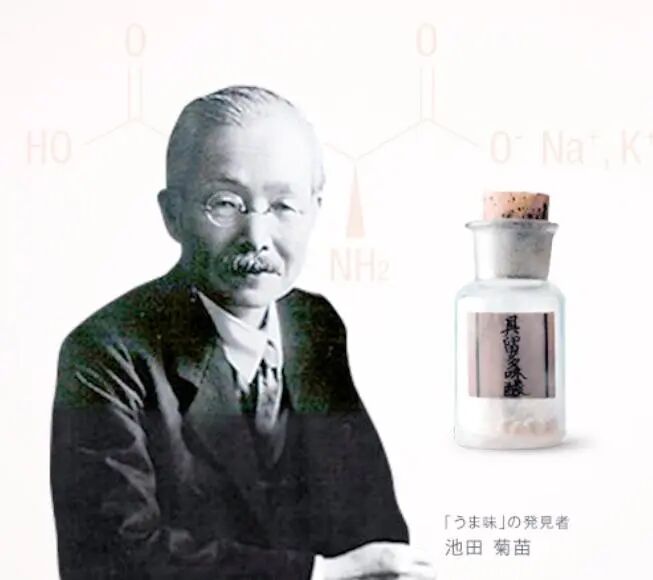
This Ajinomoto company has a significant history; can you guess who invented monosodium glutamate? It was this Japanese company. They invented monosodium glutamate in 1908: the founder Ikeda, while eating seaweed, suddenly felt that the taste of the seaweed was very special, with a unique flavor that was hard to describe, which he temporarily named “umami.” Later research found that there was a component in seaweed called sodium glutamate, and any food containing this substance would have umami flavor. So he went to the market and bought over 20 pounds of dried seaweed, boiled it, and eventually extracted 30 grams of sodium glutamate. In 1908, monosodium glutamate was born in human history, and Ajinomoto began its rapid development path.
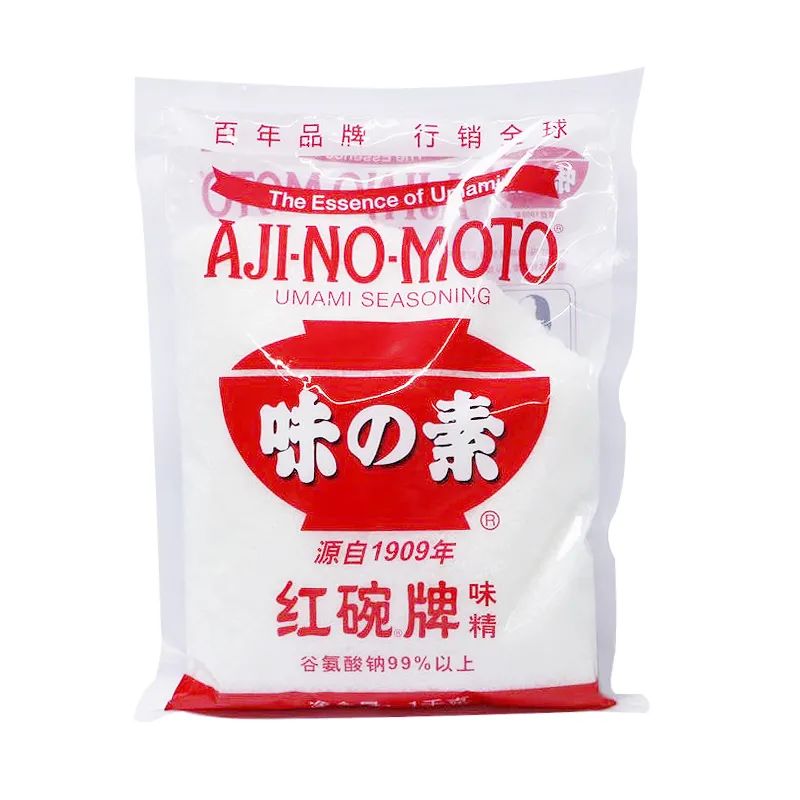
Image: Ajinomoto’s “Red Bowl” brand monosodium glutamate sold in China
By the 1970s, Ajinomoto began to think: we are not just about monosodium glutamate; the essence of the company is in chemicals and materials—because in the process of producing monosodium glutamate, they have been researching amino acids. Thus, Ajinomoto began to seriously explore: besides producing monosodium glutamate, what other possibilities does the company have?
They first thought about the many byproducts generated during monosodium glutamate production; could these “waste materials” be reused? After years of research, they finally turned the byproducts of monosodium glutamate production into a material with excellent insulation properties and publicly applied for a patent. However, at that time, they did not know how this insulation material would be used; they just believed that it would definitely be useful in the future, so they continued to refine the technology and stockpile it.
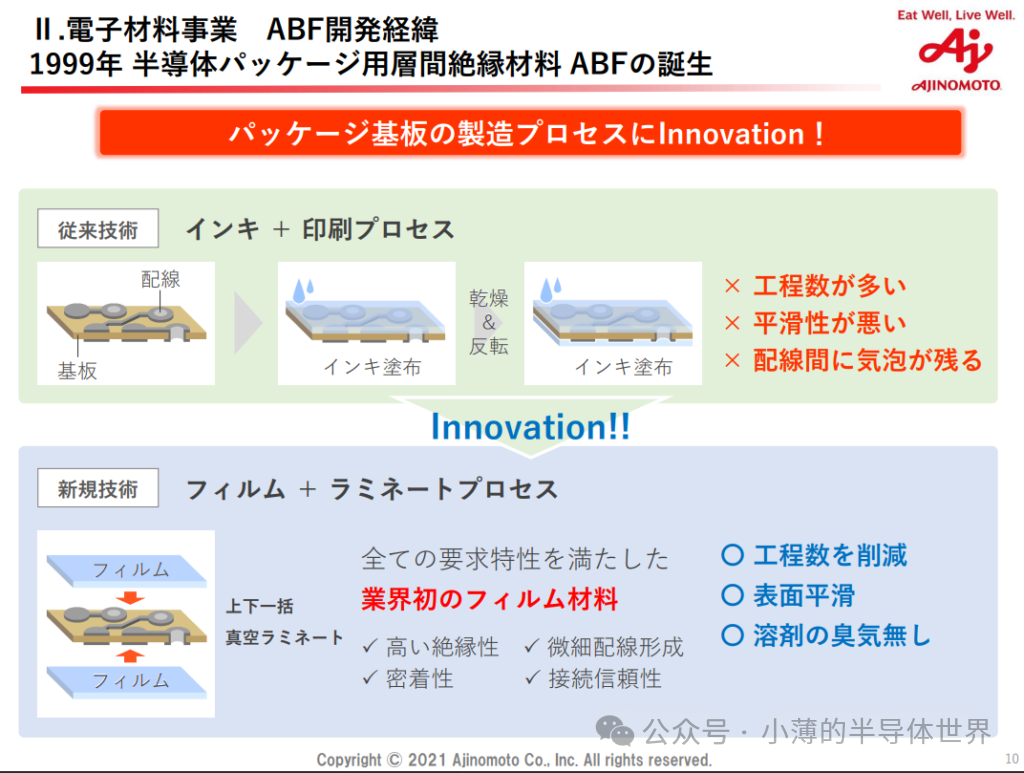
Image from Ajinomoto’s official website
Finally, in 1996, the chip industry faced a dilemma: due to rapid development, the internal circuits of chips became increasingly dense, leading to signal interference issues, and there was an urgent need for a high-performance insulation material to encapsulate the countless tiny circuits in chips, preventing them from interfering with each other. Chip companies began searching the world for such materials, and unsurprisingly, they found Ajinomoto. When Intel found this company worldwide, it was like finding a long-lost brother, and they were overjoyed—they never expected that what they needed was hidden in a monosodium glutamate company.
This is the reality of the world; there is not much meticulous design, but rather a lot of coincidences, and behind those coincidences is years of preparation. Ajinomoto designed a product called “ABF film” for chips, using this film to encapsulate chips for circuit insulation. Thus, Ajinomoto naturally became an extremely important supplier in the global chip industry.
To what extent is it important? They occupy over 90% of the market share, with almost no substitute products—because they have been researching this technology for many years, starting R&D even before knowing its applications.
Some may ask: “Isn’t it just insulation material? What is the technical barrier?” In fact, this insulation material is not just the plastic layer outside the wire; it must be placed inside the chip, ensuring insulation for circuits measured in billions and sized in nanometers, while maintaining stability. No matter how simple something is in this world, once it reaches this level, it has a very high technical barrier.
This helps everyone understand how difficult it is to manufacture chips: to create the best chips, we actually rely on technology that a monosodium glutamate company stockpiled years ago; and behind a chip are thousands of combinations of technologies, solving all of them is no easy task. How many companies like Ajinomoto are behind it?
This also explains why chips are so expensive: because the technologies behind chips often have extremely high monopolistic characteristics, such as insulation technology, which you can only buy from Ajinomoto; no other company can match their quality, so naturally, the price is dictated by Ajinomoto. When there are many such monopolistic technologies and companies, the price of a small chip naturally remains high.
A Monosodium Glutamate Factory Choking the Throat of the Global Chip Industry
These companies do not attract much investment, do not make headlines, have no hot topics, and do not receive visits from leaders. But in the industry, no one dares to underestimate them, nor can they be bypassed.
Source: Fifty Thousand
Ajinomoto is not just a food company; it is also the world’s largest producer of amino acids. In the fields of food, feed, and pharmaceuticals, Ajinomoto has maintained a very high market share. The Ajinomoto Group produces nearly twenty types of amino acids at its twenty-seven production bases worldwide.
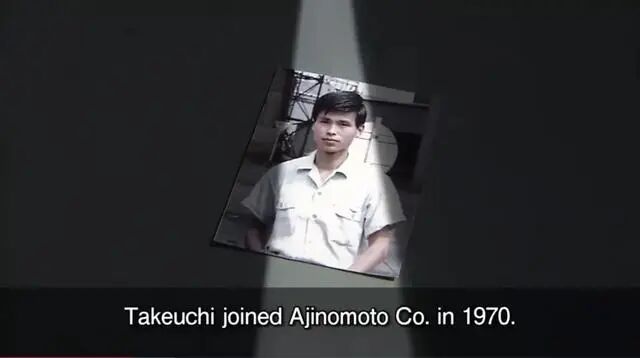
Amino acids are substances with a wide range of applications, excelling in food, medicinal, nutritional, and even cosmetic fields. But today, we will not discuss Ajinomoto’s other layouts in different fields. We will only talk about one thing—the new materials applied in the electronic chip field. In 1970, a young man named Koji Takeuchi joined Ajinomoto. After joining, he was assigned to research the potential uses of the byproducts generated during monosodium glutamate production.He discovered that the byproducts of monosodium glutamate production could be made into a synthetic resin material with extremely high insulation properties.
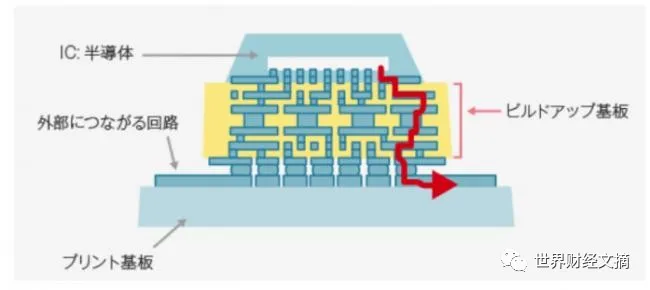 What other uses could this material have? Takeuchi turned his attention to the computer industry.In computers, the core component is called the CPU chip (central processing unit). As CPUs become faster and more integrated, their internal nanometer-level circuits need to connect with external millimeter-level circuits. However, due to limited size and space, it is impossible to spread them out; they must be arranged in a multi-layered manner, fitting these densely packed lines into a compact three-dimensional space.The irregular connections in between are the channels for the CPU to transmit data externally; these lines are both small and dense, requiring insulation from each other while generating significant heat. Handling this is not easy.Therefore, at that time in the computer industry, the method was to apply liquid insulation materials, wait for them to dry, and then proceed to the next step. This was very cumbersome, time-consuming, and prone to errors.Takeuchi thought of a good solution: by improving the process, he could turn the byproducts of monosodium glutamate production into a film. This not only allowed for flexible shapes to accommodate countless circuit combinations but also provided heat insulation and, most importantly, was very easy to install, saving time compared to liquid application.Subsequently, Takeuchi took this product, called ABF (Ajinomoto Build-up Film), to a well-known electronics manufacturer to seek cooperation.As a result, renowned chip manufacturers around the world were captivated by this insulation film from the monosodium glutamate company. Today, nearly 100% of computers worldwide use this film product from Ajinomoto. It can be said that without Ajinomoto’s ABF film, whether it is Apple, Qualcomm, Samsung, or devices like PlayStation 5 or Xbox Series X, or even smartphones, computers, cars, AI, and 5G chips, almost none could be manufactured. No matter how good the chip is, it cannot be packaged without it.A monosodium glutamate company has a grip on nearly the entire semiconductor industry…
 What is the level of Japan’s chip technology in the world? You won’t believe it!When it comes to today’s manufacturing industry, the chip manufacturing industry is the most advanced; it is the pinnacle of all manufacturing technologies.Look at the upstream raw materials for chips. Among nearly twenty essential raw materials, Japan holds three-quarters of the market share. Especially the Japanese internet giant SoftBank Group, which acquired semiconductor design giant ARM in 2016, so now Japan has core design capabilities upstream, product manufacturing capabilities downstream, and controls raw materials in the middle, making it unique in the world of chip semiconductor manufacturing.-END-
Copyright Statement
Image and text materials are sourced from the internet, and reproduction is for communication and reflection only.If there are copyright issues, please contact the backend.Editor WeChat: gao940716 Great craftsmanship is an absolute beliefHow can I bring forth the latent potential that has yet to exist, so that true abundance and prosperity can emerge? Start by deeply understanding the pain points of the Chinese people on this land. Bring forth great craftsmanship that solves these pain points, creating real value for consumers, to discover the true self. “Approaching beauty is approaching divinity.” “Great craftsmanship is a belief!” The uniqueness of exceptional skills or good products, the width, depth, and sensitivity of benefiting consumers determine the degree of “great beauty” of the “exceptional skills,” and also determine the future of individuals and enterprises. Because, in a market economy, every purchase by every consumer is a vote for the enterprise, determining its future.Let us follow Ren Zhengfei through a processOpen the mind, open the spirit, open the will
 Wang Yukun Channel Business CooperationWeChat | gao940716
QQ:2116117593
Submissions: [email protected]