ADC Drug Payload Series (Part 2): Microtubule Protein Inhibitor Auristatin
Introduction
In the previous article, we detailed one of the most widely used microtubule protein inhibitors in ADC drugs: Maytansinoids (see original text).
Today, we will continue to explore another class of microtubule protein inhibitors that occupies a significant portion of ADCs—Auristatin. These molecules also kill tumor cells by interfering with the dynamic balance of microtubule proteins and play a crucial role as “warheads” in several marketed ADC drugs.
Scroll down to the end of the article for the full text link.
Source and Core Molecule of Auristatin
The research on Auristatin molecules originated from the natural product Dolastatin 10 isolated from the marine organism Dolabella auricularia. This molecule exhibits strong anti-tumor cell proliferation activity in vitro, significantly inhibiting microtubule protein assembly, leading to cell cycle arrest and apoptosis.
However, natural products often have limitations such as limited availability and complex structures. Therefore, scientists have developed a series of synthetic analogs with better drug-like properties, among which the most famous and widely used are Monomethyl Auristatin E (MMAE) and Monomethyl Auristatin F (MMAF).
- MMAE (8): Composed of four amino acids (MeVal-Val-Dil-Dap) and a C-terminal norephedrine. It has cell membrane permeability and can penetrate the cell membrane to kill surrounding cancer cells after killing target cells, producing a so-called “bystander effect”.
- MMAF (9): Its C-terminal is replaced by phenylalanine. Due to the carboxyl group at the C-terminal, its hydrophilicity increases, significantly reducing cell membrane permeability, thus having almost no bystander effect. However, this may also result in lower systemic toxicity.
Figure B clearly shows the chemical structures of these core molecules and their activity differences.
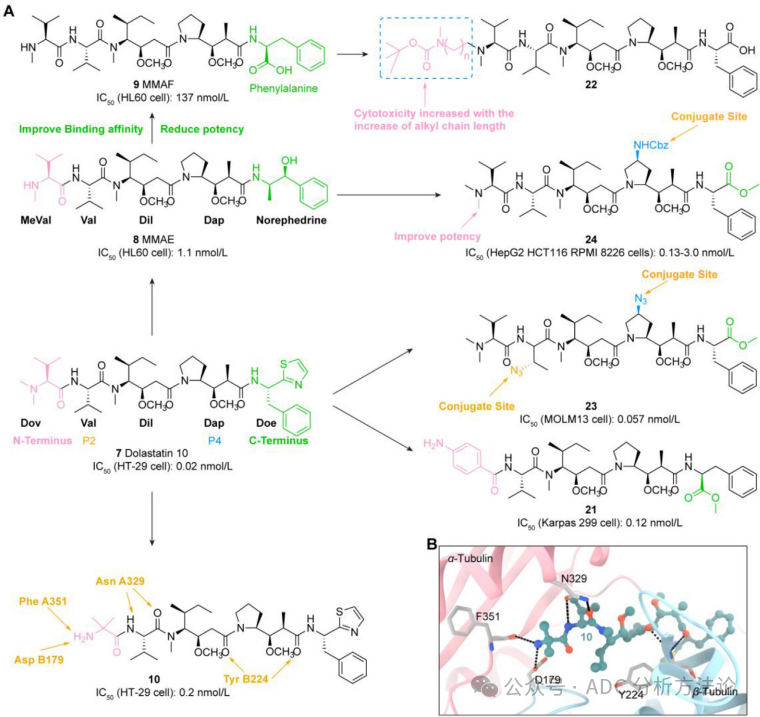
Figure Caption: (A) Shows the chemical structures of molecules such as Dolastatin 10 (7), MMAE (8), and MMAF (9). It can be seen that the in vitro activity of MMAE (IC50: 1.1 nmol/L) is much higher than that of MMAF (IC50: 137 nmol/L). (B) Shows the binding mode of the new analog 10 with microtubule proteins, providing a structural basis for rational drug design.
Structural Optimization and Structure-Activity Relationship (SAR) of Auristatin
To further enhance the performance of Auristatin as an ADC payload, such as improving activity, increasing water solubility, and providing suitable linkage sites, researchers have conducted extensive structural modifications on its N-terminus and C-terminus.
Figure 4-2 in the literature summarizes some structurally modified Auristatin analogs.
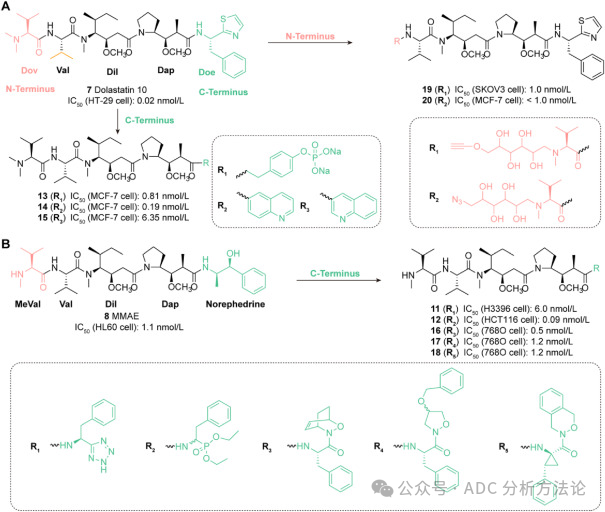
Figure Caption: This figure shows various Auristatin analogs modified at the N-terminus or C-terminus. For example, compounds 11 and 12 modify the C-terminus of MMAF, while compounds 19 and 20 introduce hydrophilic side chains at the N-terminus. These modifications aim to optimize the physicochemical properties and biological activity of the molecules, making them more suitable as effective payloads for ADCs.
The core findings of these studies include:
- C-terminal modifications: As mentioned above, replacing the C-terminus of MMAE with phenylalanine yields MMAF, which significantly reduces activity but provides different options for subsequent development. Further modifications (e.g., compounds 11, 12) can fine-tune its physicochemical properties.
- N-terminal modifications: The freedom of modification at the N-terminus is relatively greater. Studies have shown that introducing different groups at the N-terminus can regulate the molecule’s water solubility and bystander effect. For example, introducing alkyl chains (e.g., compound 22) can systematically adjust the molecule’s membrane permeability, activity, and resistance to drug efflux pumps.
- Development of new analogs: Scientists have also developed new derivatives such as azastatin (24), which has even higher cytotoxicity than MMAE, indicating that there is still significant room for optimization of this class of payloads.
Conclusion
Similar to Maytansinoids, Auristatin and its derivatives (especially MMAE and MMAF) are milestone payloads in the history of ADC drug development. With their picomolar-level ultra-high cytotoxicity, clear mechanisms of action, and modifiable chemical structures, they have become one of the most ideal “biological missile warheads”.
To date, they have become core components of many marketed and clinically trialed ADC drugs (such as Adcetris®, Polivy®, Padcev®, Aidixi®), bringing new hope to cancer patients.
In the upcoming series, we will continue to explore other types of ADC payloads, so stay tuned!Click the link to access the original text: Frontiers in ADC Payload Analysis.pdfOther ADC characterization articles:ADC Peptide Mapping Challenge (Part 2): Dual Enzyme System Solves the “Leakage” Problem, Achieving New Industry Highs in Reproducibility!Frontiers in ADC Payload Analysis (Part 1): Microtubule Protein Inhibitors