 👆If you wish to meet often, feel free to star 🌟 and bookmark it~
When it comes to Arm, we are most familiar with their influence in mobile device SoCs, including smartphones. In recent years, with the rise of Apple’s M-series chips and artificial intelligence, we have also seen an increasing number of Arm architecture chips in the PC and data center sectors.
Moreover, Arm has long played a significant role in the smart automotive chip market. As Suraj Gajendra, Vice President of Products and Solutions at Arm’s Automotive Division, stated, Arm has been deeply involved in the automotive industry for over 25 years, providing technology and product support. “When it comes to computing, almost all car manufacturers and the top 15 automotive semiconductor suppliers globally are using Arm technology. In the past five years, the shipment of Arm architecture-based chips in the automotive market has significantly increased, reaching three times the previous volume,” Gajendra added.
He further pointed out that Arm will always be at the forefront, continuously pushing the boundaries of technology to provide the new technologies required for emerging application scenarios.
Changes in Automotive Chips
In recent years, traditional automotive architectures have undergone tremendous changes due to electrification and intelligence. Coupled with the rise of artificial intelligence, automotive chips have experienced rapid development.
According to a report released earlier by the well-known analysis firm Yole, the semiconductor device market is expected to grow from $68 billion in 2024 to $132 billion by 2030. Among them, the value of automotive semiconductor devices is projected to increase from $759 per vehicle (2024) to approximately $1,332 by 2030, with the number of semiconductor devices per vehicle rising from about 824 (2024) to 1,158 (2030).
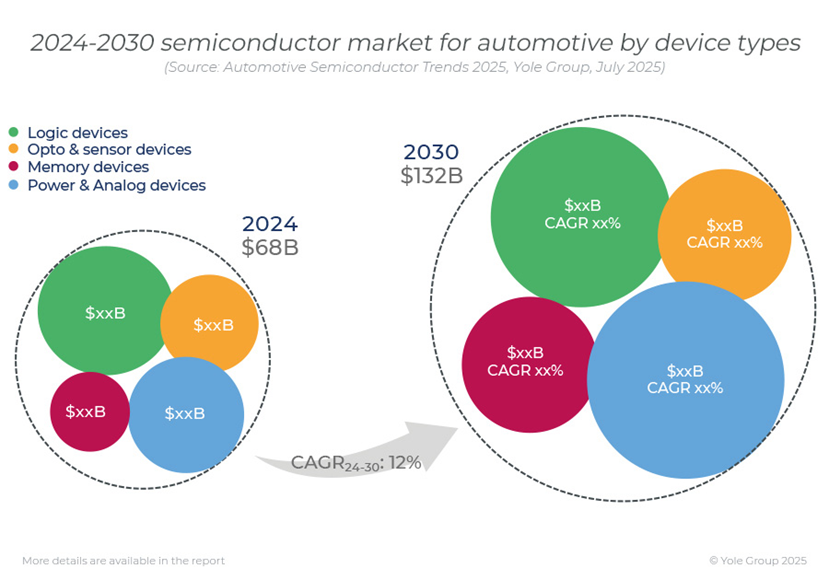
As Yole pointed out in the report, behind this growth lies a change in chip demand. For example, the automotive industry is rapidly transitioning from internal combustion engines to hybrid and pure electric vehicles, which places higher demands on the power electronics field, especially for wide bandgap switches (first SiC, then GaN), and drives the “power and analog” sector to become the largest contributor to incremental revenue; the 2026 regulations from the European New Car Assessment Programme (Euro-NCAP), the newly introduced Automatic Emergency Braking (AEB) regulations in the U.S., and the upgraded C-NCAP testing cycle in China are forcing even entry-level models to be equipped with additional cameras, radars, and domain controllers; in the coming years, the electronic and electrical (E/E) architecture will evolve towards greater centralization and a 48V grid, which requires support from advanced MCUs and new PMIC groups; in addition, artificial intelligence is fundamentally reshaping all industries, including automotive, with high-performance chip demands becoming significantly evident for multimodal interaction interfaces, end-to-end systems, and VLA models for ADAS.
Arm also believes that the transformation of future mobility is not only disrupting the automotive industry but also continuously increasing the complexity of automotive systems. AI-driven driving experiences, vehicle-to-cloud connectivity, and cloud-native development are reshaping the design, manufacturing, and experience of automobiles. Arm points out that the rapid integration and continuous deployment of advanced software and AI capabilities in vehicles present numerous challenges for increasingly complex systems: how to ensure seamless integration, real-time performance, functional safety, and cybersecurity? Furthermore, coordinating updates across different platforms, achieving cross-platform interoperability, and meeting global market compliance requirements add multiple difficulties for car manufacturers.
In discussions with media such as Semiconductor Industry Observer, Suraj Gajendra stated that AI technology has deeply integrated into the automotive industry in current application scenarios, with the industry not only supporting AI algorithms capable of planning, perception, and driving behavior decision-making but also integrating a certain degree of AI functionality in the cockpit, delivering excellent applications through wireless (OTA) updates, providing users with an outstanding experience.
Looking ahead, Suraj Gajendra anticipates that AI will play a greater role in various automotive functions, such as in autonomous driving applications, where end-to-end AI technology can enable a single AI model to handle most, if not all, driving decisions; simultaneously, AI models supporting multimodal interaction are being widely applied in the cockpit domain.
He also emphasized that to achieve these goals, three fundamental elements must be met:
First, innovative flexibility; as AI application developers begin to roll out various new features, we must ensure that hardware and software inherently possess some core functionalities, such as functional safety, information security, real-time quality of service, and the flexibility to integrate new AI applications through tools and processes;
Second, achieving the scalable deployment of AI applications across the entire automotive ecosystem; while small-scale testing is valuable, the fundamental goal is to expand it across the entire ecosystem;
Third, shortening time-to-market; due to the rapid pace of innovation brought by AI, it is crucial for hardware and software suppliers to keep up to ensure that solutions can be brought to market faster, making it essential to accelerate time-to-market.
To meet these core requirements, suitable chips are needed to provide technical support. As a long-time player in the automotive chip field, Arm has been well-prepared for this trend over the past few years.
From IP to CSS: Accelerating Chip Deployment
Throughout the semiconductor supply chain, Arm has previously played a significant role as an IP supplier. Specifically, the company delivers its designed semiconductor IP to chip manufacturers for chip design and manufacturing through technology licensing, a business model that accelerates industry development and propels the company forward by obtaining technology licensing fees and royalties. This collaborative approach has been largely similar across mobile, PC, server, and automotive sectors. However, Suraj Gajendra admitted that this approach may be somewhat unsuitable for current demands.
“Generally speaking, automotive-specific chips developed based on Arm IP typically take two years to appear after the release of Arm IP. For example, the IP we released in 2021 will not see corresponding chips in the automotive market until two years later. Software developers also have to wait until then to begin their development work. This indicates a long delay in the process,” Suraj Gajendra said.
In light of this, Arm launched a virtual prototype for the Cortex-A720AE IP simultaneously with its release last year to address the software development lag. By enabling virtual prototype technology, Arm can open the development platform to software developers as a cloud service on the same day as the IP release, effectively advancing the software development timeline by two years.
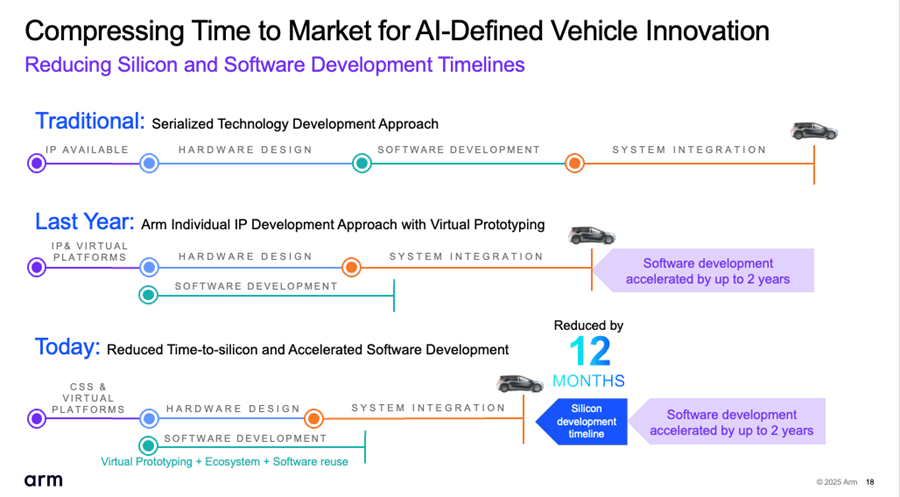
However, even so, Arm found that as automotive applications continue to increase their computational demands, chip design has also become more complex, further exacerbating the overall system complexity. This means that Arm’s partners need to invest more time to complete such design and implementation work.
“Thus, we launched Compute Subsystems (CSS) to help customers address computational complexity issues, allowing them to focus their efforts on other core aspects,” Suraj Gajendra told Semiconductor Industry Observer. “As the complexity of SoCs continues to rise, the time customers take to complete designs—including timing closure and all design work—is continually extending. Our compute subsystem solutions can intervene early and resolve these complex issues,” Suraj Gajendra added.
Suraj Gajendra further pointed out that by providing a more complete compute subsystem, the total number of engineers and their proportion required for complex SoC development will be significantly reduced (based on Arm’s case studies and evaluation data, the engineering resource investment required for each project is expected to decrease by 20%).
Since customers do not need to invest as many engineering resources, they can allocate the saved resources to other parts of the SoC, including focusing on the development of AI accelerators or building their own differentiated advantages—this is precisely the direction Arm supports.
“This not only enhances the cost efficiency for customers but also improves design efficiency. Additionally, completing designs earlier can also lead to cost savings, which is the core value we aim to convey,” Suraj Gajendra emphasized. “Considering the overall costs of the SoC, platform construction, and platform deployment, we believe that adopting Arm’s compute subsystem will require less investment from customers, as Arm has already taken on a significant portion of the development costs,” Suraj Gajendra reiterated.
Arm firmly believes that pushing products to market through compute subsystems is the optimal path. Over the past few years, the company has implemented this strategy in various fields where Arm excels, such as mobile SoCs and infrastructure chips. As mentioned earlier, the CSS aimed at the automotive market is also a key focus area for Arm, continuing this strategy in the automotive sector.
Thus, the Arm Zena CSS, a computing platform defined for AI in automotive applications, has emerged.
Arm Zena CSS: A Stunning Debut
The first generation of Zena CSS introduced by Arm is a standardized, pre-integrated, and pre-validated computing platform built on the latest market-validated Armv9 Automotive Enhanced (AE) technology. This computing platform combines low power consumption, high performance, and validated IP, along with dedicated security islands and runtime security engines, plus reference firmware and software support, forming a complete CSS for chip realization.
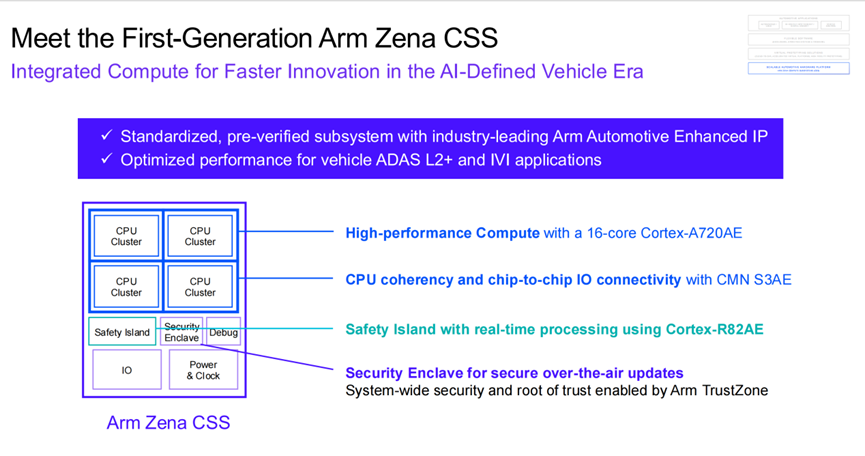
Specifically, the various subsystems of Zena CSS include the following components and features:
1. High-performance computing with a 16-core Arm Cortex-A720AE CPU cluster;
2. CPU consistency and I/O connectivity provided by CMN S3AE;
3. A security island for real-time processing using Arm Cortex-R82AE;
4. A runtime security engine for secure OTA updates;
5. System-level security and root of trust enabled by Arm TrustZone;
6. Verified RTL design and reference firmware;
7. Optional integration of graphics processing units (GPUs) driven by Arm Mali GPU and Mali-C720AE, and image signal processing (ISP);
8. Easy integration of accelerators and partner-specific logic components to meet the increasingly diverse workload demands of advanced AI system-on-chip (SoC) designs.
Compared to starting chip design from IP, Zena CSS can shorten the chip development cycle by up to 12 months due to the pre-integration of hardware and firmware components. In terms of applications, Zena CSS can also extend to IVI, central computing, and L2+ advanced driver assistance systems (ADAS), allowing automakers to flexibly deploy across various vehicle models and performance levels without redesigning the computing stack or starting from scratch for safety certification.
Additionally, Arm’s computing architecture, which spans the automotive ecosystem, enables automakers to reuse and port many components of their software, including firmware, middleware, operating systems, and applications, across Zena CSS-based SoCs from different suppliers. Arm believes that thanks to this comprehensive solution, automakers can act faster from conception to mass production, reduce costs and risks, and create a more differentiated and intelligent driving experience.
Another significant advantage of this solution is its exceptional flexibility.
“Our design allows partners to leverage the core functionalities we provide while also adding proprietary accelerators or specific logic on the compute subsystem to achieve differentiation with their own IP. Of course, partners can also integrate all surrounding peripherals on it, which is what we refer to as flexibility,” Suraj Gajendra stated. “In terms of time to market, partners only need to focus on implementing and optimizing differentiated features, rather than spending time on the deep blue parts in the diagram below, allowing them to concentrate more on modules that can provide differentiation advantages in the SoC,” Suraj Gajendra further explained.
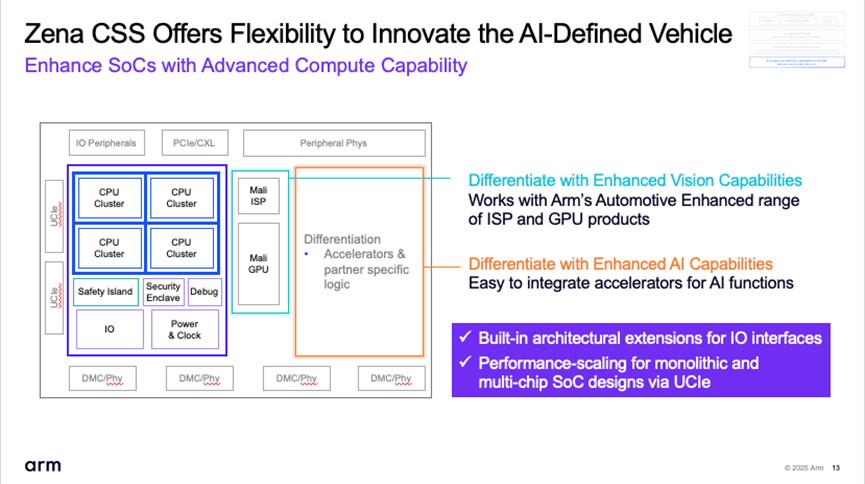
In planning Zena CSS, Arm has also made some arrangements regarding the current Chiplet trend. For instance, Zena CSS itself supports chiplet architecture and provides the key standard interfaces required for this architecture, enabling customers and partners to design based on chiplet architecture—whether it is a single Zena CSS or multiple interconnected Zena CSS units. “Support for chiplet architecture will continue to be an important design component in our future compute subsystem product roadmap,” Suraj Gajendra said.
Although Zena CSS itself does not include UCIe (Universal Chiplet Interconnect Express) interfaces, as shown in the diagram above, the CSS section marked by the purple box already has the capability to connect to the standard interfaces required for UCIe, allowing partners to design Zena CSS as an independent chiplet by adding UCIe interfaces; or they can implement it as a monolithic SoC (system-on-chip) without using UCIe interfaces, which is the product design flexibility Arm provides to its customers.
For Arm Zena CSS, in addition to the aforementioned hardware flexibility, software security, intelligence, ease of use, and rich ecosystem support are also significant advantages that must be mentioned. It is reported that Arm’s software partner ecosystem is demonstrating how its solutions run on Zena CSS—enabling pre-silicon software development through virtual platform solutions and building a cloud-native development and collaboration framework based on the SOAFEE methodology. Typical application scenarios include wireless (OTA) updates, AI-defined driving experiences, enhanced infotainment systems, and safety-critical communication synchronization, all while ensuring compliance with industry standards and adopting standardized DevOps frameworks.
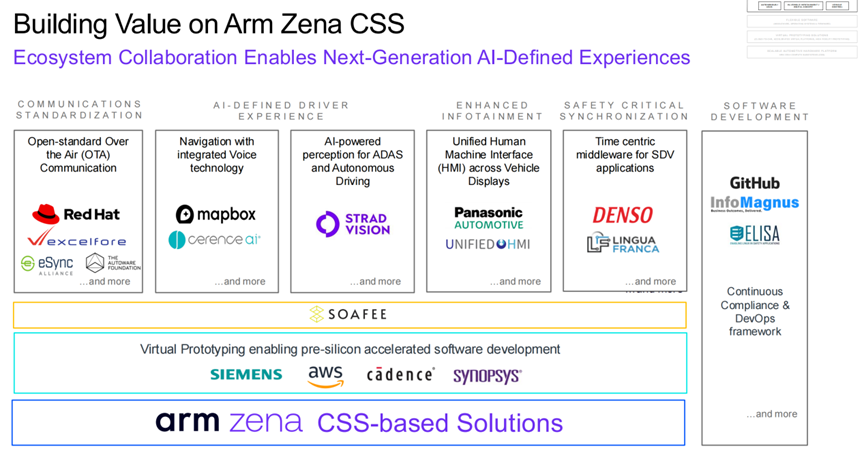
“On the road to ‘AI-defined vehicles’, Zena CSS is an important step we have taken in this direction, relying on Arm’s long-term deep cultivation and accumulation in the automotive industry. The Chinese automotive market holds significant value, and we see a wealth of innovative achievements emerging; Zena CSS can provide an accelerated innovation computing foundation for this market,” Suraj Gajendra emphasized at the end.
Click here👆 to follow and lock in more original content
*Disclaimer: The content of this article reflects the author’s personal views. Semiconductor Chip News reprints it solely to convey a different perspective and does not represent Semiconductor Chip News’s endorsement or support of this viewpoint. If there are any objections, please feel free to contact us.
Recommended Reading
$10 trillion investment in semiconductors
Chip giants see market value plummet
Jensen Huang: HBM is a technological miracle
Jim Keller: RISC-V will definitely prevail
The 10 highest-valued chip companies globally

If you like our content, please click“Looking”” and share it with your friends~