Many beginners in the programming community ask: “With so many programming languages, which one should I choose: Python, C, or C++?” In fact,there is no “best” programming language, only the “most suitable” one— understanding their core differences and aligning them with your learning goals can help you avoid 90% of the pitfalls.
Python, C++, and C are three highly representative programming languages, each with its unique charm and applicable scenarios. For beginners, understanding the differences between them can help in selecting the most suitable programming language.
Why Are There “Differences” in Programming Languages?
Simply put,programming languages are “tools for communication between humans and computers”, just as humans have Chinese and English, computers also have different “communication rules”. The design goals of different languages vary: some pursue “simplicity and understandability”, some pursue “speed of execution”, and some aim for “hardware control”— this is the core reason for the differences between Python, C, and C++.
For example:
- • If you want the computer to quickly understand and execute complex tasks (like games or systems), you might use C/C++;
- • If you want to quickly write usable tools (like data statistics or web scraping), you might use Python;
- • If you want to control robots or microcontrollers, you might use C.
Next, we will compare them one by one.
1. Differences Between Python and C++
1.1 Language Type and Design Philosophy
- • Python: is an interpreted, dynamically typed language. Its design philosophy emphasizes code readability and simplicity, following the principle of “simple is better than complex”. Python uses indentation to indicate code blocks, making the syntax concise and intuitive, suitable for beginners to quickly get started.
- • C++: is a compiled, statically typed language that allows for object-oriented, procedural, and generic programming. It was designed to provide high efficiency and low-level system access, emphasizing performance and flexibility, but its syntax is relatively complex, with a steeper learning curve.
1.2 Execution Speed and Performance
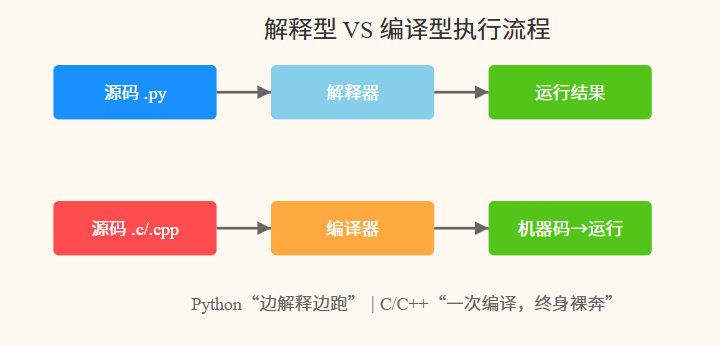
- • Python: is generally slower than C++ because it is an interpreted language, executing code line by line at runtime, and the data types in Python are more complex, such as numbers being objects, which increases runtime overhead.
- • C++: as a compiled language, the source code is compiled into machine code, executed directly by the CPU, resulting in fast execution speed, especially in compute-intensive tasks.
1.3 Syntax and Usability
- • Python: has simple and intuitive syntax, variables do not need to be explicitly declared, and code blocks are indicated by indentation, reducing the use of braces and improving code readability. For example, a for loop in Python can be simply expressed as:
for i in range(10): print(i) - • C++: has complex syntax, requiring variables to have their data types specified at compile time, and code blocks are indicated by braces. The syntax for a for loop is relatively cumbersome:
for (int i = 0; i < 10; i++) {
    cout << i << endl;
}
1.4 Application Areas
- • Python: is widely used in web development, data science, artificial intelligence, education, desktop interface development, system programming, and more. Its rich library ecosystem allows developers to quickly implement various functionalities.
- • C++: is commonly used in game engines, simulations, system software, high-performance server and client applications, and embedded processing. For example, many well-known game engines like Unreal Engine are developed using C++.
1.5 Memory Management
- • Python: has an automatic garbage collector, automating memory management, so programmers do not need to intervene manually, reducing the risk of memory leaks.
- • C++: supports manual memory management, requiring programmers to dynamically allocate and release memory using new and delete operations. While this increases programming complexity, it also provides programmers with greater flexibility and fine control over system resources.
Example: Defining “Student” Information in Python
# Directly use a dictionary to store student information without writing a "template"
student = {
    "name": "Xiaoming",
    "age": 18,
    "school": "Programming Lion Academy"  # Naturally embedded keywords, no syntax burden
}

# Print student name
print(student["name"])  # Output: Xiaoming
You can directly write what information to store without having to “agree on a format” in advance. In the Programming Lion’s Python practical course, this dictionary usage will be explained with examples, such as creating a simple student information management system, which can be achieved in just 30 lines of code.
Example: Defining “Student” Information in C++ (Object-Oriented)
// Step 1: Include header files
#include <iostream>
#include <string>
using namespace std;  // Simplify code to avoid repeating std::

// Step 2: Define "Student Class" (equivalent to setting an information template)
class Student {
public:
    // Member variables (attributes of the student)
    string name;
    int age;
    string school;

    // Member function (operations the student can perform)
    void showInfo() {
        cout << "Name: " << name << ", School: " << school << endl;
    }
};

// Step 3: Main function (program entry)
int main() {
    // Create student object (fill in information according to the template)
    Student xiaoming;
    xiaoming.name = "Xiaoming";
    xiaoming.age = 18;
    xiaoming.school = "W3C School Academy";  // Embed keywords

    // Call function to print information
    xiaoming.showInfo();  // Output: Name: Xiaoming, School: W3C School Academy
    return 0;
}
C++ requires you to first write a “template” (class) and then create objects according to that template, with many syntax rules (like
<span>public</span>,<span>using namespace std</span>). In the Programming Lion’s C++ introductory course, it starts with “Why classes are needed”, using simple language to help you understand the purpose of this complex syntax.
2. Differences Between C and Python
2.1 Language Type
- • C Language: is a procedural, compiled language, where the source code needs to be compiled into machine code before it can run. C emphasizes the use of functions to organize code.
- • Python: as mentioned earlier, is an interpreted, object-oriented dynamic language, where code can run directly without explicit compilation. Python supports multiple programming paradigms, including object-oriented and functional programming.
2.2 Syntax Complexity
- • C Language: has relatively complex syntax, requiring variables to be explicitly declared with data types, and code blocks are indicated by braces. For example:
int num = 10; char letter = 'A'; - • Python: has concise syntax, where variables do not need to be explicitly declared, and code blocks are indicated by indentation. For example:
num = 10
letter = 'A'
2.3 Memory Management
- • C Language: programmers need to manually manage memory, using malloc and free functions for memory allocation and deallocation. This manual memory management, while flexible, can lead to memory leaks and is more challenging for beginners.
- • Python: uses an automatic memory management mechanism, with a built-in garbage collector that automatically recycles unused memory, reducing the difficulty of memory management for programmers.
2.4 Application Areas
- • C Language: is suitable for system programming, embedded development, and other performance-critical areas. For example, most low-level software like operating systems and drivers are developed using C.
- • Python: is widely used in data analysis, artificial intelligence, web programming, and more. Its rich library support, such as NumPy, Pandas, TensorFlow, etc., provides developers with powerful tools to quickly implement complex functionalities.
2.5 Development Efficiency
- • C Language: due to the need for manual memory management and complex syntax, development efficiency is relatively low, resulting in more code.
- • Python: has simple syntax, high development efficiency, and can achieve the same functionality with less code, making it suitable for rapid development and prototyping.
Example: Printing “Hello, W3C School!” in C Language
// Step 1: Include the "input-output library" (beginner's understanding: borrow a tool to print text)
#include <stdio.h>

// Step 2: Define the "main function" (beginner's understanding: the program's entry point, must exist)
int main() {
    // Step 3: Print text (semicolon at the end, double quotes wrap text, strict syntax)
    printf("Hello, W3C School!\n");
    // Step 4: Return 0 (indicating normal program termination)
    return 0;
}
C Language requires writing many “rules”— must include libraries, must have a
<span>main</span>function, statements must end with a semicolon; missing a step results in an error. In the Programming Lion’s C language online compiler, you can try deleting a semicolon and immediately see an error prompt, helping you understand the syntax rules.
Example: Printing “Hello, Programming Lion!” in Python
# Directly print text (the # is a comment, does not affect execution)
print("你好, 编程狮!")
Python accomplishes this in one line! No need to “borrow tools” (print is a built-in function), no “entry point”, no semicolon (can be added or omitted), the syntax is as simple as writing a Chinese sentence. In the Programming Lion’s Python online editor, paste this code and click run to instantly see the result, which is very rewarding.
3. How to Choose a Programming Language
Choosing between Python, C++, or C depends on your project requirements and personal goals:
- • If you want to quickly get started and work in fields like data analysis, artificial intelligence, or web development, Python is a good choice. Its concise syntax and rich library ecosystem allow you to focus on solving problems rather than getting bogged down by complex language details.
- • If you need to develop applications with extremely high performance requirements, such as game engines or system software, C++ or C is more suitable. They provide fine control over hardware and efficient execution speed, but require you to invest more time in learning and mastering complex concepts like memory management.
Horizontal Comparison
| Comparison Dimension | C | C++ | Python |
|---|---|---|---|
| Language Type | Procedural | Procedural + Object + Generic | Object-Oriented + Scripting |
| Execution Method | Compile → Machine Code | Compile → Machine Code | Interpret → Bytecode → Virtual Machine |
| Syntax Difficulty | ★★★★☆ | ★★★★★ | ★★☆☆☆ |
| Variable Declaration | Must be explicit | Must be explicit | Dynamic type, write directly |
| Memory Management | Manual malloc/free | Manual + Smart Pointers | Automatic Garbage Collection |
| Execution Speed | Lightning | Lightning | 10-100 times slower (but development 5-10 times faster) |
| Ecology/Libraries | Few but refined | Medium | Extremely many (AI/Scraping/Web) |
| Learning Cycle | Long | Longest | Shortest |
Code Examples
C Language
#include <stdio.h>
int main() {
    for (int i = 0; i < 10; i++) {
        printf("%d\n", i);
    }
    return 0;
}
Requires: first
<span>#include</span>, write<span>main</span>, manually compile<span>gcc xxx.c -o xxx</span>.
C++
#include <iostream>
int main() {
    for (int i = 0; i < 10; ++i)
        std::cout << i << std::endl;
    return 0;
}
More than C with the addition of the stream
<span>iostream</span>, still needs to be compiled.
Python
for i in range(10):
    print(i)
Save → directly
<span>python xxx.py</span>to see the result, no<span>main</span>, no semicolon, no type declaration.
4. Advantages of Learning Programming Languages at Programming Lion
Programming Lion (w3cschool.cn) is a well-known programming learning platform in China, providing beginners with rich learning resources and course support. Whether you choose to learn Python, C++, or C, you can find a suitable learning path at Programming Lion.
- • Python Course: covers everything from basic syntax to advanced applications, including web development, data science, and more, helping you master Python programming skills comprehensively.
- • C++ Course: deeply explains the core concepts and programming techniques of C++, combined with practical project cases, allowing you to enhance your programming skills through practice.
- • C Language Course: helps you solidify your C language foundation and understand low-level system principles, laying a solid foundation for future learning and development.
In addition, Programming Lion also provides online programming environments, code examples, exercises, and various learning tools, allowing you to practice hands-on at any time during your learning process to reinforce what you have learned.
5. Conclusion
There is no “absolute good or bad” in programming languages, only “whether it suits you”.
Python, C++, and C each have their characteristics and advantages. Python, with its simple and understandable syntax and wide range of applications, has become one of the preferred languages for beginners; C++ excels in performance and low-level control, suitable for developing applications with extremely high performance requirements; C is an important tool for system programming and embedded development. The choice of language depends on your learning goals and project requirements.
In the process of learning programming, Programming Lion (w3cschool.cn) will be your reliable partner. Its rich course resources, practical projects, and learning tools can help you better master programming skills and embark on your programming journey.
👇👇👇
👆👆👆
Join Programming Lion’s lifetime VIP for free access to all courses