According to a report from Electronic Enthusiasts (by Wu Zipeng), as the mobile internet and gaming industries deeply integrate, user expectations for mobile gaming experiences continue to rise—demanding clearer graphics, smoother frame rates, and longer battery life. However, achieving PC-level display performance on mobile devices is a daunting task.Steve Steele, Director of Product Management at Arm’s Client Line of Business, stated that Arm has always focused on providing high-efficiency computing capabilities for the market, especially for the high-resolution graphical workloads common in today’s AAA mobile games. With the deep integration of AI and real-time graphics technology, the industry requires tightly integrated, high-performance, and energy-efficient GPU-based AI. Enabling developers to easily run AI on GPUs is the core driving force behind Arm’s launch of Arm Neural Technology.At SIGGRAPH, Arm introduced Arm Neural Technology, a groundbreaking technology that will bring dedicated neural accelerators to Arm GPUs launching in 2026. This technology can elevate GPU performance used for graphics rendering to a higher level, reducing GPU workloads by up to 50% for today’s increasingly complex mobile content that originated in the mobile gaming sector.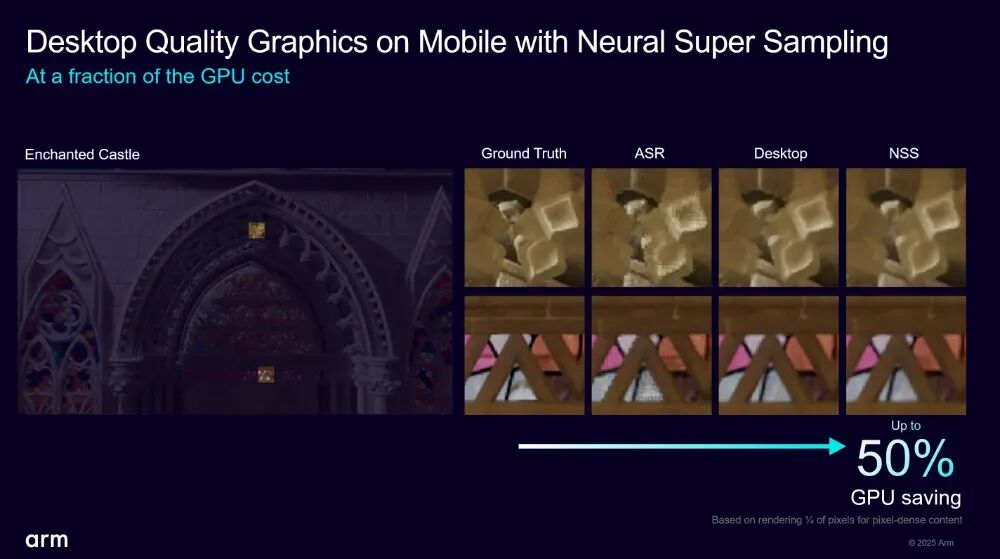
Challenges in Mobile Graphics Rendering
The global mobile gaming market is growing at an astonishing rate, with data showing that last year alone, the total gaming time on mobile reached 390 billion hours. Mobile devices are not only the platform for most games but also contribute nearly half of gaming revenue. However, mobile devices are constrained by size, power consumption, and heat dissipation, requiring a balance between “high quality” and “long battery life” with limited hardware resources. In traditional graphics rendering, high resolution, complex lighting (such as ray tracing), and dense geometric scenes lead to massive GPU workloads, directly resulting in frame rate drops, overheating, or reduced battery life.In the Asia-Pacific market, popular mobile games like “Honor of Kings,” “Peacekeeper Elite,” and “Lineage M” not only drive massive consumption but also push the graphical performance of mobile devices to their limits—demanding extreme requirements for resolution, frame rate, and lighting details, forcing hardware and software technologies to continuously break through. Steve Steele pointed out that these large mobile games are the focus of Arm’s GPU design, aiming to deliver high-quality graphics presentation for mobile users.In recent years, Arm has been dedicated to breaking through the limits of mobile graphics performance. In 2022, it introduced features like ray tracing and variable rate shading; in 2023, it introduced delayed vertex shading technology; previously, Arm’s Accuracy Super Resolution (Arm ASR) technology provided high-quality optimization upgrades for existing mobile devices through efficient shader-based algorithms, which are now open to all mobile game developers.The launch of Arm Neural Technology marks a new milestone.
A New Era of Mobile Graphics Rendering
Arm Neural Technology brings many key innovations that enable developers to easily deploy advanced neural rendering techniques. One representative technology is Arm Neural Super Sampling (Arm NSS), which provides an upgrade solution for Arm ASR in a way that is compatible with APIs.Arm NSS overcomes the performance limitations of temporal super sampling (TSS) using a neural model that learns from data rather than static rules, allowing it to generalize across conditions and content types, adapting more effectively to motion dynamics and recognizing aliasing patterns.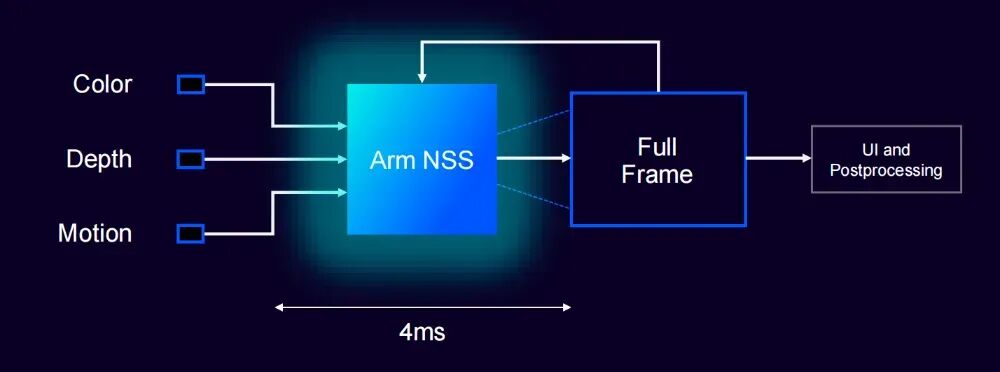 Arm NSS includes three steps in a typical pipeline:
- Preprocessing: Organizing input data (color, motion vectors, depth) into tensor format;
- Neural Inference: Running on a neural accelerator using the Vulkan ML extension;
- Postprocessing: Reconstructing the final image using model output.
In Arm’s “Magic Castle” demonstration, using Arm NSS, GPU workloads can be reduced by 50%, and under sustained performance settings, when the model renders at 540p resolution, it can optimize and upgrade to 1080p within four milliseconds. Steve Steele stated that Arm NSS is just the first use case of the newly released Arm Neural Technology, with two more new use cases currently in development and will be unveiled soon:The first new use case is Neural Frame Rate Upscaling (NFRU), which captures two consecutive frames and generates an intermediate frame to directly enhance frame rates. This neural network is tightly coupled with the new hardware added to Arm’s GPUs, accelerating the generation of motion vectors to track pixel movement in the scene. This technology can optimize and upgrade 30 FPS content to 60 FPS at a lower cost.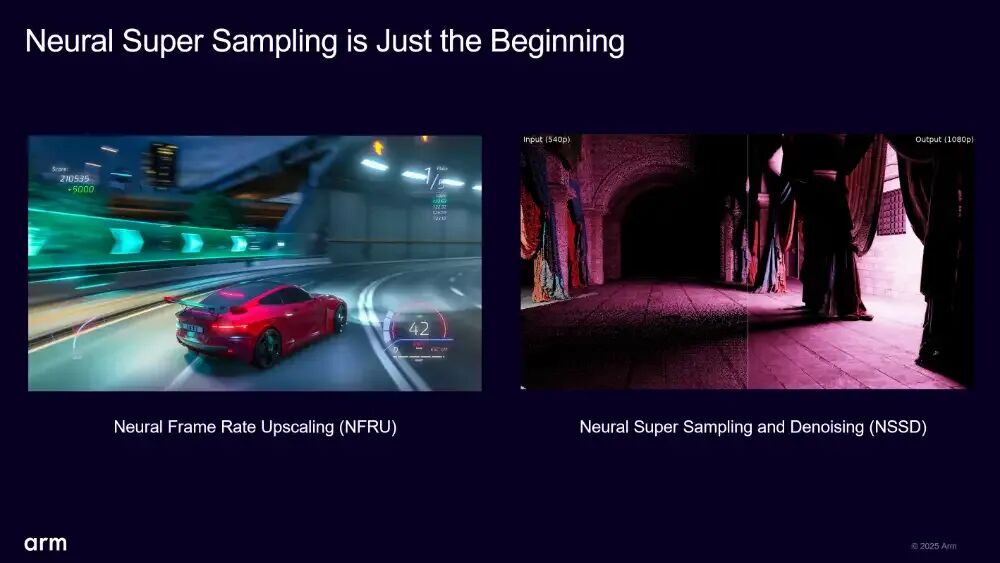 The second new use case is Neural Super Sampling and Denoising (NSSD), which is an extension of Arm NSS aimed at ray-traced content. By combining path tracing with neural networks like NSSD, each pixel only needs to emit a small number of rays, and then use neural technology to reconstruct missing details, inferring data from adjacent pixels and supplementing it with historical frame information.In addition to launching Arm Neural Technology, Arm also introduced the world’s first fully open neural graphics development kit, aimed at integrating AI rendering into existing workflows, allowing developers to start development a year before hardware is released. All Arm Neural Technology in the kit will be fully open, including model architectures, weights, and tools needed for game studios to retrain models. Currently, this development kit has the support of partners such as Enduring Games, Epic Games (Unreal Engine), NetEase Games, Sumo Digital, Tencent Games, and Traverse Research.This development kit is specifically designed for mobile games, covering all resources needed for integrating and customizing AI visual effects, including:
- Unreal Engine plugin
- PC-based Vulkan simulation
- Updated analysis tools
- Fully open models provided through GitHub and Hugging Face
- Vulkan-based Arm machine learning (ML) extensions
According to Steve Steele, the core of this kit is the Unreal Engine plugin, allowing developers to integrate Arm NSS into their games with just a few clicks; it also includes open-format models that will be pushed to Hugging Face and included in the development kit.Additionally, since hardware is still some time away, the kit also includes a complete PC simulator for Vulkan-based Arm ML extensions. This allows developers to run the entire technology stack on the desktop and validate model performance on their content. If developers want to integrate it into their own engines, the kit also provides rich sample code and documentation. Furthermore, Arm has announced early access plans for the NFRU and NSSD use cases. Unlike Arm NSS, these two use cases currently lack the technical ecosystem that supports Arm ASR, so Arm is actively recruiting game studios to join the development and help refine the technology in preparation for future public releases.At its core, Arm has established a roadmap for neural technology, and the GPU-integrated neural accelerators that developers need will be realized in Arm GPU products in 2026.

Disclaimer:This article is originally from Electronic Enthusiasts, please indicate the source above when reprinting. For group communication, please add WeChat elecfans999, for submission of reports and interview requests, please send an email to [email protected].
More Hot Articles to Read
-
Huawei Breaks HBM Dependency! AI Inference Black Technology UCM Launches, Open Source in September
-
Known as the “BYD of the Robotics Industry,” Zhiyuan Secures Millions in Orders! Yushu Aiming for IPO!
-
For the First Time in History! AMD Server CPU Market Share Reaches 50%
-
General Motors: Hard to Bear High Tariffs, Buying Chinese Batteries Still Profitable
-
GPT-5 Shocking Release: A Major Leap in the AI Field
Click to Follow and Star Us
Star us to not miss any updates!