34th Anniversary of Linux: From a Personal Project to a Collaborative Wisdom that Changed the World
How did a small hobby project grow into a technological cornerstone through open collaboration?
Today is August 25, 2025. 34 years ago today, a 21-year-old Finnish university student Linus Torvalds wrote a brief message online:
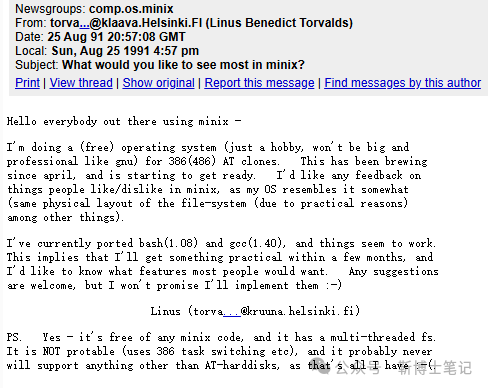
He was writing a “small operating system kernel”, “this is just a hobby, it won’t be particularly large, nor is it professional”, and he shared it for free with anyone who wanted to use or modify it. No one expected that this “seed” would grow into the underlying power of global servers, mobile phones, and supercomputers—Linux.
🌍 The Power of Open Collaboration
The miracle of Linux lies not only in its technology but also in its development model:
- Thousands of programmers worldwide participate
- Code and design are open and transparent
- Spontaneous collaboration and continuous improvement
This model is essentially a global knowledge relay race— no one completed Linux alone, but people from all over the world contributed to it.
It has proven that:openness and sharing do not diminish your competitiveness; rather, they allow results to grow faster.
🔍 Algorithmic Thinking is All Around Us
Although the Linux kernel contains a large number of complex algorithms, its core ideas are closely related to our daily lives:
-
Process Scheduling = Time Management determines which program runs first, just like deciding whether to do homework or exercise first today.
-
Memory Management = Resource Allocation involves how to allocate work with limited resources, similar to how a family allocates budget and time.
-
File System = Knowledge Management involves creating indexes, quickly searching, and deleting invalid information—similar to organizing a room or sorting notes.
📌 Three Insights for Teenagers
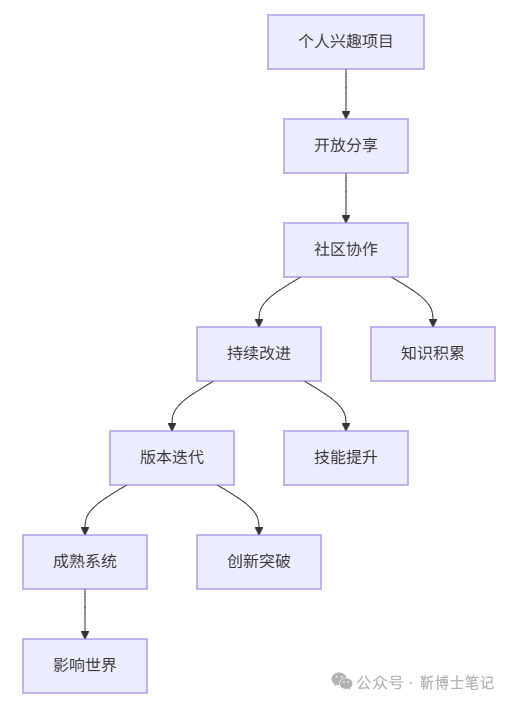
1️⃣ Start Small, Keep Polishing
Linux was initially just a personal “interest project”, yet it changed the world. Do not underestimate small projects; they may become the cornerstone of the future.
Learning Advice: Start with micro-projects, try quickly, iterate in small steps, and do not wait for the “perfect opportunity” to take action.
2️⃣ Keep an Open Mind, Be Willing to Collaborate
The achievements of Linux are inseparable from the sharing and discussion of countless people. In learning, you should also be willing to share your thoughts and methods with others.
Learning Observation: Students who are willing to share their thoughts during learning often progress faster.
3️⃣ Continuous Iteration, Always Evolving
Each version of Linux optimizes based on the previous one, never stopping its growth.
Learning Advice: Treat learning as a version upgrade, not as a one-time “final result”.
💡 The “Linux-style” Learning Method
-
Modularization Break down large goals into several controllable small goals, tackling them one by one.
-
Iterative Thinking Each round of learning is a version upgrade, not pursuing success in one go.
-
Learning Network Like an open-source community, actively build and integrate into learning communities, obtain feedback, and improve methods.
💬 Conclusion

34 years ago today, Linux moved from a student dormitory to the whole world. It tells us:
- Technology is important, but even more important is the mindset of continuous improvement and the spirit of open collaboration
- Any small interest project can grow into a force that changes the world