The Three Major Advantages of Rust: Performance, Safety, and Concurrency – Can You Refuse?

The Three Major Advantages of Rust: Performance, Safety, and Concurrency - Can You Refuse?

Why Learn Rust in 2025? According to developer survey data, Rust has entered the top 12 most widely used programming languages in the IT industry. The data shows that 10%-13% of software developers use Rust in their daily work. Notably, among those who are just starting to learn programming, this percentage even reaches 11%-18%. The … Read more


Understanding Core Concepts of Python

Understanding Core Concepts of Python

Introduction In Python development, understanding the reference differences between mutable objects (such as lists and dictionaries) and immutable objects (such as integers and strings) is crucial. This not only affects code performance but can also lead to subtle bugs. As an experienced developer, I will share insights from practical development to help you master this … Read more

Fundamentals of C++ Game Development: Dynamic Memory Allocation with new and delete

Fundamentals of C++ Game Development: Dynamic Memory Allocation with new and delete

Before discussing dynamic memory allocation, let’s first look at the two basic types of memory allocation in C++: Static memory allocation is used for static and global variables. The memory for these variables is allocated all at once when the program runs and lasts for the entire lifecycle of the program. Automatic memory allocation is … Read more

Liberation of Memory Management in C++: A Detailed Explanation of BDWGC Efficient Garbage Collector Technology

Liberation of Memory Management in C++: A Detailed Explanation of BDWGC Efficient Garbage Collector Technology

In C++ development, manual memory management (<span>new</span>/<span>delete</span>, <span>malloc</span>/<span>free</span>) is a tedious and error-prone task, with memory leaks and dangling pointers being the root cause of many bugs. Although smart pointers (<span>std::shared_ptr</span>, <span>std::unique_ptr</span>) have greatly improved this situation in modern C++, they are not a panacea, as complex circular references or interactions with C code still … Read more

Illustration of C Language Pointer Variables

Illustration of C Language Pointer Variables

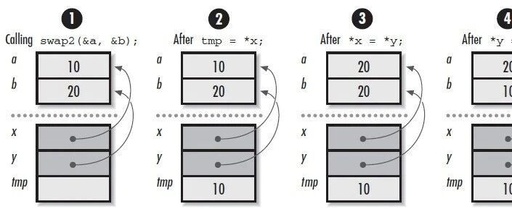
1 Basic Operations of Pointer Variables int a,*iptr,*jptr,*kptr;iptr = &a;jptr = iptr;*jptr = 100;kptr = NULL; Illustration: 1.1 Address and Memory Space A pointer variable is also a variable that corresponds to a block of memory space and an address in memory; the name of the pointer is the address. How large is this empty … Read more

Understanding Stack Overflow and Heap Overflow in C Language: The Simplest Explanation Online

Understanding Stack Overflow and Heap Overflow in C Language: The Simplest Explanation Online

Content First, imagine memory as a three-story building: The first floor is the “Global Data Area” – the hall you see as soon as you enter; The second floor is the “Stack” – like a hotel front desk with a last-in-first-out drawer cabinet, opened and closed as needed; The third floor is the “Heap” – … Read more

Comprehensive Optimization of Python ctypes: A Practical Guide from Debugging Traps to Performance Peaks

Comprehensive Optimization of Python ctypes: A Practical Guide from Debugging Traps to Performance Peaks

1. Debugging Techniques for the ctypes Module 1. Cross-Platform Error Diagnosis Mechanism When calling dynamic link libraries on Windows, <span>ctypes.get_last_error()</span> is a core debugging tool. For example, when calling <span>CreateFileW</span> fails, the following code can be used to capture the error: from ctypes import windll, wintypes, get_last_error try: handle = windll.kernel32.CreateFileW( wintypes.LPCWSTR("nonexistent.txt"), wintypes.DWORD(0), wintypes.DWORD(0), None, … Read more

Understanding the Intensity Required for C++ Interviews

Understanding the Intensity Required for C++ Interviews

No one would really go to a C++ interview without any preparation, right? C++ Basics (30 Questions) Characteristics of C++ Discuss the differences between C and C++ Discuss the differences between struct and class in C++ The order of including header files and the difference between double quotes “” and angle brackets <> Discuss the … Read more

Understanding ‘Callback Hell’ in C Language

Understanding 'Callback Hell' in C Language

Content Hello everyone, I am Bug Jun~Recently, I came across a very interesting term “callback hell”, which refers to endless callback functions that ultimately lead to stack overflow and deadlock. The manifestation of this is multiple layers of nested function pointer callbacks, resulting in poor code readability and maintenance difficulties.Below is a simple example simulating … Read more

In-Depth Exploration of C Language: long and long long, and the “Unwritten Rules” of CPU Architecture!

In-Depth Exploration of C Language: long and long long, and the "Unwritten Rules" of CPU Architecture!

We have already learned aboutshort and int types. A short typically occupies 2 bytes, while an int usually occupies 4 bytes. The larger the byte size, the greater the range of data it can represent. For example, the int type can represent values around ±2 billion, as clearly stated in Microsoft’s documentation. Today, we will … Read more