Face Recognition System Based on PCA (Implementation in Matlab)

Face Recognition System Based on PCA (Implementation in Matlab)

💥💥💞💞Welcome to this blog❤️❤️💥💥 🏆Author’s Advantage: 🌞🌞🌞The blog content aims to be logically clear and coherent for the convenience of readers. ⛳️Motto: A journey of a hundred miles begins with a single step. 💥1 Overview A face recognition system based on Principal Component Analysis (PCA) is a common face recognition technology that identifies faces in … Read more

Implementing PCA/TSNE/SVD Dimensionality Reduction Algorithms in Python

Implementing PCA/TSNE/SVD Dimensionality Reduction Algorithms in Python

Implement PCA/TSNE/KPCA/LDA/SVD dimensionality reduction algorithms (Python code). The information available online on various dimensionality reduction algorithms is inconsistent, and most do not provide source code. Here is a GitHub project that organizes 11 classic data extraction (dimensionality reduction) algorithms implemented in Python, including: PCA, LDA, MDS, LLE, TSNE, etc., along with related materials and demonstration … Read more

A New Method for Hyperspectral Recognition Integrating Local and Global Modeling: Plug-and-Play and Completely Crazy

A New Method for Hyperspectral Recognition Integrating Local and Global Modeling: Plug-and-Play and Completely Crazy

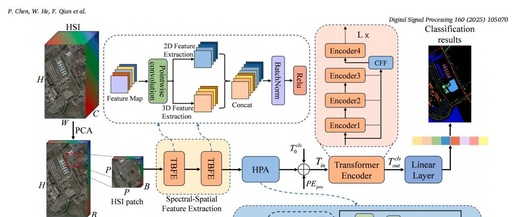
Title: A synergistic CNN-transformer network with pooling attention fusion for hyperspectral image classification Paper Link: https://github.com/chenpeng052/SCT-Net Twin-Branch Feature Extraction Module (TBFE): Parallel combination of3D Convolution (for spectral features) and2D Convolution (for spatial features), achieving spectral-spatial joint modeling early on. Hybrid Pooling Attention Module (HPA): Combines average pooling and max pooling to capture spatial dependencies through … Read more

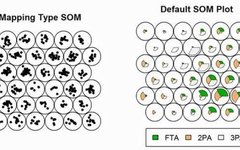
Self-Organizing Maps (SOM): Unlocking the Topological Structure and Clustering Analysis of High-Dimensional Data

Self-Organizing Maps (SOM): Unlocking the Topological Structure and Clustering Analysis of High-Dimensional Data

1 Algorithm Introduction Self-Organizing Map (SOM) is an algorithm that implements unsupervised learning based on the self-organizing properties of neural networks. Its initial design inspiration comes from the way the human brain processes visual information, aiming to simulate the response of neural cells to signals and the self-organizing process in the brain.The core feature of … Read more