Chapter 4 of C++ Programming: Classes

Chapter 4 Classes unset4-1 Explain the role of public and private. What are the differences between public and private members?unsetunset Answer: Public members are declared with the <span>public</span> keyword, defining the external interface of the class, allowing external objects to access them directly; private members are declared with the <span>private</span> keyword, allowing access only by … Read more

Introduction to C++: Object-Oriented Programming – Classes

Object-Oriented Programming – Classes Procedural Programming: A process-centered programming paradigm Object-Oriented Programming (OOP): A programming paradigm centered around objects Encapsulation, Inheritance, Polymorphism Basic Concepts of Classes and Objects A class encapsulates data and methods that share common characteristics, distinguishing them by access levels, to describe or abstract an entity Access levels in a class are: … Read more

C++ Programming Guidelines – Constructors, Assignment, and Destructors

C++ Programming Guidelines - Constructors, Assignment, and Destructors

01 Classes containing member variables must define a constructor or a default constructor. Note: If a class has member variables and does not define a constructor or a default constructor, the compiler will automatically generate a constructor, but the compiler-generated constructor will not initialize the member variables, leaving the object in an uncertain state.Exception: If … Read more

In-Depth Analysis of Virtual Functions and Constructors/Destructors in C++

In-Depth Analysis of Virtual Functions and Constructors/Destructors in C++

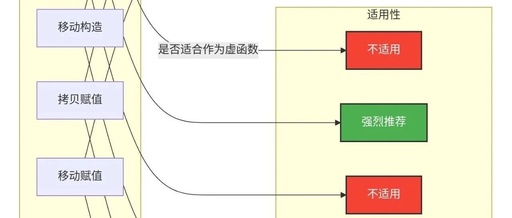
In-Depth Analysis of Virtual Functions and Constructors/Destructors in C++ Exploring key techniques and underlying implementations in object-oriented programming In C++ object-oriented programming, the virtual function mechanism is central to achieving polymorphism. However, when virtual functions are used in conjunction with special member functions (especially constructors and destructors), there are many details and considerations that require … Read more

Classes and Objects in C++

Classes and Objects in C++

Classes and objects in C++ are core concepts of Object-Oriented Programming (OOP), providing features such as encapsulation, inheritance, and polymorphism. Below is a detailed introduction to constructors, destructors, and operator overloading: 1. Basics of Classes and Objects A class is a user-defined data type that encapsulates data (member variables) and operations (member functions). An object … Read more