In-Depth Analysis of Virtual Functions and Constructors/Destructors in C++
Exploring key techniques and underlying implementations in object-oriented programming
In C++ object-oriented programming, the virtual function mechanism is central to achieving polymorphism. However, when virtual functions are used in conjunction with special member functions (especially constructors and destructors), there are many details and considerations that require in-depth understanding. This article will comprehensively analyze this important topic from the perspective of underlying principles and practical applications.
01 Scenarios and Underlying Principles of Destructors as Virtual Functions
In C++, declaring a base class destructor as a virtual function is a common and important practice, especially when manipulating derived class objects through base class pointers.
If the base class destructor is not a virtual function, deleting a derived class object through a base class pointer will lead to undefined behavior, typically only calling the base class destructor and not the derived class destructor, resulting in resource leaks.
The correct approach is to declare the base class destructor as a virtual function:
Example of a Virtual Destructor
class Base {
public:
virtual ~Base() { // Virtual Destructor
// Release base class resources
}
};
class Derived : public Base {
public:
~Derived() override { // Derived Class Destructor
// Release derived class resources
}
};
// Correct usage
Base* obj = new Derived();
delete obj; // This will call Derived::~Derived() and Base::~Base()
Virtual Destructor Call Flow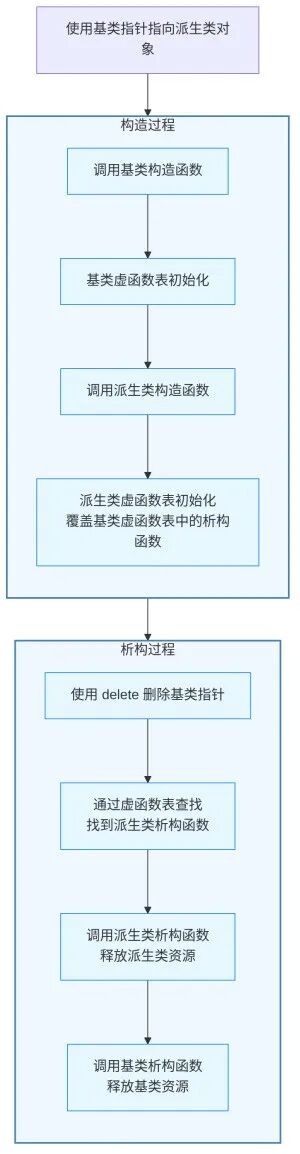
Underlying Principle: When the base class destructor is declared as virtual, it is added to the virtual function table. The derived class destructor will override the base class version, and when deleting an object through a base class pointer, the correct destructor will be found and called via the virtual function table.
The virtual destructor ensures that when deleting a base class pointer, destructors are called in the correct order from derived class to base class, preventing resource leaks. All classes intended to be used as base classes should declare a virtual destructor.
02 Analysis of Why Constructors Cannot Be Virtual Functions
In contrast to destructors, the C++ standard explicitly prohibits declaring constructors as virtual functions. Attempting to do so will result in a compilation error. This restriction stems from the underlying design of the C++ object model.
The main reasons include:
- Initialization Timing Issues: The task of a constructor is to initialize an object, while the virtual function mechanism relies on the state of an already constructed object
- vptr Not Initialized Yet: The virtual function table pointer is set only during the execution of the constructor, making it unavailable for use when calling the constructor
- Incomplete Object Type: During construction, the object type evolves from base class to derived class, and the type is uncertain before full construction
Although constructors cannot be virtual functions, we can indirectly achieve similar functionality through the Virtual Factory Function pattern, allowing the creation of different derived class objects based on the base class interface:
Example of a Virtual Factory Function
class Base {
public:
virtual ~Base() = default;
// Virtual Factory Function
static std::unique_ptr<Base> create();
// Other members…
};
class Derived : public Base {
public:
// Constructor
Derived() { /* Initialization */ }
// Implementation of Virtual Factory Function
static std::unique_ptr<Base> create() {
return std::make_unique<Derived>();
}
};
// Creating an object using the Virtual Factory Function
auto obj = Derived::create();
Constructors cannot be virtual functions because the virtual function mechanism cannot work correctly before the object is fully constructed. When polymorphic object creation is needed, the virtual factory function pattern can be used as an alternative.
03 Other Special Member Functions as Virtual Functions
In addition to destructors, C++ has other special member functions, including copy constructors, move constructors, and assignment operators. Their usage as virtual functions has its own characteristics.
| Special Member Function | Can It Be Declared as a Virtual Function | Usage Scenarios | Notes |
|---|---|---|---|
| Copy Constructor | Theoretically possible, rarely used | Clone Pattern | Usually implemented through a virtual Clone() function |
| Move Constructor | Theoretically possible, almost never used | Polymorphic scenarios for efficient resource transfer | Complex implementation, high risk, limited benefits |
| Copy Assignment Operator | Possible, with some applications | Assignment operations for polymorphic objects | Need to be aware of the slice problem |
| Move Assignment Operator | Possible, but rarely used | Move assignment for polymorphic objects | Complex implementation, needs careful handling |
The clone pattern is a common design pattern that implements polymorphic copy functionality through virtual functions. A typical implementation is as follows:
Clone Pattern Implementation
class Base {
public:
virtual ~Base() = default;
// Virtual Clone Function
virtual std::unique_ptr<Base> clone() const {
return std::make_unique<Base>(*this);
}
};
class Derived : public Base {
public:
// Override Clone Function
std::unique_ptr<Base> clone() const override {
return std::make_unique<Derived>(*this);
}
};
// Polymorphic Copy
std::unique_ptr<Base> original = std::make_unique<Derived>();
std::unique_ptr<Base> copy = original->clone(); // Correctly copies Derived object
Slice Problem: When assigning a derived class object to a base class object through a base class reference or pointer, only the base class part will be copied, while the derived class-specific part will be “sliced off”. A virtual assignment operator does not completely solve the slice problem, but it can provide additional safety through return type covariance and dynamic type checking.
04 Conclusion
The interaction between virtual functions and special member functions is an important aspect of C++ object-oriented programming. The key points are summarized as follows:
- Destructors: Base class destructors should be declared as virtual functions to ensure correct behavior during polymorphic deletion
- Constructors: Cannot be declared as virtual functions, but polymorphic object creation can be achieved through virtual factory functions
- Copy Constructors: Theoretically can be declared as virtual functions, but in practice, the virtual Clone() function is usually used to implement polymorphic copying
- Assignment Operators: Can be declared as virtual functions, but care must be taken to avoid the slice problem
- Move Operations: Move constructors and move assignment can theoretically be implemented as virtual functions, but their practical application value is limited
Matrix of Applicability for Special Member Functions and Virtual Functions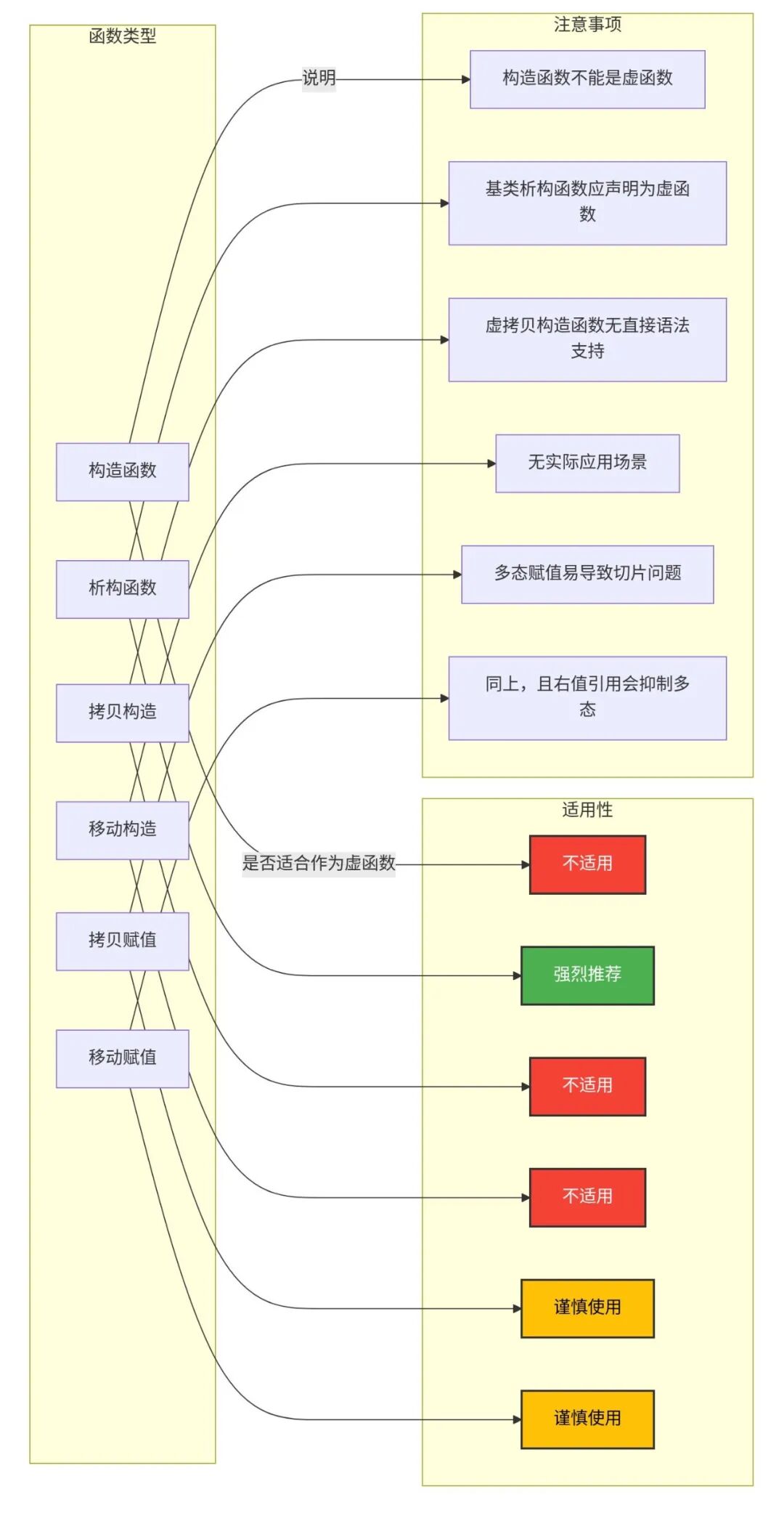
Understanding these mechanisms not only helps in writing correct C++ code but also provides a deeper understanding of the C++ object model and the implementation principles of virtual functions, laying a theoretical foundation for solving complex object-oriented design problems.
In-Depth Analysis of C++ Techniques
This article explores the interaction between virtual functions and various special member functions in C++
Understanding these underlying mechanisms is crucial for writing efficient and correct object-oriented code