
Zhang Zhengyou is Tencent’s first 17th-level (the highest professional rank in Tencent’s history) distinguished scientist and the founder of Robotics X from 0 to 1. He proposed the “Zhang Zhengyou Calibration Method” for machine vision. To support his company’s embodied business, Zhang Zhengyou, who rarely attends media events, announced at the Tencent WAIC Forum: “Tencent aims to become a partner for robot manufacturers.”
Tencent publicly released a panoramic view of AI product applications and an open-source 3D world model.
Zhang Zhengyou is a top scientist in China’s artificial intelligence and robotics field, with a career spanning academic breakthroughs and industrial implementation. Under his leadership, Tencent’s robot strategy presents a unique technological path and ecological positioning. The following is an in-depth analysis from the perspectives of personal achievements and strategic layout:
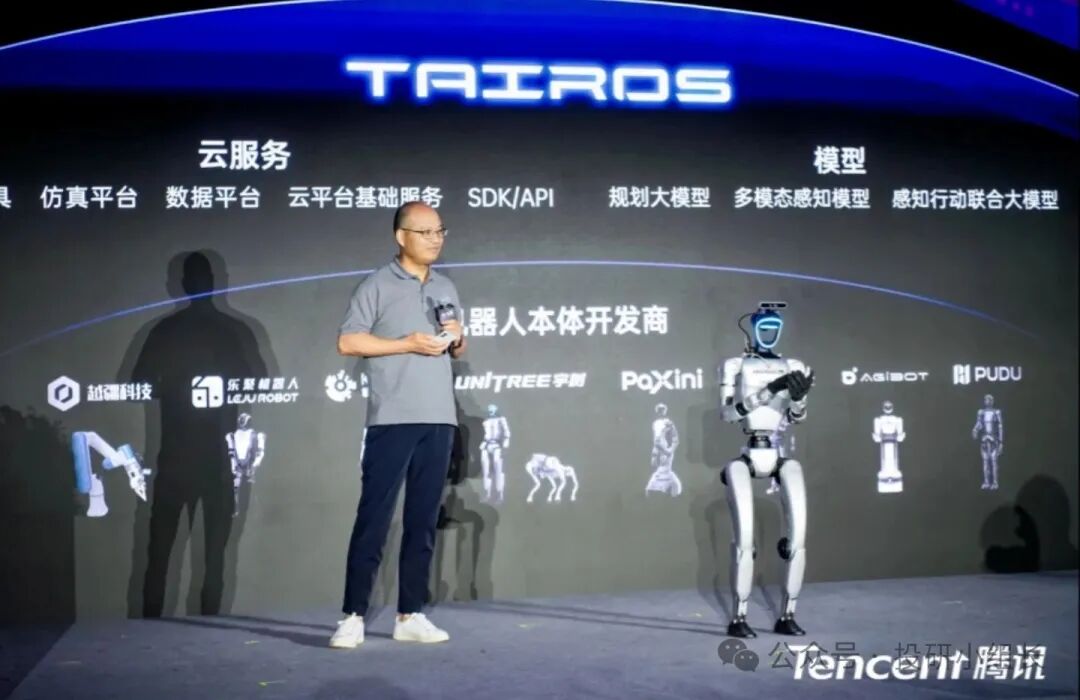

Zhang Zhengyou: From Academic Benchmark to Industrial Architect
1. Academic Foundation: The “Zhang Calibration Method” for Machine Vision
As one of the founders of the computer vision field, Zhang Zhengyou’s “Zhang Calibration Method,” proposed in 1999, completely changed the industry standard for camera calibration. This method achieves high-precision calibration through a two-dimensional checkerboard, solving the complex processes of traditional three-dimensional calibration, and has become a core technology in global industrial inspection, autonomous driving, and other fields. Its core innovations include:
– Mathematical Simplification: By combining homography matrices with nonlinear optimization, the calibration steps are simplified from cumbersome three-dimensional coordinate systems to two-dimensional plane operations.
– Engineering Practicality: Calibration can be completed without special equipment, promoting three-dimensional vision from the laboratory to the production line.
– Lasting Influence: In 2013, he received the IEEE Helmholtz Time-Tested Award for this achievement, which remains a foundational algorithm in mainstream vision libraries like OpenCV.
2. Career Trajectory: Strategic Shift from Microsoft to Tencent
Zhang Zhengyou’s career reflects a leap from fundamental research to industrial innovation:
– Academic Deepening Period (1985-1998): During his time at the French National Institute for Research in Computer Science and Automation (INRIA), he led foundational research in stereo vision and three-dimensional reconstruction, establishing the theoretical framework for computer vision.
– Industrial Breakthrough Period (1998-2018): At Microsoft Research, he applied computer vision technology to consumer products like Kinect, promoting the popularization of gesture interaction technology.
– Strategic Transformation Period (2018 to present): After joining Tencent, he established the Robotics X laboratory and proposed the concept of “Integrated Virtual and Real World” (IPDE), deeply integrating AI, VR/AR, and robotics technology.
3. Technical Philosophy: Hierarchical Control of Embodied Intelligence
Zhang Zhengyou’s proposed “SLAP Paradigm” (Sensing-Learning-Action-Planning) redefines the control logic of robots:
– Reactive Autonomy (System 1): Achieving millisecond-level responses through direct closed-loop sensing and action, such as dynamic obstacle avoidance in robotic arms.
– Rational Planning (System 2): Utilizing large models for complex task decomposition, such as multi-step service processes for elderly care robots.
– Learning Penetration: Continuously optimizing capabilities at all levels through reinforcement learning, forming dynamically evolving intelligent agents.
The TRX-Hand dexterous hand (8 joints, 15N fingertip force) and TRX-Arm robotic arm (7.4m/s movement speed) developed by his team have already achieved complex operations from bartending to precision assembly, validating the engineering feasibility of hierarchical control.
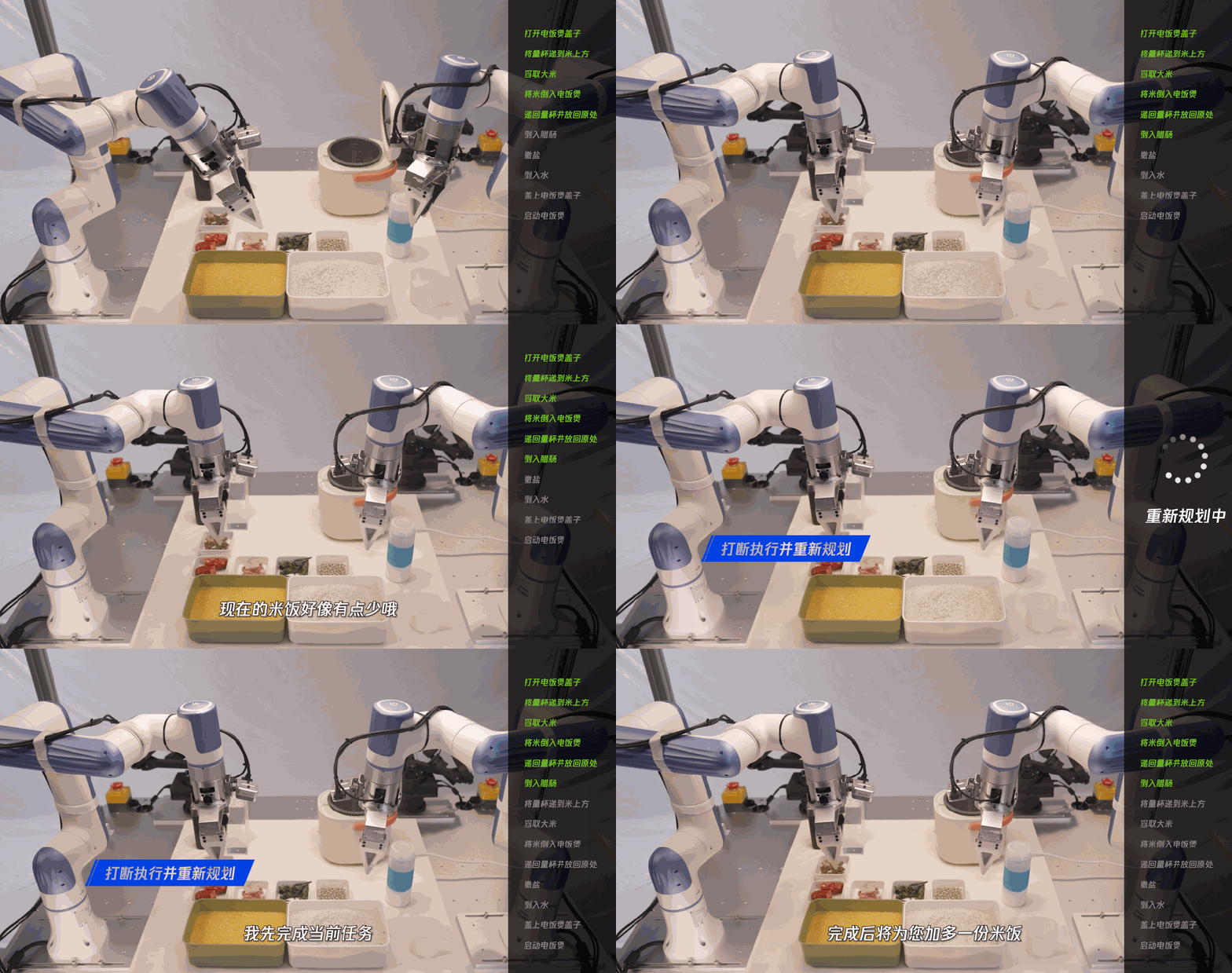

Tencent’s Robot Strategy: Becoming the “Titanium Screw” of the Industry
1. Strategic Positioning: From Hardware Exploration to Platform Empowerment
Tencent’s robot strategy has gone through three development stages:
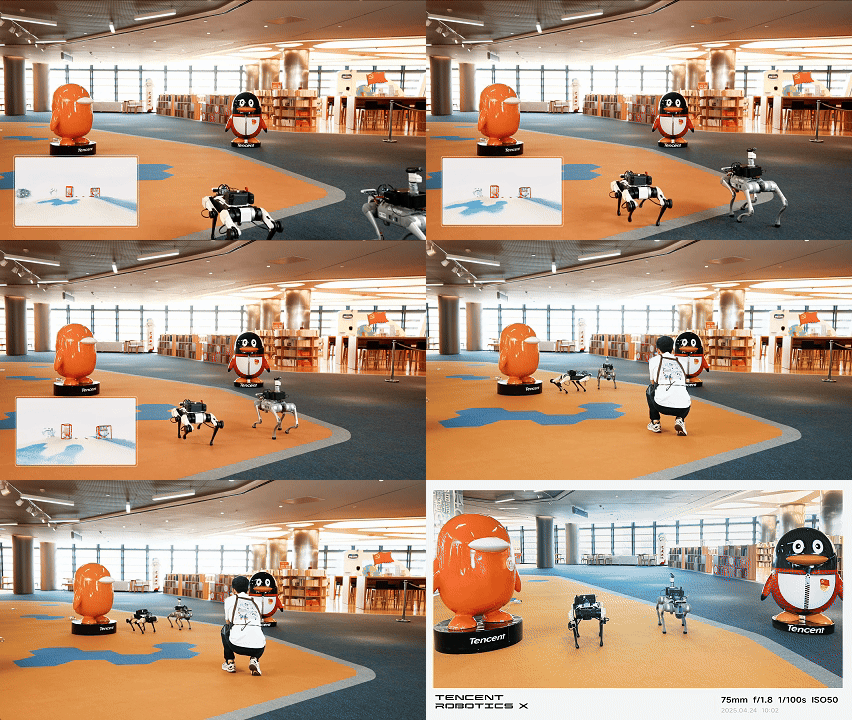
– Technology Verification Period (2018-2023): Launched prototypes like the quadruped robot Max and the wheeled robot Ollie to verify mobility and operation technologies.
– Scene Focus Period (2023-2025): Released the humanoid environment robot “Xiao Wu,” developing tactile interaction and environmental adaptability for elderly care scenarios.
– Ecological Open Period (2025 to present): Launched the Tairos open platform for embodied intelligence, positioning itself as the “brain supplier” for the robotics industry.
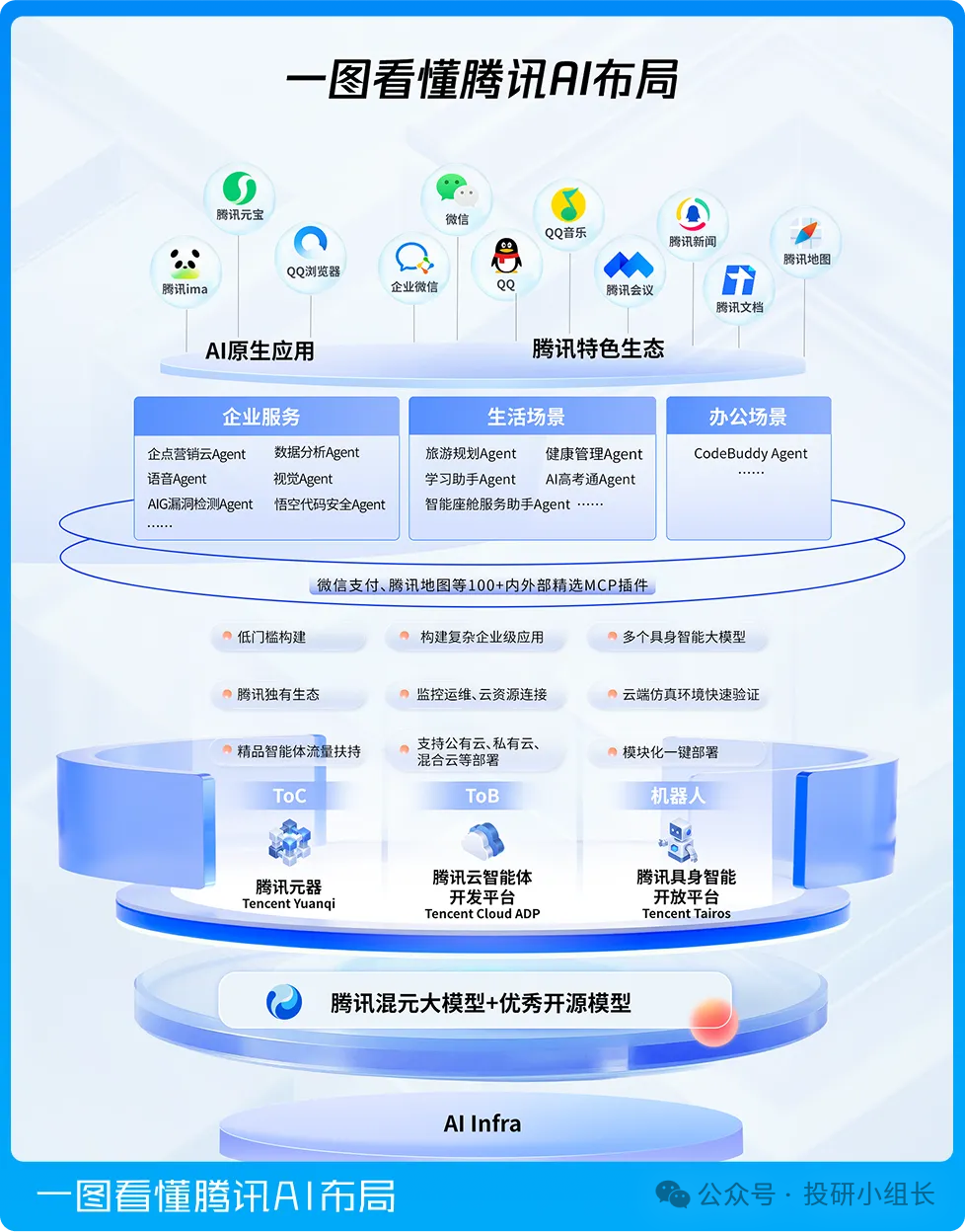
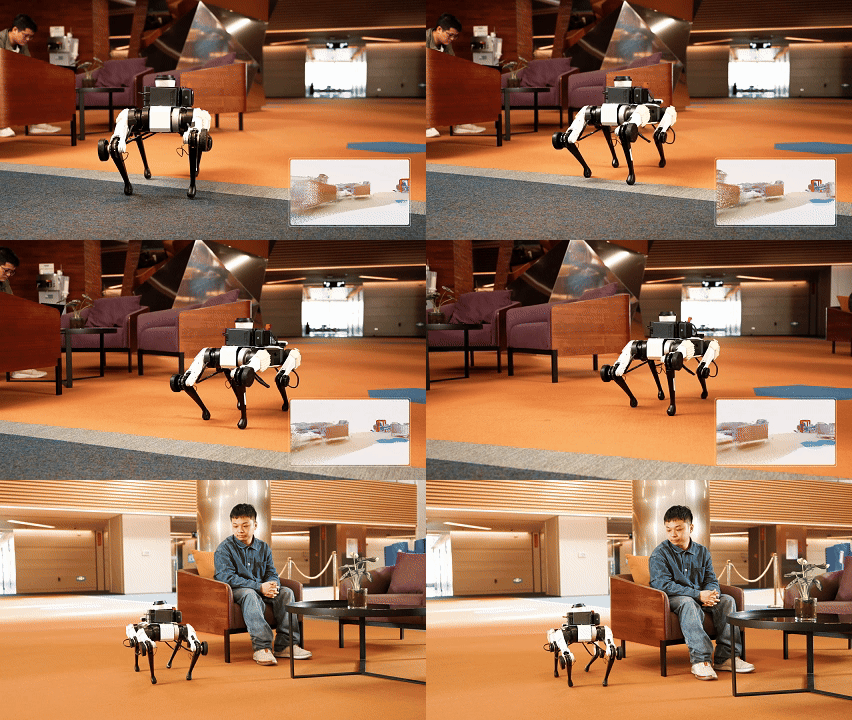
2. Technical Architecture: Trinity Empowerment of Intelligent Agents
The Tairos platform constructs a complete system of “model + cloud services”:
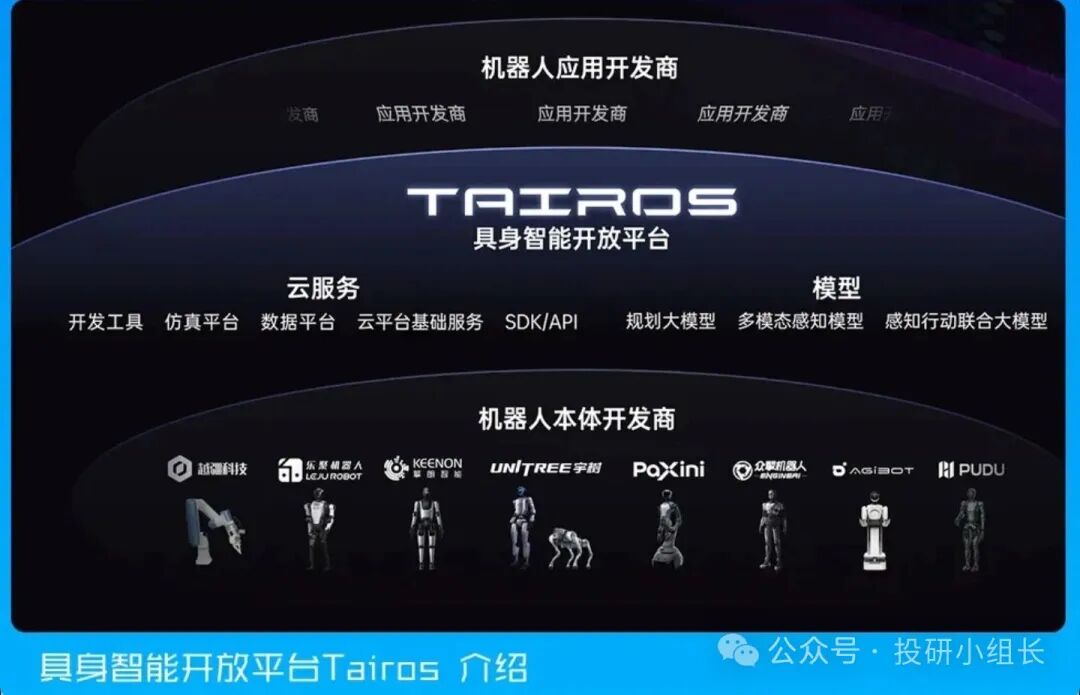
– Three Major Models:
– Multi-modal Perception Model: Integrates visual, tactile, and voice data to achieve object material recognition and environmental semantic understanding.
– Planning Large Model: Supports complex task decomposition from “preparing dinner” to “accompanying medical visits,” generating executable action sequences.
– Perception-Action Joint Model: Achieves end-to-end optimization from visual perception to robotic arm control through reinforcement learning.
– Cloud Services:
– High-Fidelity Simulation: Utilizes Tencent’s game engine to construct virtual home environments, supporting robots to complete 90% of training tasks in the cloud.
– Data Factory: Provides annotation tools and privacy computing frameworks to address industry data scarcity and compliance challenges.
3. Ecological Strategy: Hardware-Independent Symbiotic Model
Tencent builds its ecosystem through a dual-driven approach of “investment + cooperation”:
– Capital Layout: In 2025, led the investment in Zhiyuan Robotics and participated in Yushu Technology, targeting leading industrial and consumer-grade robotics companies.
– Technical Collaboration: Collaborated with Yujian Technology to develop industrial collaborative robots, achieving full-process automation from “voice commands – path planning – precise assembly.”
– Scene Implementation: Piloted the elderly care robot “Xiao Wu” in Xuhui District, achieving safe companionship and health monitoring through tactile sensors and emotional computing.
4. Industry Value: Redefining the Human-Robot Collaboration Paradigm
Compared to other tech companies’ hardware-dominant strategies, Tencent’s differentiation lies in:
– Non-Hardware Dependency: Clearly stating that it does not manufacture robots, focusing on software empowerment to avoid direct competition with partners.
– Scene Depth: Focusing on long-cycle scenarios such as elderly care and education, continuously iterating data to enhance the human-like interaction capabilities of robots.
– Technological Inclusivity: The Tairos platform provides “low-code” development tools, enabling small and medium-sized robotics companies to quickly access large model capabilities.

Challenges and Future: Technical Breakthroughs in Three Years
Zhang Zhengyou proposed a “three-year goal” at the WAIC Forum, directly addressing the core pain points of embodied intelligence:
1. Tactile Standardization: Current tactile sensors face a contradiction between precision and cost. Tencent is collaborating with Pashini Perception Technology to develop flexible electronic skin, aiming to achieve millimeter-level tactile feedback by 2027.
2. Dynamic World Modeling: Utilizing mixed-element 3D world models to construct a dynamic object database, solving the real-time reasoning problem of robots in unknown environments.
3. Safety and Ethical Framework: Establishing a dual safety model of “emotional-physical” to ensure the controllability of robots’ behavior in complex interactions.
Conclusion
Zhang Zhengyou’s career reflects the journey of China’s artificial intelligence from following to leading, while Tencent’s robot strategy embodies the unique value of tech giants in industrial transformation—not manufacturing robots, but making them smarter. Through the openness and ecological co-construction of the Tairos platform, Tencent is building a new ecosystem of embodied intelligence that is “hardware-pluggable, scene-expandable, and capability-evolvable,” with the ultimate goal of evolving robots from tools to collaborative partners for humanity, which may be what Zhang Zhengyou refers to as the future of “human-robot symbiosis.”