Last Saturday, I was wandering around Damianshan. A few steps behind me, someone was on the phone, and the sound was on speaker. Without consciously listening, I could grasp the general situation.
The caller was a security guard, talking to his spouse on his way home from the night shift. The two were passionately discussing the guard’s career prospects, expressing great concern that the job of guarding might not be secure.
“In less than five years, security jobs will be taken over by robots.” I don’t know where the old man learned this, or if he was influenced by some internet celebrity during a live stream, but he was visibly worried about robots taking over his job.
How terrible! What kind of people are these, promoting artificial intelligence to such an extent that it scares the working class like this?
First, let me clarify my stance: I, Master Yan, do not appreciate the term “artificial intelligence”. I do not advocate for robots to possess wisdom and emotions like humans, nor do I agree that robots should have autonomous decision-making and behavioral capabilities.
I strongly oppose the idea and practice of artificial intelligence “replacing” humans. Artificial intelligence should “assist” humans, not replace them, especially in service industries that require “reading the room”. We should not take away the livelihoods of ordinary skilled workers.
I fully support the development of industrial robots. They can greatly contribute to increasing human material production (in agriculture, industry, resource extraction, etc.) and alleviating human physical suffering (such as in medical assistance). There is also a third aspect: entertaining humans.
For example, whether in agriculture or industry, it is best to let robots do the work, freeing humans from heavy physical labor. Especially in high-risk jobs, toxic and harmful operations, and high-precision mechanical tasks that are difficult for humans to reach, whether using robotic dogs or Optimus Prime, let the robots handle it.
Of course, there is no need to worry about robots completely replacing farmers and industrial workers. First, the population can shift to the tertiary industry; second, manufacturing, operating, using, and maintaining robots creates new job positions that also require ordinary skilled workers. Third, some high-skilled jobs cannot be performed by robots and can only be completed by humans. At the same time, to ensure a pool of high-skilled talent, a certain base of ordinary skilled workers is also needed as a backup.
The purpose of humans using robots is to improve production efficiency and provide better and richer materials for human enjoyment. Therefore, robots have great potential in the field of material production.
Human needs, besides material ones, also include spiritual aspects. With the significant increase in material production efficiency and the extreme abundance of materials, people’s pursuit of spiritual life is becoming increasingly strong.Spiritual needs can be self-satisfied, but many require fulfillment through the tertiary industry—services. And the service industry requires “reading the room”, which is precisely what robots cannot do and should not replace humans.
Let me give a few examples to explore this.
In the restaurant service industry, dining out solves the hunger problem, but many require quality service. No matter how advanced intelligent robots are, they can greet guests with a smile and standardize ordering and serving, but they cannot read the room and perceive every subtle emotional change of the consumer. Timely serving tea, adjusting dishes on the table, and delivering compliments at the right moment… these are things robots will probably never be able to do.
In the delivery industry, fixed point-to-point transportation is where robots excel, as they can operate 24 hours a day. However, the last mile delivery to homes requires a level of agility and service quality that even the smartest robots cannot achieve compared to human delivery personnel.
Similarly, in the takeaway industry, during peak delivery times, delivery personnel can efficiently coordinate order taking, food collection, and delivery, using their phones and vehicles to complete multiple orders. I do not believe that a robot’s computational power can surpass the brain of a delivery person or that it can match their agility. Of course, in standardized services at fixed locations, such as hotel room service, robots can perform well.
Then there is the property service industry, where the security guard works. In your own unit or community, would you prefer a living security guard or a robot security guard?
Robots can work 24 hours without rest and strictly enforce security protocols, ensuring that no unauthorized individuals enter. But is property service a strictly standardized industry?
Robots provide a rigid standardized service, which might work for military units and confidential departments. However, for various security posts facing ever-changing scenarios daily, and the personalized service needs of owners, can robots match the flexibility and perceptiveness of a security guard who adheres to principles while being adept at reading the room? Master Yan bets that it will not be able to do so even in a hundred years.
Lastly, let me mention one more example. I once saw a report about someone researching “intelligent traditional Chinese medicine”. I want to say, is this direction completely wrong? Are you hoping to train robots to become experts in observation, listening, questioning, and pulse-taking to replace traditional Chinese medicine practitioners? Or do you think this can elevate thousands of years of traditional Chinese medicine from experience to a precise scientific level?
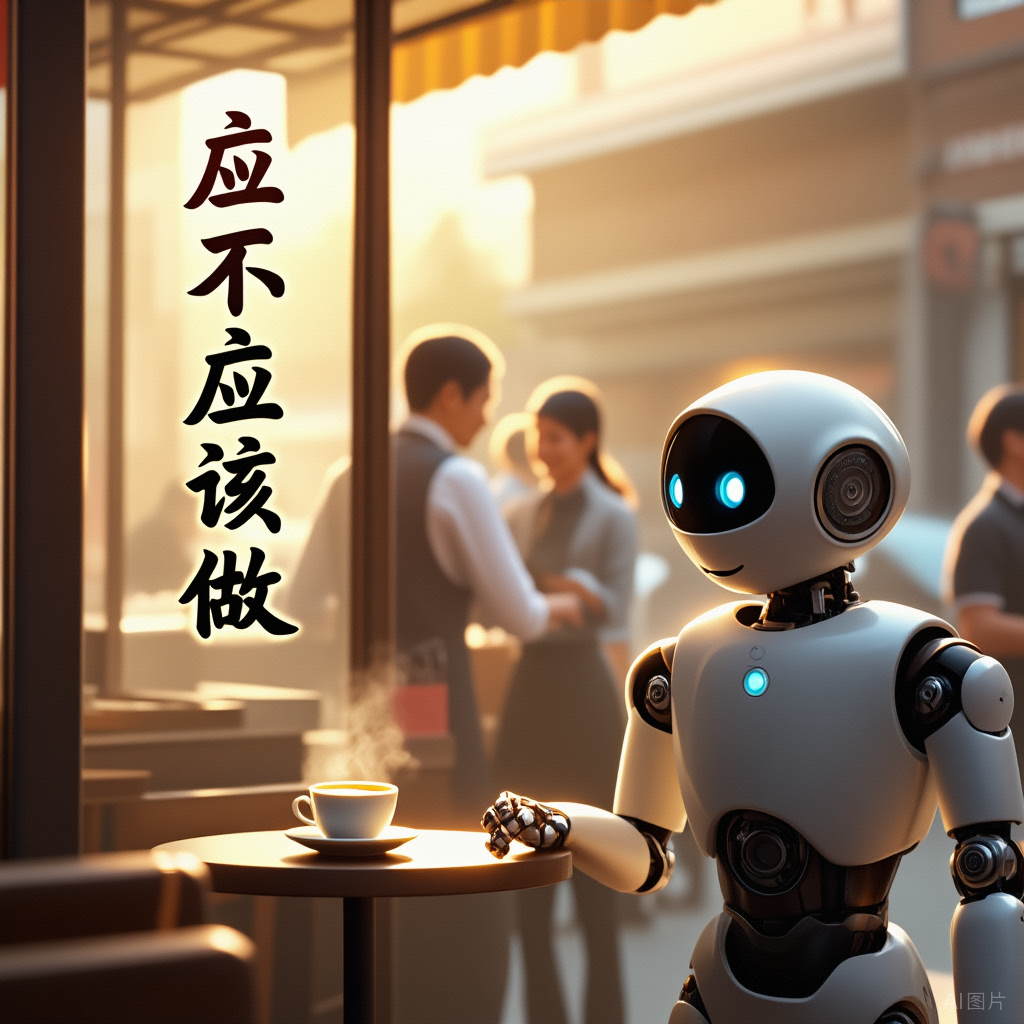
No need to list more examples. In summary, artificial intelligence should not only consider “can it be done”, but more importantly, “should it be done”. In all cases involving human wisdom in decision-making, robots should not intervene. In service industries that require “reading the room”, robots should keep their distance.