
Click the top Computer Enthusiasts to follow us
The “heart” of a smartphone is only the size of a fingernail, but due to its high integration as a SoC, this chip perfectly embodies the definition of “small but complete”.
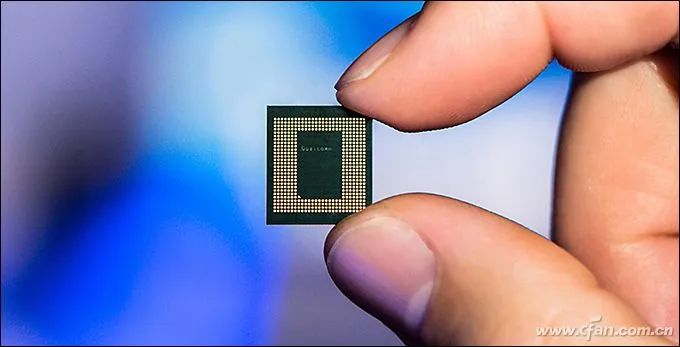
If the instruction set architecture and process technology determine the innate talent of the SoC (see more in “Hardcore Science! Why Is It Said That SoC Performance Depends on Architecture and Technology?“), then the intuitive combat power of the SoC is entirely dependent on the specifications of the CPU and GPU modules. The reason why Snapdragon 865 is the strongest SoC in the Android smartphone arena is due to its more powerful integrated GPU.
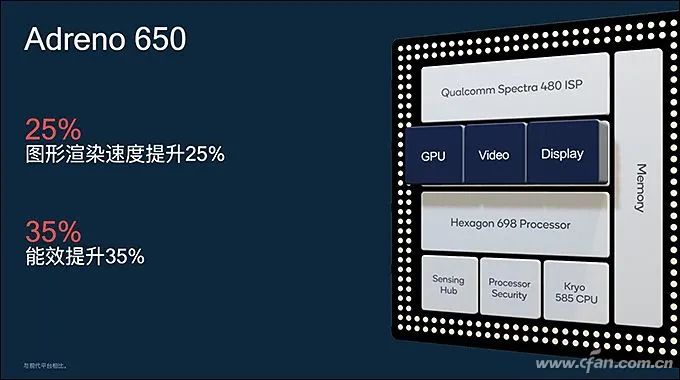
Next, we will decompose the SoC and first take a look at these two key modules that affect its absolute performance.
CPU: The Foundation of Performance
Among the components of the SoC, the CPU is one of the most critical core units; we can understand it as the Core processor on a PC, and its strength is mainly influenced by the following parameters.
SoCs designed for smartphones all belong to the “ARM processors”, and there are three forms of cooperation between ARM and chip manufacturers:
Native Cortex-A Series Architecture
ARM releases a brand new “native” (public version) architecture every year, including the performance-level Cortex-A7x and the efficiency-level Cortex-A5x, where the former can serve as the “big core” in the CPU. Currently, the SoC is in the transition phase from Cortex-A76 to Cortex-A77, and ARM will release the Cortex-A78 architecture in mid-2020.
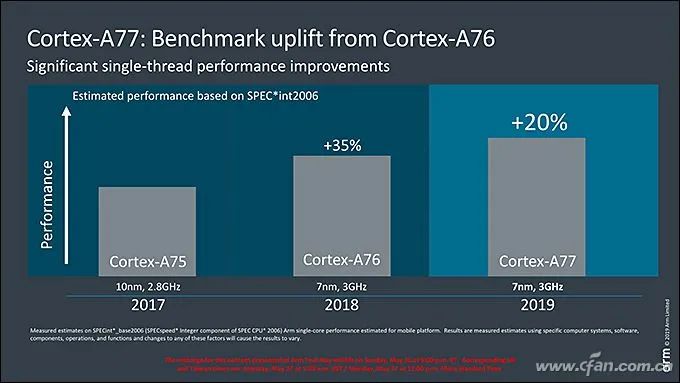
The higher the version of the Cortex-A architecture, the stronger the performance
The latter belongs to the “little core” in the CPU, where Cortex-A73 or earlier big cores are paired with Cortex-A53, and starting from Cortex-A75, they are coupled with Cortex-A55. In the short term, ARM has no plans to update the efficiency-level core architecture.
Custom Semi-Customized Architecture Based on Cortex
Chip manufacturers can make certain modifications to the ARM native Cortex-A architecture to achieve higher performance, more features, or lower power consumption.
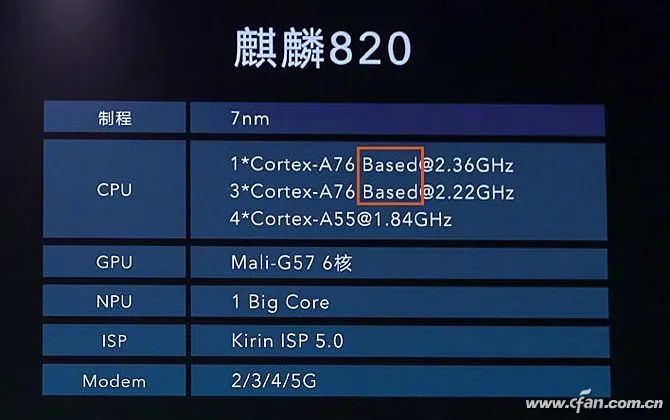
Qualcomm’s Snapdragon SoCs always adopt a core architecture called “Kryo”, which is semi-customized based on the native Cortex-A architecture. Industry insiders also refer to this form as “magical modification”.
Huawei has also been focusing on Cortex-A Based since the Kirin 980, including the latest Kirin 820, which is theoretically a semi-customized magical modification.
Self-Developed Architecture Based on Instruction Set
If a chip manufacturer develops a chip solely based on ARM’s instruction set authorization, it can be classified as a “self-developed” architecture.
For example, the Kryo core used in Snapdragon 820, Samsung’s Mongoose core, and Apple’s SoC from A5 onwards all use self-developed CPU architectures based on the ARM instruction set.
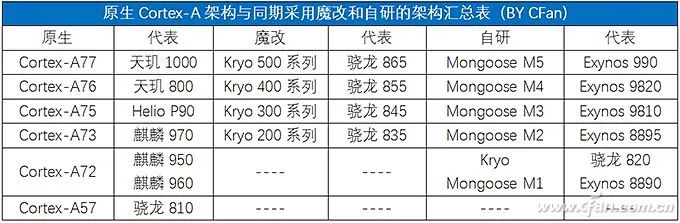
From the perspective of ARM’s licensing costs, using the native architecture has the lowest licensing fees, followed by the magical modification, and the self-developed architecture based on the instruction set has the highest fees. Moreover, chip manufacturers wishing to customize optimizations based on the ARM instruction set to form their unique designs require strong R&D capabilities, so currently only Apple, Qualcomm, and Samsung are involved.
From a performance perspective, there is a significant performance suppression between architectures of different periods; for example, Cortex-A77 is inherently stronger than Cortex-A76, but the differences between the native, magical modification, and self-developed architectures of the same period are actually not large, and are mainly constrained by the number of cores, multi-clusters, and maximum clock frequency.
Multi-Cluster Design
We all know that Cortex-A7x performs better than Cortex-A5x, so why is there no SoC that uses a multi-core processor entirely made up of Cortex-A7x?
The answer is simple: high performance comes with high power consumption. To ensure that smartphones can maintain at least a day of battery life, smartphone SoCs must adopt a “big.little” (Cortex-A73 was previously called Big.Little, after Cortex-A75 it is called DynamIQ Big.Little) pairing strategy.
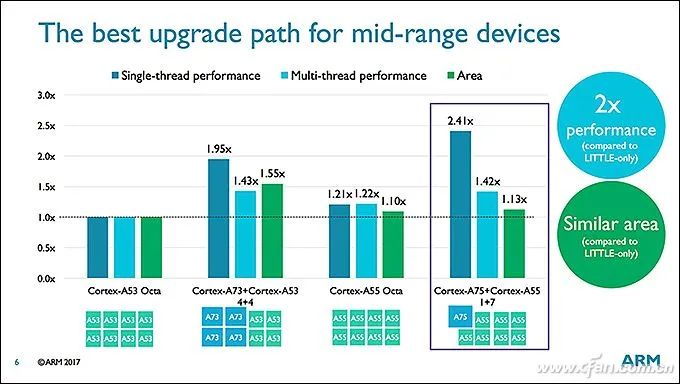
Starting from Cortex-A75, DynamIQ technology allows for more flexible core pairing
To better balance performance and power consumption, smartphone SoCs have also introduced the concept of “multi-cluster” on the basis of “big.little”. For example, MediaTek’s Dimensity 1000 is a representative of the “4+4” dual-cluster, consisting of 4×Cortex-A77 and 4×Cortex-A55, totaling 8 CPU cores.
Kirin 990 and Snapdragon 865 are both representatives of the tri-cluster design, with the former adopting a “2+2+4” (2×A76+2×A76+4×A55) configuration, while the latter uses a “1+3+4” (1×Kryo 585+3×Kryo 585+4×Kryo 585), which is a strategy of pairing big cores, medium cores, and little cores.
Disregarding power consumption, naturally, the more advanced the big core architecture and the more cores it has, the stronger the performance.
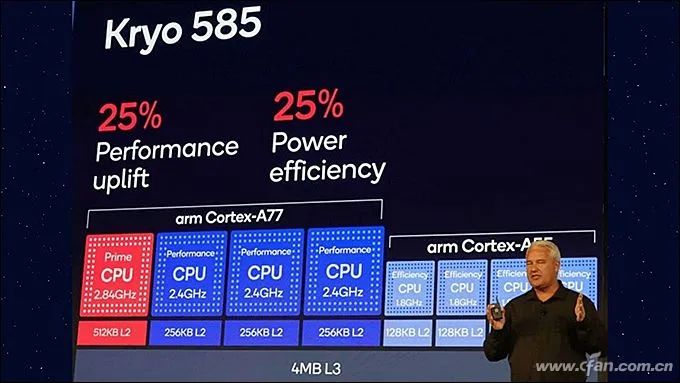
Snapdragon 865’s tri-cluster design
However, in reality, when SoCs are running at full speed (playing games), the CPU is very likely to trigger a frequency reduction mechanism due to overheating, leading to a sudden drop in performance and causing stuttering issues.
Therefore, the “2+6” dual-cluster and “1+3+4” or “2+2+4” tri-cluster designs are gradually becoming mainstream.
Operating Frequency
The strength of the CPU’s performance, in addition to being constrained by core architecture and multi-cluster design, is also significantly influenced by operating frequency.
We all know that the Cortex-A77 architecture is stronger than the Cortex-A76 architecture, but the MediaTek 1000L (with Cortex-A77 as the big core) which just started mass production at the end of 2019, has a CPU performance that is still not as good as the Kirin 980 (with Cortex-A76 as the big core) that was launched at the end of 2018.
The reason is simple: the big core frequency of MediaTek 1000L is only 2.2GHz, while the Kirin 980’s frequency reaches 2.6GHz. The higher frequency is sufficient to make up for the disadvantages in core architecture and the number of big cores.
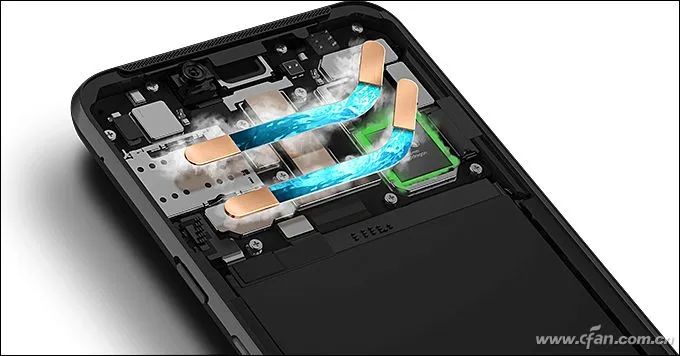
Among smartphones with the same SoC, the better the heat dissipation design, the stronger the performance
Therefore, for SoCs of the same level during the same period, the higher the CPU frequency, the more likely it is to achieve a performance advantage. Of course, the prerequisite is that the smartphone’s own heat dissipation design must be solid enough to allow the CPU to run at the preset maximum frequency for a long time.
GPU: The Game Engine
The GPU is the second most important unit in the SoC after the CPU; we can understand it as the independent graphics card on a PC. The resolution, refresh rate, and frame rate that a smartphone can support while playing games largely depend on the GPU.
GPU Brands
Unlike the CPU unit in the SoC, which is dominated by ARM, the integrated GPU units are not yet unified in the market. In the Android smartphone sector, there is currently a “Three Kingdoms” situation—Qualcomm’s Snapdragon SoCs all integrate their own Adreno brand GPUs, while Huawei/Samsung’s SoCs favor ARM’s Mali brand GPUs. MediaTek often “walks on both sides” and has involvement with both ARM Mali GPUs and Imagination’s PowerVR GPUs.
It is reported that Samsung has partnered with AMD, and future Exynos SoCs are likely to integrate AMD-licensed RDNA architecture GPUs, while Huawei is also working on self-developed GPU projects.
Core Architecture
Like ARM CPU architecture, which is constantly being upgraded, the GPUs of various brands also undergo iterations every 1 to 2 years.
Among them, Qualcomm’s Adreno GPU has just completed a comprehensive upgrade from Adreno 500 to Adreno 600, with the Snapdragon 665 (Adreno 610) positioned in the mid-to-low end and the latest flagship Snapdragon 865 (Adreno 650) being the highest. In the Adreno 6×0 series, the larger the “x” number, the stronger the performance.
The high-end GPU of ARM Mali brand is transitioning from Mali-G76 (paired with Cortex-A76 CPU) to Mali-G77 (paired with Cortex-A77 CPU), while the mid-range GPU is soon to upgrade from Mali-G52 to Mali-G53.
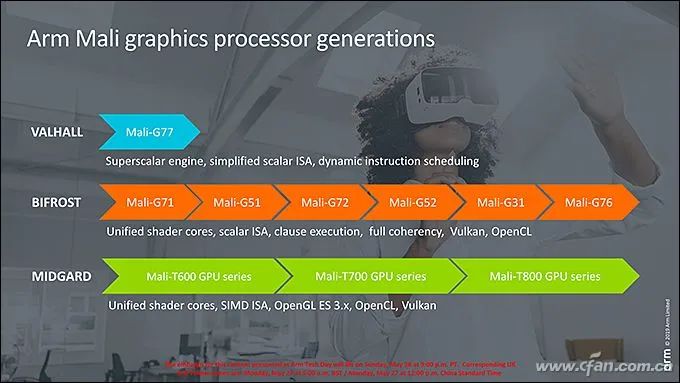
Development Path of ARM Mali GPU
In large directions, Mali-G7x is certainly stronger than Mali-G5x, and similarly, the larger the “x” number, the stronger the performance. Imagination GPU is also about to transition from the ninth generation (PowerVR 9) to the tenth generation (PowerVR IMG A). Given that this series of GPUs is relatively niche, we will not elaborate on it in this article.
If you want to learn more about the history and related technologies of smartphone GPUs, please refer to “Which Smartphone Processor’s GPU Is the Strongest? You Will Understand After Reading This Article!“
Computing Units
In reality, many GPUs adopt cores with the same architecture, but their GPU performance can vary greatly.
For example, Snapdragon 675 (Adreno 612) and Snapdragon 730 (Adreno 618) both integrate Adreno 61x series GPUs, and Kirin 990 and Exynos 980 also integrate Mali-G76 GPUs, but their 3D performance is not comparable.
DIY users know that independent graphics cards in the PC field are categorized based on the number of “stream processors”.
The GPUs within smartphone SoCs are similar; however, here the term “stream processors” is different. Qualcomm’s Adreno GPU calls them “ALUs,” while ARM’s Mali GPU refers to them as “Shader Cores,” and we commonly refer to them collectively as “computing units”.
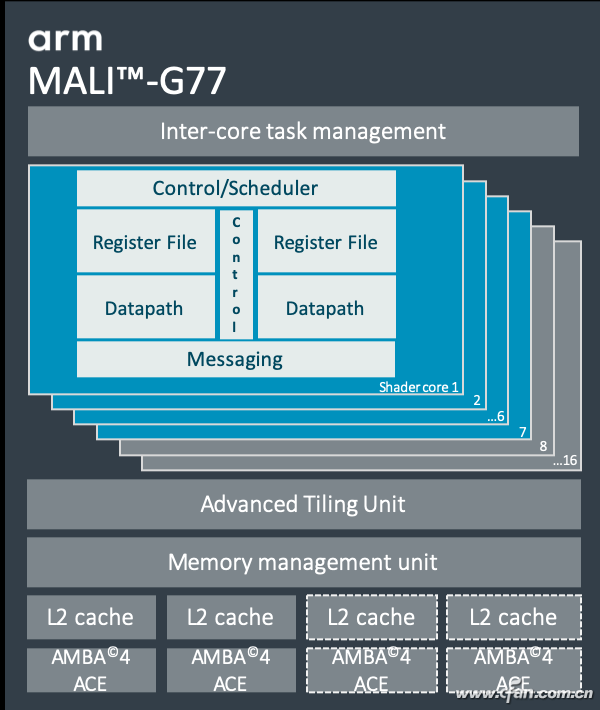
Taking Kirin 990 and Exynos 980 as examples, the former has a Mali-G76 GPU with 16 computing units, namely Mali-G76MP16, while the latter has only 5 computing units, namely Mali-G76MP5, so Kirin 990’s 3D performance is at least 2 to 3 times that of Exynos 980.
Graphics Interface
In 3D game development, the more advanced the API graphics interface, the higher the GPU’s execution efficiency.
If a smartphone GPU happens to support such an API, it can maximize the avoidance of “negative optimization” and even achieve “level-up challenges”.
The APIs supported by smartphone SoC GPUs mainly include OpenCL, OpenGL, Vulkan, and DirectX. Currently, their latest versions are OpenCL 2.0FP, OpenGL ES3.2, Vulkan 1.1, and DX12. Many of the latest GPUs have added optimizations for multi-neural network accelerators, which can work with NPU units to further accelerate AI computing.
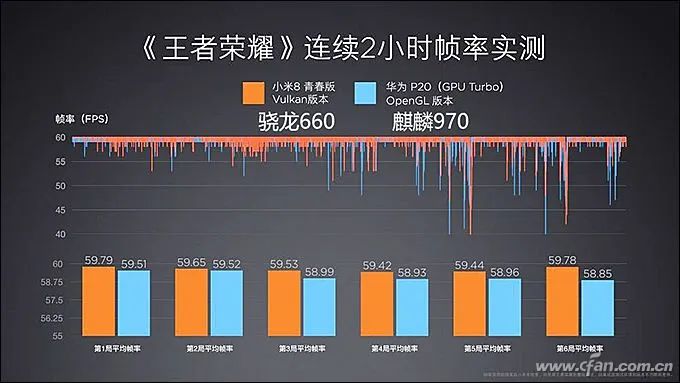
Since the end of 2018, many mid-range smartphones can also launch 60FPS mode in “Honor of Kings” and run smoother than flagship models of the same period, because the game has released an optimized version of the Vulkan API, which can further unleash the full potential of the new GPUs.
Operating Frequency
Like the CPU, the strength of the GPU is also constrained by its operating frequency, in addition to architecture. MediaTek Helio G90, Snapdragon 730, and Snapdragon 765 are the most representative SoCs; they all have a suffix with a “G” that enhances performance by increasing CPU and GPU frequencies (Table 2).
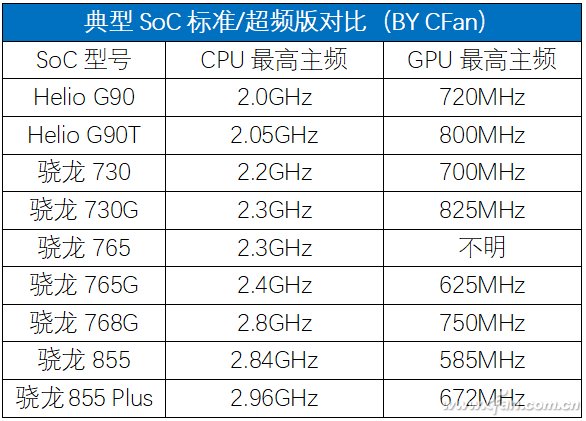
If you only care about absolute performance, you can conclude here.
When we see an unfamiliar SoC, we can first look at the process technology; if it can adopt 7nm or 7nm+EUV, it indicates that it has more energy-saving features.
Next, look at the CPU architecture and clock frequency; Cortex-A77 and Kryo 500 cores represent the strongest architecture currently available. If the CPU frequency exceeds 2.6GHz, it has flagship-level CPU performance; if it is below 2.4GHz, it is considered mid-range.
If you enjoy gaming, you need to check whether its GPU is Mali-G7x or Mali-G5x and count the number of computing units; the more, the better.
However, smartphones are not limited to benchmarking and gaming; in pursuit of stronger performance, their performance in daily application environments is often more important than absolute performance. For example, baseband, DSP, ISP, and other units. If you are interested in their roles, please follow CFan’s subsequent reports.

Click “Read the Original” for more exciting content