At 6:30 AM in the park, a post-2000s individual wearing a sports tank top practices Baduanjin while following a live stream on their phone, with a smartwatch on their wrist recording their heart rate in real-time. Nearby, Aunt Wang’s radio also broadcasts the same set of exercises. This seemingly incongruous scene has become a snapshot of life in the summer of 2025.
The WeChat index shows that this set of health exercises, originating from the Song Dynasty, has surpassed 620 million views on social platforms, equivalent to 2.5 times the total views of “Empresses in the Palace.” Young people have even given it a trendy nickname – “Pamela for Chinese people.”
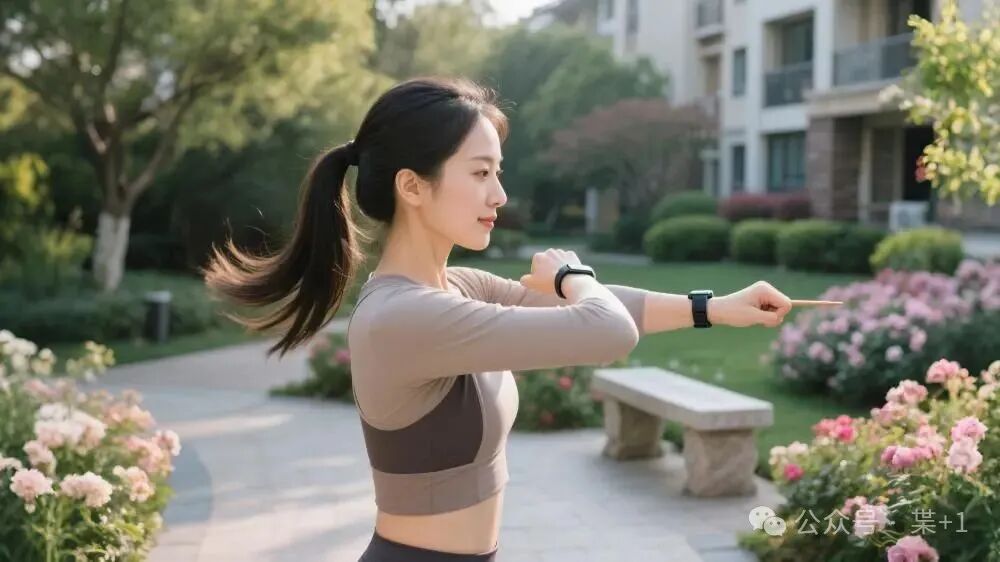
Baduanjin: A New Skin for Old Health Practices
Last week, while handling business at Baiyun Temple, I witnessed the “traffic password” of traditional health practices firsthand. The Taoist priest had just sent the registration link for a public welfare class to the community group, and 100 spots were snatched up in 3 minutes, with over half of the participants being young IDs marked with “XX Internet Company.” The instructor, Taoist Deng Yi, humorously noted that the most common question from students now is: “Teacher, can this movement relieve mouse hand?” and “What filter is suitable for live streaming?”
This breaking of boundaries is not coincidental. After trying “Cloud Baduanjin” with an AI virtual coach from a fitness influencer, I suddenly understood its magic: the most basic movement of Baduanjin, “Two Hands Hold Up the Sky to Regulate the Three Burners,” feels like a “system reboot” for a stiff body, while “Shaking Head and Wagging Tail to Eliminate Heart Fire” is practically a neck-saving technique tailored for those who sit for long periods. Sports medicine experts mentioned in interviews that this set of exercises effectively alleviates the common issue of liver stagnation and qi blockage prevalent in modern individuals – it sounds mystical, but after practicing for three consecutive days, I indeed found my late-night urge to scroll through my phone diminished, which might be what young people refer to as “health-conscious internet detox.”
Decluttering 2.0: From Throwing Things Away to Throwing Away Anxiety
The explosive popularity of Baduanjin unexpectedly created a chemical reaction with another trending term – decluttering. Under the topic #I Became Happier After Decluttering# on Xiaohongshu, over 100,000 users share their “throwing things away diaries,” with some giving away idle air fryers to neighbors who love cooking, while others deleted 3,000 WeChat friends. Interestingly, the currently popular “discriminative decluttering” aligns with the breathing techniques of Baduanjin: the former teaches you to distinguish between “needs” and “wants,” while the latter emphasizes the focused feeling of “qi sinking to the dantian,” both serving to simplify an overloaded life.
My downstairs neighbor, a 95-born organizer named Xiao Lin, is a typical example. Her workspace features a comparison chart: on the left is a cluttered wardrobe of a client, and on the right is a breakdown of the Baduanjin movement “Regulating the Spleen and Stomach Requires Single Lifting.” “You see, the stretching movements during organizing items are conceptually similar to the principles in the exercises.” Xiao Lin pulled out her phone’s order records, noting a recent surge in clients seeking “office decluttering,” with 60% also inquiring about the feasibility of “workstation Baduanjin.” This philosophy of synchronously “detoxifying” the body and belongings is what she calls “dual decluttering in the digital age.”
Contemporary Translation of Traditional Wisdom
As the camping craze shifts from Instagrammable spots to professional hiking, and young people begin to study the waterproof ratings of tents rather than their photo appeal, the rise of Baduanjin seems to herald a return to another form of consumer rationality – no need for expensive equipment, just an empty space and fragmented time can reset the body and mind. As my colleague Awen remarked: “I used to worry about not being able to stick to yoga classes, but now I spend 5 minutes every day in the tea room practicing ‘Left and Right Bow Like Shooting Eagles,’ and it has really cured my rounded shoulders.”
This summer, I replaced the electronic wooden fish on my phone with a countdown app and found that when the “ping ping” sound of the wooden fish transformed into the breathing guidance of “shh – he -“, anxiety truly dissipated with each exhale. Perhaps the wisdom of life in 2025 lies in this contrast: using smartwatches to monitor Baduanjin exercise data, placing a traditional health book in an empty drawer after decluttering – tradition and modernity are never a choice but rather a seasoning that breathes new life into old principles.