Many people have heard of embedded systems and microcontrollers, but when first encountering them, some may have heard that embedded systems are essentially microcontrollers. In fact, there are distinctions between embedded systems and microcontrollers. What is the relationship between microcontrollers and embedded systems?
Let’s discuss the connections and differences between embedded systems and microcontrollers.
01
What is a Microcontroller?
First, let’s understand what a microcontroller is.
The core of an embedded system is the embedded processor. Embedded processors can generally be classified into the following types:
-
Embedded Microcontroller (MCU)
-
Embedded DSP Processor (Digital Signal Processor)
-
Embedded Microprocessor (MPU)
-
Embedded System on Chip (SoC)
-
System on a Programmable Chip (SoPC)
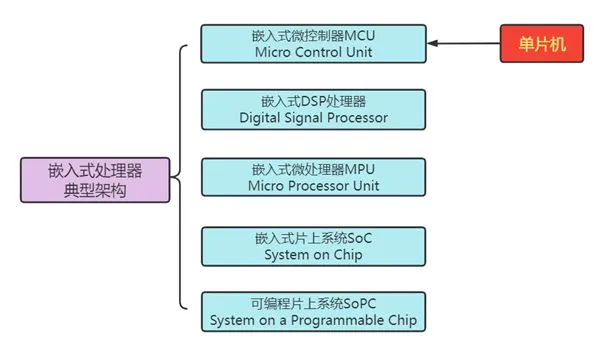
Our microcontroller belongs to the embedded microcontroller (MCU) category.
MCUs integrate ROM/RAM, bus logic, timers/counters, watchdogs, I/O, serial ports, A/D, D/A, FLASH, etc. Typical representatives include 8051, 8096, C8051F, etc.
A microcontroller is a single chip that integrates the CPU, SRAM, Flash, and other necessary modules, forming a microcomputer system on a single chip, hence the name Single Chip Microcomputer.
It is essentially an integrated circuit chip that uses very large scale integration technology to pack the CPU, RAM, ROM, I/O, interrupt system, timer/counter, and other functions into a silicon chip, creating a very compact computer.
So, is a microcontroller not an embedded system?
Hold on, let’s look further.
“Microcontroller” is actually an old term. In the early days when semiconductor technology was still in its infancy, integration capabilities were poor, often requiring separate chips for the CPU, SRAM, and Flash, and a dedicated chip for handling interrupts, resulting in a complete usable computer system being made up of multiple chips on a PCB.
Different functions could not be integrated into a single chip, leading to multi-chip systems. Now, semiconductor technology has advanced significantly, so multi-chip systems are no longer common. However, the term “microcontroller” has persisted.
Microcontroller technology emerged in the late 1970s, initially as 4-bit, later evolving to 8-bit, 16-bit, and 32-bit. It truly flourished during the 8-bit era, where 8-bit microcontrollers were powerful and widely used in industrial control, instrumentation, home appliances, and automotive applications.
When studying microcontrollers, we often hear the term—51 microcontroller. Let’s understand what it is.
The 51 microcontroller is actually a collective term for a series of microcontrollers that are compatible with the Intel 8031 instruction set. Their ancestor is Intel’s 8004 microcontroller.
Note that not all 51 microcontrollers are products of Intel. Companies like ATMEL, Philips, Winbond, Dallas, Siemens, and STC also have many products that belong to the 51 microcontroller series.
ATMEL’s 51 microcontroller, AT89C51, is a development board where the chip in the middle is the 51 microcontroller.
The 51 microcontroller has long been the most mainstream and widely used microcontroller in the market, occupying a large market share.
In fact, the 51 microcontroller has no technical advantages today; it is an old technology. Its persistence is due not only to its past popularity but also because Intel has completely opened the copyright for the 51 core.
Thus, any organization or individual can use the 51 microcontroller without concern for copyright risks or fees, which is why many schools also use it.
Additionally, the 51 microcontroller has a strong existing user base. Many legacy projects use the 51 microcontroller, and for cost considerations, sometimes it is necessary to continue upgrading using 51 microcontroller technology.
Moreover, many older engineers are proficient in 51 microcontroller development technology.
Therefore, the vitality of the 51 microcontroller continues to persist.
02
What is Embedded?
An embedded system is a dedicated computer system that is part of a device or equipment. Typically, an embedded system is a control program stored in ROM on an embedded processor control board.
In fact, all devices with digital interfaces, such as watches, microwaves, VCRs, and cars, use embedded systems. Some embedded systems also include operating systems, but most embedded systems implement the entire control logic with a single program.
Defined by application objects, an embedded system is a combination of software and hardware, and can also encompass mechanical components. The commonly accepted definition of embedded systems in China is:
Application-centered, based on computer technology, with customizable software and hardware, meeting the strict requirements of application systems for functionality, reliability, cost, size, power consumption, etc.
What specific “dedicated” directions are embedded systems applied to?
Here are some examples:
-
Office automation: printers, copiers, fax machines
-
Military and aerospace products: drones, radar, combat robots
-
Home appliances: digital TVs, robotic vacuum cleaners, smart appliances
-
Medical electronics: biochemical analyzers, blood analyzers, CT scanners
-
Automotive electronics: engine control, safety systems, automotive navigation and entertainment systems
-
Network communication products: communication switching devices, network equipment (switches, routers, network security)
-
Communication and entertainment: mobile phones, digital cameras, music players, wearable electronics, PSP game consoles
-
Industrial control products: industrial control computers, interactive terminals (POS, ATM), security monitoring, data collection and transmission, instrumentation
All of the above fields use embedded systems. This is just the tip of the iceberg.
It can be said that embedded systems are fully integrated into our lives, constantly influencing our work and daily activities.
Since an embedded system is a computer system, it certainly involves both hardware and software.
A typical architecture of an embedded system is as follows:
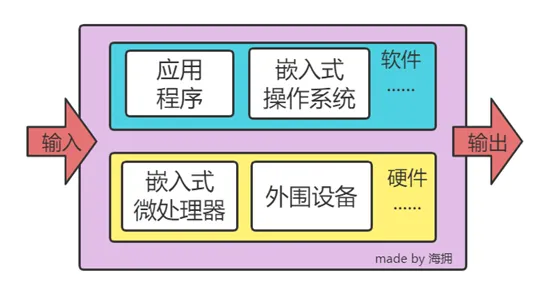
The most important components here are the embedded operating system and the embedded microprocessor.
From a hardware perspective, an embedded system is a multi-module system centered around a processor (CPU) and connected via a bus:
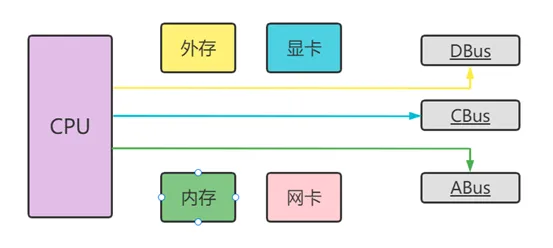
It is not difficult to see that this is similar to the architecture of a personal computer.
A microcontroller is clearly defined as a computer system on a single chip. Although different microcontrollers may have different configurations, performances, manufacturers, and even instruction sets and development methods, they all represent a complete computer system on a single chip, and this definition holds true.
On the other hand, the term embedded is less clearly defined; there is no precise definition for the term “embedded.” It is not like a microcontroller, which is a specific “thing.”
03
Is a Microcontroller an Embedded System?
So, is a microcontroller an embedded system?
In simple terms: yes.
Because in many embedded products, the embedded computer system is indeed a microcontroller; for example, the control board embedded in an air conditioner is essentially a microcontroller. In fact, most embedded computer systems in home appliances are microcontrollers.
Microcontrollers are simple, inexpensive, and sufficient for many applications, making them the most cost-effective and suitable choice.
Currently, the largest market for microcontrollers is in home appliances, and in the future, applications in IoT will continue to grow, becoming a significant market for microcontrollers.
04
Broad and Narrow Definitions of Embedded Systems
The concept of embedded systems is quite broad; when people talk about embedded systems, they may mean different things. The embedded systems concept discussed above refers to the original definition, which is the broad definition of embedded systems.
The narrow definition of embedded systems actually refers to “embedded Linux systems.”
This narrow definition originally referred to embedded computer systems running Linux. It later expanded to include other embedded systems that are on par with Linux (such as WinCE, Vxworks, Android, etc.).
After reading the above introduction, you should understand the relationship between microcontrollers and embedded systems. In fact, there is a deep connection between the two. In summary, whether you are preparing to learn about embedded systems or microcontrollers, you should think carefully before making a decision.
05
Differences Between Embedded Systems and Microcontrollers
At this point, let’s look at the differences between embedded systems and microcontrollers.
From the previous discussion, embedded systems are a broad category, while microcontrollers are an important subclass within that category. An embedded system resembles a complete computer, while a microcontroller is more like a computer without peripherals.
In the past, microcontrollers included fewer components, and the hardware differences between the two were quite obvious.
However, with the rapid advancement of semiconductor technology, various hardware functions can now be integrated into microcontrollers. Therefore, the hardware differences between embedded systems and microcontrollers are becoming less distinct, and the boundary is increasingly blurred.
As a result, people tend to differentiate them based on software.
From a software perspective, the industry often refers to systems without an MMU (Memory Management Unit) that cannot support virtual addresses and can only run bare-metal or RTOS (Real-Time Operating Systems, such as uCos, Huawei LiteOS, RT-Thread, FreeRTOS, etc.) as microcontrollers (e.g., STM32, NXP LPC series, NXP imxRT1052 series, etc.).
Meanwhile, systems with an MMU that can support virtual addresses and run “advanced” operating systems like Linux, Vxworks, WinCE, and Android are referred to as embedded systems.
In some cases, microcontrollers are powerful enough to be used as embedded systems. They are more cost-effective, and the development and maintenance are relatively easier, especially for more targeted applications. On the other hand, embedded systems theoretically have stronger performance and broader applications, but they are more complex and harder to develop.
06
Why Should We Learn Embedded Systems and Microcontrollers?
Today, I have only provided a brief introduction to microcontrollers and embedded systems, as well as their relationships and differences. Although embedded systems have been around for over 30 years, they have remained somewhat hidden. Since the Internet of Things has become a national strategy, embedded systems have gradually moved from the background to the forefront.
Embedded systems and microcontrollers are not purely “hardware” fields. If you want to excel in embedded systems and microcontrollers, merely understanding digital circuits and microcomputer interfaces is not enough; you also need to learn assembly, C/C++ programming, data structures, and algorithms. Having the ability to integrate hardware and software is far more valuable than simply mastering a programming language.
Furthermore, embedded systems and microcontrollers have a wide range of application scenarios, with project and talent demands in various fields. Moreover, our country is currently vigorously developing the chip industry, which will drive employment for embedded talent and improve compensation.
With the deepening of 5G construction, society is transforming towards “Internet of Everything.”
The Internet of Things technology will also usher in unprecedented historical opportunities. Embedded systems and microcontroller technology are important components of IoT technology and will enter a period of rapid development.
The more difficult the technology, the more challenging the process, the more it helps to build competitive barriers. Many students in universities are keen on learning various programming languages, often neglecting this area. It can be said that our country still lacks talent in embedded development. Therefore, I believe it is very worthwhile for everyone to invest time in learning embedded development skills.
Author: Huawei Cloud Developer CommunityLink: https://www.zhihu.com/question/315310041/answer/2179945564

Screenshots of Some Electronic Books
【Complete Set of Hardware Learning Materials】